γ-Hydroxybutyric acid
| GHB | |
|---|---|
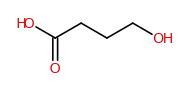 |
| Molecular structure drawn from PubChem coordinates |
| Physical properties [] | |
|---|---|
| Molecular mass | 104.10 g/mol [1] |
| Appearance | Viscid yellow mass [1] |
| Melting point | 48-50 °C [1] |
| Boiling point | 180 °C (dec) [1] |
| Solubility | Very soluble in water, alcohol and ether. [1] |
| Predicted LogP | -0.6 [1] |
| Structural Identifiers [] | |
|---|---|
| Molecular formula | C4H8O3 |
| IUPAC name | 4-hydroxybutanoic acid |
| SMILES | C(CC(=O)O)CO |
| InChI | InChI=1S/C4H8O3/c5-3-1-2-4(6)7/h5H,1-3H2,(H,6,7) |
| InChIKey | SJZRECIVHVDYJC-UHFFFAOYSA-N |
| CAS number | 591-81-1 |
| UNII | 30IW36W5B2 |
| PubChem CID | 10413 |
| Pharmacokinetics[] | |
|---|---|
| Onset | Within 5–15 minutes[3] |
| Elimination half-life | 30–60 minutes |
| Metabolism | 95–98%, mainly liver, also in blood and tissues |
| Excretion | 1–5%, kidney |
| Routes of administration | By mouth, intravenous |
| Addiction liability | High[4] |
| Toxicity [] | |
|---|---|
| LD50 | Mouse: - ip: 2960-3700 [1] |
γ-Hydroxybutyric acid (also known as 4-hydroxy-butyric acid, Anetamin, 4-hydroxy-butanoic acid, oxy-n-butyric acid, Butyric acid, 4-hydroxy-, 3-carboxypropoxy acid, 4-Hydroxyalkanoic acid, γ-Hydroxybutanoic acid, Butanoic acid, 4-hydroxy- or γ-Hydroxybutyrate) is a substance of the carboxylic acid class.
Chemistry
Stereochemistry []
γ-Hydroxybutyric acid is achiral.
Druglikeness
Lipinski's rule of five
γ-Hydroxybutyric acid matches Lipinski's rule of five.Reagents
There are currently 3 reagent-interactions on DrugsPRO
| Reagent | Color change | Description |
|---|---|---|
| Marquis | no color change | |
| Mecke | no color change | |
| Mandelin | no color change |
Pharmacology
Mechanism of action []
GHB is present at much higher concentrations in the brain, where it activates GABA-B receptors to exert its sedative effects. With high affinity, GHB binds to excitatory GHB receptors that are densely expressed throughout the brain, including the cotex and hippocampus. There is some evidence in research that upon activation of GHB receptors in some brain areas, the excitatory neurotransmitter glutamate is released. GHB stimulates dopamin release at low concentrations by acting on the GHB receptor, and the release of dopamine occurs in a biphasic manner. At higher concentrations, GHB inhibits dopamine release by acting on the GABA-B receptors, which is followed by GHB receptor signaling and increased release of dopamine. This explains the paradoxical mix of sedative and stimulatory properties of GHB, as well as the so-called "rebound" effect, experienced by individuals using GHB as a sleeping agent, wherein they awake suddenly after several hours of GHB-induced deep sleep. It is proposed that overtime, the level of GHB in the brain decreases below the threshold for significant GABA-B receptor activation, leading to preferential activation of GHB receptor over GABA-B receptors and enhanced wakefulness. [1]
Medical side effects []
179 side effects listed on drug labels in SIDER 4.1 (hydroxybutyrate).
- Headache
- Dizziness
- Syncope
- Nausea
- Sleep disorder
- Pain
- Infection
- Confusional state
- Feeling abnormal
- Albuminuria
- Cystitis
- Bladder pain
- Cystitis noninfective
- Haematuria
- Metrorrhagia
- Pollakiuria
- Micturition urgency
- Urinary incontinence
- Vomiting
- Diarrhoea
- Asthenia
- Fatigue
- Enuresis
- Viral infection
- Somnolence
- Paraesthesia
- Muscle spasms
- Cramps of lower extremities
- Tremor
- Abdominal pain upper
- Disorientation
- Anxiety
- Cataplexy
- Hyperhidrosis
- Sweating increased
- Pain in extremity
- Dry mouth
- Disturbance in attention
- Sleep paralysis
- Shock
- Loss of consciousness
- Ageusia
- Irritability
- Feeling drunk
- Arthralgia
- Musculoskeletal discomfort
- Myalgia
- Hypersensitivity
- Hypertension
- Weight decreased
- Panic attack
- Hangover
- Decreased appetite
- Anorexia
- Memory impairment
- Fluid retention
- Vision blurred
- Abdominal pain
- Gastrointestinal pain
- Alopecia
- Amblyopia
- Amnesia
- Anaemia
- Apnoea
- Arthritis
- Ataxia
- Back pain
- Mental disorder
- Bone disorder
- Chest pain
- Coma
- Connective tissue disorder
- Constipation
- Libido decreased
- Disturbance in sexual arousal
- Dehydration
- Depersonalisation
- Depression
- Dermatitis contact
- Dysgeusia
- Dysmenorrhoea
- Dyspepsia
- Dyspnoea
- Ecchymosis
- Oedema
- Epistaxis
- Dermatitis
- Rash
- Eye disorder
- Faecal incontinence
- Gastrointestinal disorder
- Hallucination
- Cardiac disorder
- Hiccups
- Hyperbilirubinaemia
- Hypercholesterolaemia
- Hyperglycaemia
- Hypernatraemia
- Hypoaesthesia
- Hypocalcaemia
- Immune system disorder
- Incontinence
- Influenza
- Leukocytosis
- Mediastinal disorder
- Hypertonia
- Myoclonus
- Nasal congestion
- Nasopharyngitis
- Nervous system disorder
- Nervousness
- Tension
- Neuralgia
- Nightmare
- Palpitations
- Parasomnia
- Pharyngitis
- Polycythaemia
- Psychotic disorder
- Paranoia
- Restless legs syndrome
- Rhinitis
- Convulsion
- Sinusitis
- Sleep apnoea syndrome
- Snoring
- Somnambulism
- Stomatitis
- Mouth ulceration
- Withdrawal syndrome
- Suicide attempt
- Thirst
- Tinnitus
- Urethral disorder
- Urinary tract disorder
- Urticaria
- Angiopathy
- Vertigo
- Weight increased
- Chills
- Stupor
- Depressed level of consciousness
- CNS depression NOS
- Agitation
- Hyperkinesia
- Apathy
- Flat affect
- Oedema peripheral
- Musculoskeletal stiffness
- Nuchal rigidity
- Blood creatinine increased
- Injury
- Blood alkaline phosphatase increased
- Aspartate aminotransferase increased
- Alanine aminotransferase increased
- Malnutrition
- Skin disorder
- Thinking abnormal
- Mental disability
- Abnormal dreams
- Respiratory depression
- Pulmonary function test decreased
- Euphoric mood
- Abdominal distension
- Akathisia
- Initial insomnia
- Middle insomnia
- Suicidal ideation
- Lymphadenopathy
- Blood pressure increased
- Paralysis
- Balance disorder
- Blood sodium increased
- Acne
- Blood uric acid increased
- Hyperuricaemia
- Infestation
- Insomnia
- Muscular weakness
Indications
- Cataplexy
- Excessive daytime sleepiness
- Narcolepsy
Subjective effects []
| bonzi / γ-Hydroxybutyric acid [] | |
|---|---|
Routes:
| |
| magnus / γ-Hydroxybutyric acid [] | |
|---|---|
Routes:
| |
| nervewing / γ-Hydroxybutyric acid [] | |
|---|---|
Experience reports
Erowid
There are currently 30 experience reports involving γ-hydroxybutyric acid on Erowid: []- "Mental Molasses Swirl" by Anatoli Smorin
- "Addiction and Withdrawal" by Fitful Sleeper
- "The Hammock of Life" by Gorgon
- "10 Year Anniversary" by Murple
- "Female Dosage Experiment" by atomicblonde
- "The Arrival of Absolom" by Music Entity
- "Deep into the Rabbit Hole" by Ellipsis
- "Rewards and Punishments" by Gorgon
- "A Dosage Experiment - How Much to Take?" by SciGuy
- "Words From a Very Experienced User" by ScotHibb
- "Thought I Was OK and I Woke Up in the ER" by JAB
- "Strange Attractor" by Neural Shock
- "A Night with Madame M" by Floyd F
- "Low Dose 2C-T-7 as MDMA Alternative" by Gandolf
- "Mistakes One Through Five" by Scotto
- "Flying Foxes" by Murple
- "Beyond Euphoria" by Leprechaun
- "A Trip to ToxiCity" by Murple
- "An Effortless Transition" by Toad
- "Sunday Night Embraced by IT-290" by Anonymous
- "Dizziness and Fighting to Stay Awake" by Robert
- "I Love You Very Much" by t9x
- "Alternate World Trip Lasting a Month" by NarcolepticM
- "Lovely In The Sweet Spot" by InnerExplorer
- "Rushing in Untouched Corners of My Perception" by Plinth
- "Buzz, Never a Hangover" by Jawcut
- "The Cure" by Jet
- "Nightmares While Awake" by Maffmatix
- "It Almost Killed Me" by Changed
- "Finding the G-Spot" by Seven Up
- "I Have Tried Every Single Drug and Steroid" by Hangeth_Thy_Dong (51 upvotes)
- "My last time taking LSD (it’s a doozy)" by shadowofthedogman (41 upvotes)
- "My full drug career to this point. (Feel free to skim )" by Solid-Ambition-6635 (28 upvotes)
- "Spacing out rolls?" by headychemist (27 upvotes)
- "First time F*cking with LSD Xtal" by throwawayaccount024 (13 upvotes)
- "Broke this old report out of my email, enjoy" by CokeIsDandy (6 upvotes)
- "4 grams of Psilocybe Cubensis and Salvia 10x alone in the woods for guidance and healing" by postcooked_2 (6 upvotes)
- "There are 45 psychedelic and dissociative trip reports in the Drug Users Bible: Download a free copy from here. Whether psychedelics are used for recreation, you need to look after yourself. Stay safe." by DMTrott (3 upvotes)
- "GHB/GBL Fun" by punilyHeave (3 upvotes)
- "My First LSD Trip... Psychedelics in Portland Oregon" by trippinglydotnet (2 upvotes)
- "My first ever time doing DMT!!! :)" by headychemist (2 upvotes)
- "Reposting an old post. This time in the right channel. Enjoy the report. " by GoodAd2131 (1 upvotes)
- "Reposting an old post. This time in the right channel. Enjoy the report. " by GoodAd2131 (1 upvotes)
Legal status []
- Australia: γ-Hydroxybutyric acid is a S9 / S8 as sodium oxybate.[5]
- Brazil: γ-Hydroxybutyric acid is a B1.[6]
- Canada: γ-Hydroxybutyric acid is a Schedule I.
- Germany: γ-Hydroxybutyric acid is Prescription only/Anlage III.
- New Zealand: γ-Hydroxybutyric acid is a Class B.
- United Kingdom: γ-Hydroxybutyric acid is a Class B under the "Misuse of Drugs Act 1971".
- United States: γ-Hydroxybutyric acid is a Schedule I / Schedule III under the "Controlled Substances Act".[7]
- European Union: γ-Hydroxybutyric acid is a List I (Netherlands).
- United Nations: γ-Hydroxybutyric acid is a Schedule II psychotropic under the "Convention on Psychotropic Substances 1971".
- Other: γ-Hydroxybutyric acid is a SE: Förteckning II.[8]
See also []
External links []
- γ-Hydroxybutyric acid (Wikipedia)
- γ-Hydroxybutyric acid (PubChem)
- γ-Hydroxybutyric acid (Wikidata)
- γ-Hydroxybutyric acid (DrugBank)
- γ-Hydroxybutyric acid (ChEMBL)
- γ-Hydroxybutyric acid (ChEBI)
- γ-Hydroxybutyric acid (Common Chemistry)
- γ-Hydroxybutyric acid (HMDB)
- γ-Hydroxybutyric acid (KEGG)
- γ-Hydroxybutyric acid (EPA DSSTox)
- γ-Hydroxybutyric acid (Effect Index)
- γ-Hydroxybutyric acid (UNII)
- γ-Hydroxybutyric acid (SIDER)
- γ-Hydroxybutyric acid (Erowid)
References []
National Center for Biotechnology Information. PubChem Compound Summary for CID 10413, γ-Hydroxybutyric acid. Accessed November 24, 2026. https://pubchem.ncbi.nlm.nih.gov/compound/10413
U.S. Food and Drug Administration; National Center for Advancing Translational Sciences. γ-Hydroxybutyric acid. UNII: 30IW36W5B2. Global Substance Registration System. Accessed November 24, 2026. https://gsrs.ncats.nih.gov/ginas/app/beta/substances/30IW36W5B2
Riviello RJ. Manual of forensic emergency medicine: a guide for clinicians. Jones and Bartlett Publishers. 2010. https://books.google.com/books?id=keng9ELAE2IC&pg=PA42
Tay E, Lo WK, Murnion B. Current Insights on the Impact of Gamma-Hydroxybutyrate (GHB) Abuse. Substance Abuse and Rehabilitation. 2022; 13:13–23. PMID 35173515. https://doi.org/10.2147/SAR.S315720
Therapeutic Goods (Poisons Standard—June 2024) Instrument 2024. Legislation.gov.au. 30 May 2024. https://www.legislation.gov.au/F2024L00589/latest/text
RDC Nº 784 - Listas de Substâncias Entorpecentes, Psicotrópicas, Precursoras e Outras sob Controle Especial. Diário Oficial da União. 2023-03-31. https://www.in.gov.br/en/web/dou/-/resolucao-rdc-n-784-de-31-de-marco-de-2023-474904992
What is GHB?. U.S. Drug Enforcement Administration. https://www.dea.gov/sites/default/files/2020-06/GHB-2020_0.pdf
Xyrem (Oral lösning 500 mg/ml) • Produktresumé | FASS Vård. Fass.se. https://fass.se/health/product/20040607004715/smpc
Data sources []
| Source | Status | Updated (UTC) |
|---|---|---|
| dosing | missing (no dosing statistics) | 2026-11-20 16:00:58 |
| drugspro | ok | 2026-11-20 16:00:54 |
| erowid | ok | 2026-11-20 16:00:56 |
| gsrs | ok | 2026-11-20 16:00:54 |
| hmdb | missing (hmdb.ca refused automated access to HMDB0000710) | 2026-11-20 16:00:54 |
| kegg | missing (no KEGG DRUG entry) | 2026-11-20 16:00:59 |
| pubchem | ok | 2026-11-20 16:00:54 |
| ok | 2026-11-20 16:00:54 | |
| sider | ok | 2026-11-20 16:00:55 |
| structure | ok | 2026-11-20 16:00:54 |
| wikipedia | ok | 2026-11-20 16:00:56 |