2,3,7,8-Tetrachlorodibenzodioxin
| TCDD | |
|---|---|
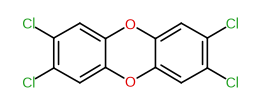 |
| Molecular structure drawn from PubChem coordinates |
| Physical properties [] | |
|---|---|
| Molecular mass | 322.00 g/mol [1] |
| Appearance | Colorless needles [1] |
| Density | 1.8 g/cm³ [1] |
| Melting point | 563 °F (NTP, 1992) [1] |
| Boiling point | Decomposes at 932 °F (NTP, 1992) [1] |
| Decomposition | /2,3,7,8-Tetrachlorodibenzo-p-dioxin/ begins to decompose at 500 °C and virtually complete decomposition occurs within 21 seconds at a temp of 800 °C. [1] |
| Solubility | less than 1 mg/mL at 77 °F (NTP, 1992) [1] |
| Predicted LogP | 6.4 [1] |
| Structural Identifiers [] | |
|---|---|
| Molecular formula | C12H4Cl4O2 |
| IUPAC name | 2,3,7,8-tetrachlorodibenzo-p-dioxin |
| SMILES | C1=C2C(=CC(=C1Cl)Cl)OC3=CC(=C(C=C3O2)Cl)Cl |
| InChI | InChI=1S/C12H4Cl4O2/c13-5-1-9-10(2-6(5)14)18-12-4-8(16)7(15)3-11(12)17-9/h1-4H |
| InChIKey | HGUFODBRKLSHSI-UHFFFAOYSA-N |
| CAS number | 1746-01-6 |
| UNII | DO80M48B6O |
| PubChem CID | 15625 |
| Toxicity [] | |
|---|---|
| LD50 | Dog: - oral: 1 μg/kg Hamster: - oral: 1,157-5,051 Rat: - Oral: 201 μg/kg [1] |
2,3,7,8-Tetrachlorodibenzodioxin (also known as Dioxin, Tetradioxin, Dioxine, Tcdbd, 2,3,7,8-Tetrachlorooxanthrene, 2,3,7,8-tcdd, Dioksyny, Nci-c03714, Pcdd 48 or 2,3,7,8-Tetrachlorodibenzo-1,4-dioxin) is a substance of the phenol class.
Chemistry
Stereochemistry []
2,3,7,8-Tetrachlorodibenzodioxin is achiral.
Druglikeness
Lipinski's rule of five
2,3,7,8-Tetrachlorodibenzodioxin matches Lipinski's rule of five (violations: 1).Pharmacology
MeSH Classification
Mechanism of action []
The LD50 value shows a positive log/log correlation with the lipid content of mammals. This is due to the high lipophilicity of the compound which, after entering the body, tends to partition into the lipid fraction, where it is prevented from reaching the target organs (liver, nervous system), and/or receptors. The main toxic effect in all animals is a loss of body weight (wasting syndrome) which is mainly contributed to loss of body fat; thus, animals having greater fat reserves are more resistant. Some similarities in the chemical structure of 2,3,7,8-TCDD and thyroid hormones suggest an influence on the thyroid physiology and thus on lipid metabolism, which would explain the wasting syndrome. ...The mediator of the toxicity of 2,3,7,8-TCDD is via Ah-receptor. Binding to this receptor is a precondition for most of the toxic action of 2,3,7,8-TCDD and related compounds. The ligand-receptor complex interacts in the cell nucleus with certain DNA sequences ('Ah locus' and other gene loci), to cause an increase in mRNA synthesis followed by a dose-related induction of various proteins, especially cytochrome P450-associated monooxygenases. The induction of enzymes is observed after both acute and chronic application of 2,3,7,8-TCDD. The receptor is principally localized in the liver, but is also found in other organs. [1]
See also []
External links []
- 2,3,7,8-Tetrachlorodibenzodioxin (PubChem)
- 2,3,7,8-Tetrachlorodibenzodioxin (Wikidata)
- 2,3,7,8-Tetrachlorodibenzodioxin (ChEMBL)
- 2,3,7,8-Tetrachlorodibenzodioxin (ChEBI)
- 2,3,7,8-Tetrachlorodibenzodioxin (Common Chemistry)
- 2,3,7,8-Tetrachlorodibenzodioxin (HMDB)
- 2,3,7,8-Tetrachlorodibenzodioxin (KEGG)
- 2,3,7,8-Tetrachlorodibenzodioxin (EPA DSSTox)
- 2,3,7,8-Tetrachlorodibenzodioxin (Effect Index)
- 2,3,7,8-Tetrachlorodibenzodioxin (UNII)
References []
National Center for Biotechnology Information. PubChem Compound Summary for CID 15625, 2,3,7,8-Tetrachlorodibenzodioxin. Accessed November 29, 2026. https://pubchem.ncbi.nlm.nih.gov/compound/15625
U.S. Food and Drug Administration; National Center for Advancing Translational Sciences. 2,3,7,8-Tetrachlorodibenzodioxin. UNII: DO80M48B6O. Global Substance Registration System. Accessed November 29, 2026. https://gsrs.ncats.nih.gov/ginas/app/beta/substances/DO80M48B6O
Data sources []
| Source | Status | Updated (UTC) |
|---|---|---|
| dosing | missing (no dosing statistics) | 2026-11-20 21:00:19 |
| drugspro | missing (no DrugsPRO reagent data) | 2026-11-20 21:00:15 |
| erowid | missing (no Erowid substance of that name) | 2026-11-20 21:00:15 |
| gsrs | ok | 2026-11-20 21:00:15 |
| hmdb | missing (hmdb.ca refused automated access to HMDB0258755) | 2026-11-20 21:00:15 |
| kegg | missing (no KEGG DRUG entry) | 2026-11-20 21:00:20 |
| pubchem | ok | 2026-11-20 21:00:15 |
| missing (no r/tripreports posts mention it) | 2026-11-20 21:00:15 | |
| sider | missing (not in SIDER) | 2026-11-20 21:00:15 |
| structure | ok | 2026-11-20 21:00:15 |
| wikipedia | missing (no Wikipedia article with a drug infobox) | 2026-11-20 21:00:15 |