2,4-Dichlorophenoxyacetic acid
| 2,4-D | |
|---|---|
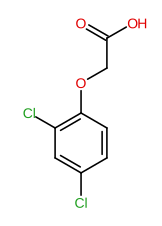 |
| Molecular structure drawn from PubChem coordinates |
| Physical properties [] | |
|---|---|
| Molecular mass | 221.03 g/mol [1] |
| Appearance | White to yellow crystalline powder /SRP: yellow color is phenolic impurities/ [1] |
| Odor | Oodorless [1] |
| Density | 1.563 at 68 °F (USCG, 1999) - Denser than water; will sink [1] |
| Melting point | 280 °F (NTP, 1992) [1] |
| Boiling point | Decomposes (NTP, 1992) [1] |
| Decomposition | When heated to decomposition it emits toxic fumes of /chlorides/. [1] |
| Solubility | Decomposes (NTP, 1992) [1] |
| Predicted LogP | 2.8 [1] |
| Structural Identifiers [] | |
|---|---|
| Molecular formula | C8H6Cl2O3 |
| IUPAC name | 2-(2,4-dichlorophenoxy)acetic acid |
| SMILES | C1=CC(=C(C=C1Cl)Cl)OCC(=O)O |
| InChI | InChI=1S/C8H6Cl2O3/c9-5-1-2-7(6(10)3-5)13-4-8(11)12/h1-3H,4H2,(H,11,12) |
| InChIKey | OVSKIKFHRZPJSS-UHFFFAOYSA-N |
| CAS number | 94-75-7 |
| UNII | 2577AQ9262 |
| PubChem CID | 1486 |
| Toxicity [] | |
|---|---|
| LD50 | Mouse: - ingestion: 521 mg/kg Rabbit: - skin: 1400 mg/kg - Dermal: 1400 mg/kg [1] |
2,4-Dichlorophenoxyacetic acid (also known as Dicopur, B-Selektonon, Amoxone, Chloroxone, Fernimine, Netagrone, Ipaner, Pielik, Rhodia or Agrotect) is a herbicide substance of the phenol and carboxylic acid class.
Chemistry
Stereochemistry []
2,4-Dichlorophenoxyacetic acid is achiral.
Druglikeness
Lipinski's rule of five
2,4-Dichlorophenoxyacetic acid matches Lipinski's rule of five.Pharmacology
MeSH Classification
- herbicides (M0010248)
Mechanism of action []
The widely used hormonal herbicide, 2,4-dichlorophenoxyacetic acid, blocks meiotic maturation in vitro and is thus a potential environmental endocrine disruptor with early reproductive effects. To test whether maturation inhibition was dependent on protein kinase A, an endogenous maturation inhibitor, oocytes were microinjected with PKI, a specific PKA inhibitor, and exposed to 2,4-D. Oocytes failed to mature, suggesting that 2,4-D is not dependent on PKA activity and likely acts on a downstream target, such as Mos. De novo synthesis of Mos, which is triggered by mRNA poly(A) elongation, was examined. Oocytes were microinjected with radiolabelled in vitro transcripts of Mos RNA and exposed to progesterone and 2,4-D. RNA analysis showed progesterone-induced polyadenylation as expected but none with 2,4-D. 2,4-D-activated MAPK was determined to be cytoplasmic in localization studies but poorly induced Rsk2 phosphorylation and activation. In addition to inhibition of the G2/M transition, 2,4-D caused abrupt reduction of H1 kinase activity in MII phase oocytes. Attempts to rescue maturation in oocytes transiently exposed to 2,4-D failed, suggesting that 2,4-D induces irreversible dysfunction of the meiotic signaling mechanism. [1]
External links []
- 2,4-Dichlorophenoxyacetic acid (PubChem)
- 2,4-Dichlorophenoxyacetic acid (Wikidata)
- 2,4-Dichlorophenoxyacetic acid (ChEMBL)
- 2,4-Dichlorophenoxyacetic acid (ChEBI)
- 2,4-Dichlorophenoxyacetic acid (Common Chemistry)
- 2,4-Dichlorophenoxyacetic acid (HMDB)
- 2,4-Dichlorophenoxyacetic acid (KEGG)
- 2,4-Dichlorophenoxyacetic acid (EPA DSSTox)
- 2,4-Dichlorophenoxyacetic acid (Effect Index)
- 2,4-Dichlorophenoxyacetic acid (UNII)
References []
National Center for Biotechnology Information. PubChem Compound Summary for CID 1486, 2,4-Dichlorophenoxyacetic acid. Accessed November 20, 2026. https://pubchem.ncbi.nlm.nih.gov/compound/1486
U.S. Food and Drug Administration; National Center for Advancing Translational Sciences. 2,4-Dichlorophenoxyacetic acid. UNII: 2577AQ9262. Global Substance Registration System. Accessed November 20, 2026. https://gsrs.ncats.nih.gov/ginas/app/beta/substances/2577AQ9262
Data sources []
| Source | Status | Updated (UTC) |
|---|---|---|
| dosing | missing (no dosing statistics) | 2026-11-20 09:11:30 |
| drugspro | missing (no DrugsPRO reagent data) | 2026-11-20 09:11:26 |
| erowid | missing (no Erowid substance of that name) | 2026-11-20 09:11:26 |
| gsrs | ok | 2026-11-20 09:11:26 |
| hmdb | missing (hmdb.ca refused automated access to HMDB0041797) | 2026-11-20 09:11:26 |
| kegg | missing (no KEGG DRUG entry) | 2026-11-20 09:11:31 |
| pubchem | ok | 2026-11-20 09:11:26 |
| missing (no r/tripreports posts mention it) | 2026-11-20 09:11:26 | |
| sider | missing (not in SIDER) | 2026-11-20 09:11:26 |
| structure | ok | 2026-11-20 09:11:26 |
| wikipedia | missing (no Wikipedia article with a drug infobox) | 2026-11-20 09:11:26 |