2,4-Dinitrophenol
| DNP | |
|---|---|
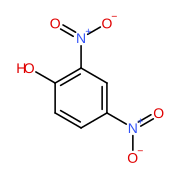 |
| Molecular structure drawn from PubChem coordinates |
| Physical properties [] | |
|---|---|
| Molecular mass | 184.11 g/mol [1] |
| Appearance | Pale yellow platelets or leaflets from water [1] |
| Odor | SWEET, MUSTY ODOR [1] |
| Taste | BITTER TASTE [1] |
| Density | 1.68 at 68 °F (USCG, 1999) - Denser than water; will sink [1] |
| Melting point | 234 to 237 °F (NTP, 1992) [1] |
| Boiling point | Sublimes (when carefully heated) (NTP, 1992) [1] |
| Decomposition | When heated to decomposition it emits toxic fumes of /nitroxides/. [1] |
| Solubility | less than 1 mg/mL at 67.1 °F (NTP, 1992) [1] |
| Predicted LogP | 1.7 [1] |
| Structural Identifiers [] | |
|---|---|
| Molecular formula | C6H4N2O5 |
| IUPAC name | 2,4-dinitrophenol |
| SMILES | C1=CC(=C(C=C1[N+](=O)[O-])[N+](=O)[O-])O |
| InChI | InChI=1S/C6H4N2O5/c9-6-2-1-4(7(10)11)3-5(6)8(12)13/h1-3,9H |
| InChIKey | UFBJCMHMOXMLKC-UHFFFAOYSA-N |
| CAS number | 51-28-5 |
| UNII | Q13SKS21MN |
| PubChem CID | 1493 |
| Toxicity [] | |
|---|---|
| LD50 | Rat: - oral: 30 mg/kg - male weanling oral: 71 mg/kg - ip: 28.5 to - ip: 20 mg/kg [1] |
2,4-Dinitrophenol (also known as Aldifen, Nitrophene, Dinofan, Phenol, 2,4-dinitro-, Fenoxyl carbon N, Solfo Black B, Tertrosulphur PBR, α-Dinitrophenol, Solfo Black G or Nitro kleenup) is a substance of the aniline, arylalkylamine and phenol class.
Chemistry
Stereochemistry []
2,4-Dinitrophenol is achiral.
Druglikeness
Lipinski's rule of five
2,4-Dinitrophenol matches Lipinski's rule of five.Pharmacology
MeSH Classification
Mechanism of action []
2,4-DNP was demonstrated to be an uncoupler of oxidative phosphorylation in an in vitro study. 2,4-DNP prevented phosphorylation without affecting, or with a slight stimulation of, oxidation. During the Krebs cycle, 2,4-DNP uncouples oxidative phosphorylation from electron transport by carrying protons across the inner mitochondrial membrane, thereby dissipating the pH gradient and membrane electrochemical potential and preventing the formation of adenosine triphosphate (ATP). During this uncoupling, electron transport from NADH to oxygen proceeds normally, but the energy produced, which is normally stored in high-energy phosphate bonds in ATP, is released as heat. The small amount of ATP produced directly from glycolysis is not affected. In vitro studies further demonstrated and investigated the ability of 2,4-DNP to uncouple oxidative phosphorylation. 2,4-DNP increased the rate of oxygen uptake and changed the electron microscopic appearance of rat liver mitochondria in vitro from an expanded configuration to a condensed state, with the ultrastructural change occurring in concert with the functional changes of uncoupling. All energy-dependent biochemical processes thus are likely to be affected. Many of the clinical observations of 2,4-DNP toxicity, such as elevated basal metabolic rate or oxygen consumption, elevated respiration and pulse rates, increased perspiration, increased body temperature in humans and animals are related to the uncoupling of oxidative phosphorylation. When heat production exceeds the organism's capacity to dissipate heat, fatal hyperthermia may result [1]
External links []
- 2,4-Dinitrophenol (PubChem)
- 2,4-Dinitrophenol (Wikidata)
- 2,4-Dinitrophenol (DrugBank)
- 2,4-Dinitrophenol (ChEMBL)
- 2,4-Dinitrophenol (ChEBI)
- 2,4-Dinitrophenol (Common Chemistry)
- 2,4-Dinitrophenol (HMDB)
- 2,4-Dinitrophenol (KEGG)
- 2,4-Dinitrophenol (EPA DSSTox)
- 2,4-Dinitrophenol (Probes & Drugs)
- 2,4-Dinitrophenol (Effect Index)
- 2,4-Dinitrophenol (UNII)
References []
National Center for Biotechnology Information. PubChem Compound Summary for CID 1493, 2,4-Dinitrophenol. Accessed November 20, 2026. https://pubchem.ncbi.nlm.nih.gov/compound/1493
U.S. Food and Drug Administration; National Center for Advancing Translational Sciences. 2,4-Dinitrophenol. UNII: Q13SKS21MN. Global Substance Registration System. Accessed November 20, 2026. https://gsrs.ncats.nih.gov/ginas/app/beta/substances/Q13SKS21MN
Data sources []
| Source | Status | Updated (UTC) |
|---|---|---|
| dosing | missing (no dosing statistics) | 2026-11-20 07:33:11 |
| drugspro | missing (no DrugsPRO reagent data) | 2026-11-20 07:33:07 |
| erowid | missing (no Erowid substance of that name) | 2026-11-20 07:33:07 |
| gsrs | ok | 2026-11-20 07:33:07 |
| hmdb | missing (hmdb.ca refused automated access to HMDB0245462) | 2026-11-20 07:33:07 |
| kegg | missing (no KEGG DRUG entry) | 2026-11-20 07:33:11 |
| pubchem | ok | 2026-11-20 07:33:07 |
| missing (no r/tripreports posts mention it) | 2026-11-20 07:33:07 | |
| sider | missing (not in SIDER) | 2026-11-20 07:33:07 |
| structure | ok | 2026-11-20 07:33:07 |
| wikipedia | missing (no Wikipedia article with a drug infobox) | 2026-11-20 07:33:08 |