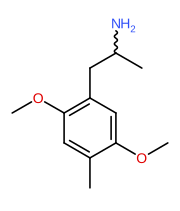
2,5-Dimethoxy-4-methylamphetamine
| DOM | |
|---|---|
 |
| Salts [] | |
|---|---|
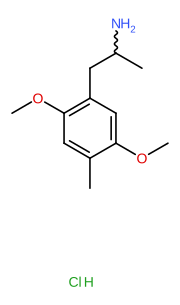
| 2,5-Dimethoxy-4-methylamphetamine hydrochloride | |
 |
| Molecular structure drawn from PubChem coordinates |
| Physical properties [] | |
|---|---|
| Molecular mass | 209.28 g/mol [1] |
| Melting point | 60.5 to 60.1 °C [1] |
| Decomposition | When heated to decomposition it emits toxic vapors of /Nitrogen oxides/. [1] |
| Predicted LogP | 2.2 [1] |
| Structural Identifiers [] | |
|---|---|
| Molecular formula | C12H19NO2 |
| IUPAC name | 1-(2,5-dimethoxy-4-methylphenyl)propan-2-amine |
| SMILES | CC1=CC(=C(C=C1OC)CC(C)N)OC |
| InChI | InChI=1S/C12H19NO2/c1-8-5-12(15-4)10(6-9(2)13)7-11(8)14-3/h5,7,9H,6,13H2,1-4H3 |
| InChIKey | NTJQREUGJKIARY-UHFFFAOYSA-N |
| CAS number | 15588-95-1 |
| UNII | UKI9MLD5OI |
| PubChem CID | 85875 |
| Pharmacokinetics[] | |
|---|---|
| Onset | 0.5–1.5 hours, Peak: 2–6 hours |
| Duration of action | Low doses: 5–8 hours, Moderate doses: 8–24 hours, High doses: possibly up–3–4 days |
| Metabolism | Demethylation |
| Excretion | 5–20% unchanged |
| Routes of administration | Oral |
| Toxicity [] | |
|---|---|
| LD50 | Mouse: - ip: 89 + - ip: 94 mg/kg Rabbit: - oral: 200 mg/kg [1] |
2,5-Dimethoxy-4-methylamphetamine (also known as STP (hallucinogen), (rs)-dom, 2,5-Dimethoxymethylamphetamine, dl-2,5-Dimethoxy-4-methylamphetamine, 4-Methyl-2,5-dimethoxyamphetamine, dl-4-Methyl-2,5-dimethoxyamphetamine, 2',5'-Dimethoxy-4'-methylamphetamine, 2,5-Dimethoxy-4-methylphenylisopropylamine, (+-)-dom or 2,5-Dimethoxy-4,α-dimethylphenethylamin) is a psychedelic substance of the amphetamine and 2,5-dimethoxyamphetamine class.
Chemistry
Salts []
Stereochemistry []
2,5-Dimethoxy-4-methylamphetamine is a racemic mixture of the enantiomers (optical activity ( + / - )).


Druglikeness
Lipinski's rule of five
2,5-Dimethoxy-4-methylamphetamine matches Lipinski's rule of five.Reagents
There are currently 10 reagent-interactions on DrugsPRO
| Reagent | Color change | Description |
|---|---|---|
| Marquis | no color change | |
| Mecke | yellow > green > brown | |
| Mandelin | green | |
| Liebermann | yellow > black | |
| Froehde | yellow > green | |
| Robadope | no pink color change | |
| Simon's | no blue color change | |
| Ehrlich | no color change | |
| Hofmann | light yellow | |
| Scott | no color change |
Pharmacology
MeSH Classification
Mechanism of action []
Alterations in brain serotonergic function have been implicated in the mechanism of action of LSD, mescaline, and other similarly acting hallucinogenic drugs of abuse such as STP (2,5-dimethoxyphenylisopropylamine; DOM). In order to test the hypothesis that the mechanism of action of LSD and phenylisopropylamine hallucinogens is through stimulation of a specific brain serotonin receptor sub-type, the affinities of these compounds for radiolabelled 5-HT2, 5-HT1A, 5-HT1B, and 5-HT1C receptors have been determined using recently developed in vitro radioligand binding methodologies. The 5-HT2 receptor was labelled with the agonist/hallucinogen radioligand 3H-DOB (4-bromo-2,5-dimethoxyphenylisopropylamine). The 5-HT1A, 5-HT1B, and 5-HT1C receptors were labelled with 3H-OH-DPAT, 3H-5-HT, and 3H-mesulergine, respectively. In general, the phenylisopropylamines displayed 10-100 fold higher affinities for the 5-HT2 receptor than for the 5-HT1C receptor and 100-1000 fold higher affinities for the 5-HT2 receptor than for the 5-HT1A or 5-HT1B receptor. There was a strong correlation between hallucinogenic potencies and 5-HT2 receptor affinities of the phenylisopropylamines (r = 0.90); the correlation coefficients for the 5-HT1A, 5-HT1B, and 5-HT1C were 0.73, 0.85, and 0.78, respectively. Because there is no evidence that 5-HT1A-selective or 5-HT1B-selective agonists are hallucinogenic and because the phenylisopropylamines are potent hallucinogens, a 5-HT2 receptor interaction is implicated and supports previous suggestions to this effect. A secondary role for 5-HT1C receptors cannot be discounted at this time. [1]
Subjective effects []
| nervewing / 2,5-Dimethoxy-4-methylamphetamine [] | |
|---|---|
Experience reports
Erowid
There are currently 30 experience reports involving 2,5-dimethoxy-4-methylamphetamine on Erowid: []- "Set The Controls for the Heart of the Man" by 77k
- "Running on Psychedelics (Anecdotal Study)" by Leprechaun
- "A Bit Too Stimulating for Me" by G
- "Stimulated for Quite Some Time" by Henk
- "To Feel the Forest" by lama
- "Full of Potential" by Simple Man
- "Low Dose Wisdom" by InnerExplorer
- "The Bliss of the Sun" by nervewing
- "Accidental Overdose" by 4thDimension
- "A Holy War in My Head" by Dexter's Lab
- "First Dance with Doctor Methyl" by LucidStudies
- "Prophetic Dream" by Xorkoth
- "Lifes Manifestations" by DOM
- "The Glory and the Terror" by Prometheus
- "The Timing Involved Was Critical" by staples
- "Not as Scary as I Thought" by AngerStartsFire
- "Initiation" by Leprechaun
- "My Day With STP" by Morninggloryseed
- "Now I Know Why They Call It STP" by dmunk
- "Gentle First Experience" by Smeagol2
- "Threshold Effects" by Alexander Shulgin
- "A Journey to Heaven, a Journey to Hell" by J. Andersen
- "Ground Control to Major DOM" by PiPPUK
- "Truly Deserving" by Fetus54
- "Fear is the Mind Killer" by Joker
- "Resonating Peace" by Divine Janitor
- "LSDOM: A Wonderful Combo" by TheOrigiinalMrT
- "Life Altering Transcendence" by Rahul
- "Completely Weird and Not What I Expected" by Electric Shaman
- "A Struggle to Find Meaning Ending in Nirvana" by Illum
Legal status []
- Australia: 2,5-Dimethoxy-4-methylamphetamine is a Schedule 9.
- Brazil: 2,5-Dimethoxy-4-methylamphetamine is a F2.[3]
- Canada: 2,5-Dimethoxy-4-methylamphetamine is a Schedule I.
- United Kingdom: 2,5-Dimethoxy-4-methylamphetamine is a Class A under the "Misuse of Drugs Act 1971".
- United States: 2,5-Dimethoxy-4-methylamphetamine is a Schedule I under the "Controlled Substances Act".
External links []
- 2,5-Dimethoxy-4-methylamphetamine (Wikipedia)
- 2,5-Dimethoxy-4-methylamphetamine (PubChem)
- 2,5-Dimethoxy-4-methylamphetamine (Wikidata)
- 2,5-Dimethoxy-4-methylamphetamine (DrugBank)
- 2,5-Dimethoxy-4-methylamphetamine (ChEMBL)
- 2,5-Dimethoxy-4-methylamphetamine (Common Chemistry)
- 2,5-Dimethoxy-4-methylamphetamine (HMDB)
- 2,5-Dimethoxy-4-methylamphetamine (KEGG)
- 2,5-Dimethoxy-4-methylamphetamine (EPA DSSTox)
- 2,5-Dimethoxy-4-methylamphetamine (Effect Index)
- 2,5-Dimethoxy-4-methylamphetamine (UNII)
- 2,5-Dimethoxy-4-methylamphetamine (Erowid)
References []
National Center for Biotechnology Information. PubChem Compound Summary for CID 85875, 2,5-Dimethoxy-4-methylamphetamine. Accessed November 22, 2026. https://pubchem.ncbi.nlm.nih.gov/compound/85875
U.S. Food and Drug Administration; National Center for Advancing Translational Sciences. 2,5-Dimethoxy-4-methylamphetamine. UNII: UKI9MLD5OI. Global Substance Registration System. Accessed November 22, 2026. https://gsrs.ncats.nih.gov/ginas/app/beta/substances/UKI9MLD5OI
RDC Nº 804 - Listas de Substâncias Entorpecentes, Psicotrópicas, Precursoras e Outras sob Controle Especial. Diário Oficial da União. 2023-07-24. https://www.in.gov.br/en/web/dou/-/resolucao-rdc-n-804-de-24-de-julho-de-2023-498447451
Data sources []
| Source | Status | Updated (UTC) |
|---|---|---|
| dosing | missing (no dosing statistics) | 2026-11-20 04:06:53 |
| drugspro | ok | 2026-11-20 04:06:49 |
| erowid | ok | 2026-11-20 04:06:52 |
| gsrs | ok | 2026-11-20 04:06:50 |
| hmdb | missing (hmdb.ca refused automated access to HMDB0245501) | 2026-11-20 04:06:49 |
| kegg | missing (no KEGG DRUG entry) | 2026-11-20 04:06:54 |
| pubchem | ok | 2026-11-20 04:06:48 |
| missing (no r/tripreports posts mention it) | 2026-11-20 04:06:49 | |
| sider | missing (not in SIDER) | 2026-11-20 04:06:49 |
| structure | ok | 2026-11-20 04:06:49 |
| wikipedia | ok | 2026-11-20 04:06:50 |