3,4-Methylenedioxymethamphetamine
| MDMA | |
|---|---|
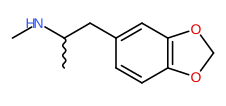 |
| Salts [] | |
|---|---|
| 3,4-Methylenedioxymethamphetamine hydrochloride | |
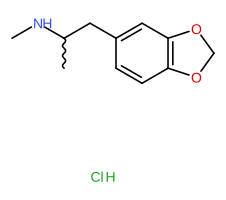 |
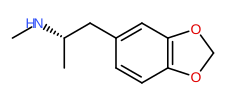
| Molecular structure drawn from PubChem coordinates |
| Physical properties [] | |
|---|---|
| Molecular mass | 193.24 g/mol [1] |
| Appearance | Oil [1] |
| Boiling point | BP: 100-110 °C at 0.4 mmHg [1] |
| Predicted LogP | 2.2 [1] |
| Structural Identifiers [] | |
|---|---|
| Molecular formula | C11H15NO2 |
| IUPAC name | 1-(1,3-benzodioxol-5-yl)-N-methylpropan-2-amine |
| SMILES | CC(CC1=CC2=C(C=C1)OCO2)NC |
| InChI | InChI=1S/C11H15NO2/c1-8(12-2)5-9-3-4-10-11(6-9)14-7-13-10/h3-4,6,8,12H,5,7H2,1-2H3 |
| InChIKey | SHXWCVYOXRDMCX-UHFFFAOYSA-N |
| CAS number | 42542-10-9 |
| UNII | KE1SEN21RM |
| PubChem CID | 1615 |
| Pharmacokinetics[] | |
|---|---|
| Onset | Oral: 30–45 min |
| Elimination half-life | MDMA: 8.7 (range 4.6–16) hours, (S)-MDMA: 5.1 (range 3.5–7.4) hours, (R)-MDMA: 11 (range 5.1–24) hours[3] |
| Duration of action | 3–6 hours |
| Metabolism | Liver, CYP450 extensively involved, including CYP2D6 |
| Excretion | Kidney |
| Routes of administration | Common: By mouth, Uncommon: Insufflation, inhalation, injection, rectal[4][5] |
| Dependence liability | Physical: Not typical, Psychological: Moderate[6][7] |
| Addiction liability | Low–moderate[8][9][10] |
| Toxicity [] | |
|---|---|
| LD50 | Guinea: - pig ip: 98 mg/kg /MDMA Mouse: - ip: 97 mg/kg /MDMA Rat: - ip: 49 mg/kg /MDMA [1] |
| Dosing[] |
|---|
| Insufflated [] | |
|---|---|
| Light | ≤ 31.4 mg(25x - 27.5%) |
| Common | 31.4 - 50 mg(31x - 34.1%) |
| Strong | 50 - 65 mg(13x - 14.3%) |
| Heavy | 65 - 80 mg(15x - 16.5%) |
| Extreme | 80 mg +(7x - 7.7%) |
| Oral [] | |
|---|---|
| Light | ≤ 74.6 mg(22x - 36.1%) |
| Common | 74.6 - 100 mg(14x - 23.0%) |
| Strong | 100 - 120 mg(10x - 16.4%) |
| Heavy | 120 - 200 mg(9x - 14.8%) |
| Extreme | 200 mg +(6x - 9.8%) |
| Intrarectal [] | |
|---|---|
| Light | ≤ 86.3 mg(2x - 50.0%) |
| Common | 86.3 - 95 mg |
| Strong | 95 - 110 mg(2x - 50.0%) |
| Heavy | 110 mg |
| Extreme | 110 mg + |
Statistically derived dosages via DBI-IGS (archived by anodyne.wiki) We do not take any responsibility for medical complications or loss of life sustained by following these dosages blindly. |
3,4-Methylenedioxymethamphetamine (also known as Ecstasy, Midomafetamine, Methylenedioxymethamphetamine, DL-(3,4-Methylenedioxy)methamphetamine, N-methyl-3,4-methylenedioxyamphetamine, (RS)-3,4-(methylenedioxy)methamphetamine, N,α-Dimethyl-1,3-benzodioxole-5-ethanamine, midomafetamina, Methylenedioxymetamphetamine or Methylenedioxymethamfetamine) is a antidepressant and depressant substance of the 3,4-methylenedioxyphenethylamine and amphetamine class.
Chemistry
Salts []
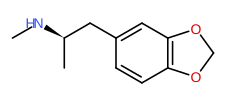
Stereochemistry []
3,4-Methylenedioxymethamphetamine is a racemic mixture of the enantiomers (optical activity ( + / - )).
Druglikeness
Lipinski's rule of five
3,4-Methylenedioxymethamphetamine matches Lipinski's rule of five.Reagents
There are currently 14 reagent-interactions on DrugsPRO
| Reagent | Color change | Description |
|---|---|---|
| Marquis | instant purple/brown > black | |
| Mecke | instant green > blue/black | |
| Mandelin | instant purple/blue > black | |
| Liebermann | instant black | |
| Froehde | instant black | |
| Robadope | no pink color change | |
| Simon's | instant dark blue | |
| Ehrlich | no color change | |
| Hofmann | no color change | |
| Scott | no color change | |
| Morris | pale green | |
| Zimmermann | no change / faint yellow | |
| Gallic | green>brown | |
| Folin | orange |
Pharmacology
MeSH Classification
Mechanism of action []
It enters neurons via carriage by the monoamine transporters. Once inside, MDMA inhibits the vesicular monoamine transporter, which results in increased concentrations of serotonin, norepinephrine, and dopamine into the cytoplasm, and induces their release by reversing their respective transporters through a process known as phosphorylation. It also acts as a weak 5-HT1 and 5-HT2 receptor agonist. MDMA's unusual entactogenic effects have been hypothesized to be, at least partly, the result of indirect oxytocin secretion via activation of the serotonin system. Oxytocin is a hormone released following events like hugging, orgasm, and childbirth, and is thought to facilitate bonding and the establishment of trust. Based on studies in rats, MDMA is believed to cause the release of oxytocin, at least in part, by both directly and indirectly agonizing the serotonin 5-HT1A receptor. [1]
Prodrugs of 3,4-methylenedioxymethamphetamine: N-(L-Lysinamidyl)-3,4-methylenedioxymethamphetamine.
Subjective effects []
| 0xea / 3,4-Methylenedioxymethamphetamine [] | |
|---|---|
Routes:
| |
| a1ko / 3,4-Methylenedioxymethamphetamine [] | |
|---|---|
Routes:
| |
| bonzi / 3,4-Methylenedioxymethamphetamine [] | |
|---|---|
| emily / 3,4-Methylenedioxymethamphetamine [] | |
|---|---|
Routes:
| |
| magnus / 3,4-Methylenedioxymethamphetamine [] | |
|---|---|
Routes:
| |
| Mere / 3,4-Methylenedioxymethamphetamine [] | |
|---|---|
| michalina / 3,4-Methylenedioxymethamphetamine [] | |
|---|---|
Effects:
| |
| nervewing / 3,4-Methylenedioxymethamphetamine [] | |
|---|---|
| ninerik / 3,4-Methylenedioxymethamphetamine [] | |
|---|---|
Routes:
| |
| x86pup / 3,4-Methylenedioxymethamphetamine [] | |
|---|---|
Routes:
| |
Experience reports
Erowid
There are currently 30 experience reports involving 3,4-methylenedioxymethamphetamine on Erowid: []- "Big Bright Lights" by Lightshowoff
- "Some Growing Up to Do" by thingummajig
- "Confessions of a Middle-aged Ecstasy Eater" by Anonymous
- "K-Holing Into a Meta-Entity After a Day of Play" by Duende
- "Questions Illuminated" by wajd
- "The Barrier Had Lifted" by Shamu
- "The Rave Rolling Was Definitely Positive" by Soma91
- "Drowning in My Own Negligence" by Moldy Plates
- "Touch and the River" by fortymore
- "The Department of Existential Destruction" by Anatoli Smorin
- "Monochromatic Mischief" by Anatoli Smorin
- "Clarity of Silence" by Anatoli Smorin
- "The Magic Can't Last Forever" by Pyrojax
- "They Should Have Sent a Poet" by Kalosidos
- "There Is Nothing but Beauty" by Holotropic Thinker
- "Nexus Flip the Hard Way" by CurvedAir
- "The Sundering of the Veil" by Brother23
- "Social Lubricant to Infinity" by mrluky
- "Searching for Samadhi in West Philadelphia" by B-E-H, inc.
- "Jedi Mind Tricks" by Ben Kenobi
- "Life Death Rebirth" by NewRainbowChild
- "From Beautiful to Terrifying" by Hypersphere
- "The Weekend At The Edge Of The Universe" by Sparticus
- "Great Expectations, Wonderful Results" by SoaV
- "Feels Like Rolling for Twelve Hours" by Hypersphere
- "Big Smile" by Astro
- "Late Night in the Mini Noodle" by xEdize
- "Our Crazy Night � a Bonding Experience" by Sweetpea & Hunnypie
- "Not What I Had Planned..." by Mr. Bad Example
- "'We Have Art in the Living-Room Ceiling!'" by E4ME
- "My first time on ~50 mg 2C-B: a cautionary tale about weighing your drugs properly" by psilocindream (89 upvotes)
- "15 years of drug use ended by a single mushroom" by oxide-NL (74 upvotes)
- "An Acid Trip that Only Satan Himself could Imagine || A Detailed Account of the Events that Transcended one Fateful Halloween 5 yrs ago. Resulting in the Admittance of my Best Friend into the ER, Him Stealing a Car, Developing Psychosis, and so so Much More Crazy Shit!!" by GrizzlyAdams123 (74 upvotes)
- "Talking to a Cop on my first Acid Trip" by PotatoSharp6339 (69 upvotes)
- "I had a house fire on 400ug" by Mycofriendly (63 upvotes)
- "1 Gram Of Meth And Being Abducted By Aliens From My Jail Cell (Psychosis Story)" by W8_420 (63 upvotes)
- "Trip report on MDMA, KETAMINE, Coke and Weed. I escaped the matrix and realised we are nothing more than a reality TV show for aliens" by flowfollowsfocus (57 upvotes)
- "I became spiritual last night thanks to mushrooms." by mustbearealfunguy (55 upvotes)
- "5 tabs of lsd, 100mg of mdma, weed,a big hit of nitrous and Coke." by aaaowbtway (53 upvotes)
- "I Have Tried Every Single Drug and Steroid" by Hangeth_Thy_Dong (51 upvotes)
- "The time I accidentally got dosed 3200mics while hanging out with a friend from playstation (long read)" by MrFuzzySeratonin (50 upvotes)
- "The Soup: 250ug LSD, 22mg 2C-B, Nitrous Oxide, Cannabis, and Nicotine." by postcooked_2 (49 upvotes)
- "Direct Mystical Experience with Penis Envy" by tinystronk (41 upvotes)
- "Doing Every Drug For The Last Time" by stjakey (39 upvotes)
- "I and a buddy tried shrooms together for the first time, it got quite... interesting" by ObligationGlum (39 upvotes)
- "A small trip on shrooms might have changed my life." by SRuler (39 upvotes)
- "Shrooms+ DMT+ heated pool = BLISSFUL EXTASY" by ketikat88 (38 upvotes)
- "Life Changing 8g Psilocybin Trip" by BigOrangeWaffle (37 upvotes)
- "Interacted with my deceased brother (this time off DMT)" by souljamookie (37 upvotes)
- "Psilohuasca trip report" by prettygreenleaf (37 upvotes)
- "First time doing and unknown quantity of Shrooms" by hazym8z (36 upvotes)
- "3.5 grams Penis envy trip report" by worldisbutadream (36 upvotes)
- "Salvia, DXM, Nitrous and Tobacco: Became a salvia god" by [deleted] (35 upvotes)
- "1G MDMA trip" by Odinboi69 (35 upvotes)
- "2 Gram MDMA Trip report" by W8_420 (34 upvotes)
- "Jedi Flip trip report." by puffpuffandpass (34 upvotes)
- "The Sandman: A Cautionary Tale on Why You Should Never Mix MDMA and Benzos" by I_Am_Denny_King (34 upvotes)
- "2nd Music Festival - 🍬 flips, first 🍄, gummy worms" by An_Impure_Throwaway (33 upvotes)
- "The Time I Got Spike With a Mystery Hallucinogen During a Summer Camp Staff Orgy" by I_Am_Denny_King (33 upvotes)
- "Temporary psychosis or local celebrity, you decide." by Phisermansfriend (32 upvotes)
- "Trip Report (long) of an absolutely magical experience: Taking 20 grams of magic truffles in the woods" by coochieforbreakfast (32 upvotes)
- "Body on autopilot while in k hole and acid" by shoonbooon (32 upvotes)
- "LSD trip from hell" by Meathippie (32 upvotes)
- "200 ug of Acid got me tripping through time. Trip report from my first ever Rave." by sassysalmnder (31 upvotes)
- "high dose shrooms on a surreal island in the middle of the open ocean." by drug-mosphere (30 upvotes)
- "Tripreport: LSD+MDMA+2CB+KETAMINE+WEED" by boogerscrap (30 upvotes)
- "Weed became my nicotine" by stjakey (30 upvotes)
- "Thank you Lucy for changing my life [LSD 150ug]" by AmITrippingHahaYes (30 upvotes)
- "Psychedelia Turned Into Stimulant Psychosis (on a tab of DOC)." by 26LT (30 upvotes)
- "I’m a Christian who took shrooms" by TryptechCo (29 upvotes)
- "Old guy takes shrooms and gets his ass kicked." by Bonusball (29 upvotes)
- "First MDMA Experience" by buffetisking (29 upvotes)
- "Trip Report - 3g of Penis Envy Psilocybin (first timer)" by KingPurps (29 upvotes)
- "My full drug career to this point. (Feel free to skim )" by Solid-Ambition-6635 (28 upvotes)
- "Veryyy low dose dmt w cart" by [deleted] (28 upvotes)
- "First morning glory trip" by monce1 (28 upvotes)
- "First shroom experience" by buffetisking (28 upvotes)
- "Spacing out rolls?" by headychemist (27 upvotes)
- "First solo trip with 2C-B" by Sardoudoune (27 upvotes)
- "1.8 grams mushrooms Gold Caps + lemon tek. Psychedelic misrepresentation?" by mikeygtho (27 upvotes)
Legal status []
- Australia: 3,4-Methylenedioxymethamphetamine is a S8 (PTSD), S9 (all other uses).
- Brazil: 3,4-Methylenedioxymethamphetamine is a F2.[11]
- Canada: 3,4-Methylenedioxymethamphetamine is a Schedule I.
- Germany: 3,4-Methylenedioxymethamphetamine is a Anlage I under the "Betäubungsmittelgesetz (BtMG)".
- New Zealand: 3,4-Methylenedioxymethamphetamine is a Class B.
- United Kingdom: 3,4-Methylenedioxymethamphetamine is a Class A under the "Misuse of Drugs Act 1971".
- United States: 3,4-Methylenedioxymethamphetamine is a Schedule I under the "Controlled Substances Act".
- United Nations: 3,4-Methylenedioxymethamphetamine is a Psychotropic Schedule I.
- European Union: 3,4-Methylenedioxymethamphetamine is a Fully prohibited.
- Other: 3,4-Methylenedioxymethamphetamine is a SE: Förteckning I.[12]
See also []
External links []
- 3,4-Methylenedioxymethamphetamine (Wikipedia)
- 3,4-Methylenedioxymethamphetamine (PubChem)
- 3,4-Methylenedioxymethamphetamine (Wikidata)
- 3,4-Methylenedioxymethamphetamine (DrugBank)
- 3,4-Methylenedioxymethamphetamine (ChEMBL)
- 3,4-Methylenedioxymethamphetamine (ChEBI)
- 3,4-Methylenedioxymethamphetamine (Common Chemistry)
- 3,4-Methylenedioxymethamphetamine (HMDB)
- 3,4-Methylenedioxymethamphetamine (KEGG)
- 3,4-Methylenedioxymethamphetamine (EPA DSSTox)
- 3,4-Methylenedioxymethamphetamine (Effect Index)
- 3,4-Methylenedioxymethamphetamine (UNII)
- 3,4-Methylenedioxymethamphetamine (Erowid)
References []
National Center for Biotechnology Information. PubChem Compound Summary for CID 1615, 3,4-Methylenedioxymethamphetamine. Accessed November 21, 2026. https://pubchem.ncbi.nlm.nih.gov/compound/1615
U.S. Food and Drug Administration; National Center for Advancing Translational Sciences. 3,4-Methylenedioxymethamphetamine. UNII: KE1SEN21RM. Global Substance Registration System. Accessed November 21, 2026. https://gsrs.ncats.nih.gov/ginas/app/beta/substances/KE1SEN21RM
Straumann I, Avedisian I, Klaiber A, Varghese N, Eckert A, Rudin D, Luethi D, Liechti ME. Acute effects of R-MDMA, S-MDMA, and racemic MDMA in a randomized double-blind cross-over trial in healthy participants. Neuropsychopharmacology. August 2024; 50(2):362–371. PMID 39179638. https://doi.org/10.1038/s41386-024-01972-6
Methylenedioxymethamphetamine (MDMA or 'Ecstasy'). EMCDDA. http://www.emcdda.europa.eu/publications/drug-profiles/mdma
Methylenedioxymethamphetamine (MDMA, ecstasy). Drugs and Human Performance Fact Sheets. http://www.nhtsa.dot.gov/people/injury/research/job185drugs/methylenedioxymethamphetamine.htm
Palmer RB. Medical toxicology of drug abuse: synthesized chemicals and psychoactive plants. John Wiley & Sons. 2012. https://books.google.com/books?id=OWFiVaDZnkQC&pg=PA139
Upfal J. Australian Drug Guide: The Plain Language Guide to Drugs and Medicines of All Kinds. Black Inc. 2022.
Malenka RC, Nestler EJ, Hyman SE. Molecular Neuropharmacology: A Foundation for Clinical Neuroscience. McGraw-Hill Medical. 2009.
Betzler F, Viohl L, Romanczuk-Seiferth N. Decision-making in chronic ecstasy users: a systematic review. The European Journal of Neuroscience. January 2017; 45(1):34–44. PMID 27859780. https://doi.org/10.1111/ejn.13480
Jerome L, Schuster S, Yazar-Klosinski BB. Can MDMA play a role in the treatment of substance abuse?. Current Drug Abuse Reviews. March 2013; 6(1):54–62. PMID 23627786. http://pdfs.semanticscholar.org/33fd/4f5decd405dee8d4f280a9158bfb16ae6e27.pdf
Anvisa. RDC Nº 804 - Listas de Substâncias Entorpecentes, Psicotrópicas, Precursoras e Outras sob Controle Especial. Diário Oficial da União. 2023-07-24. https://www.in.gov.br/en/web/dou/-/resolucao-rdc-n-804-de-24-de-julho-de-2023-498447451
Läkemedelsverkets föreskrifter (LVFS 2011:10) om förteckningar över narkotika. Swedish Medical Products Agency. https://www.lakemedelsverket.se/globalassets/dokument/lagar-och-regler/lvfs/lvfs-2011-10-konsoliderad.pdf
Data sources []
| Source | Status | Updated (UTC) |
|---|---|---|
| dosing | ok | 2026-11-20 05:22:32 |
| drugspro | ok | 2026-11-20 05:22:28 |
| erowid | ok | 2026-11-20 05:22:30 |
| gsrs | ok | 2026-11-20 05:22:29 |
| hmdb | missing (hmdb.ca refused automated access to HMDB0254382) | 2026-11-20 05:22:28 |
| kegg | ok | 2026-11-20 05:22:31 |
| pubchem | ok | 2026-11-20 05:22:26 |
| ok | 2026-11-20 05:22:28 | |
| sider | missing (not in SIDER) | 2026-11-20 05:22:28 |
| structure | ok | 2026-11-20 05:22:28 |
| wikipedia | ok | 2026-11-20 05:22:28 |