4-Aminopyridine
| 4-AP | |
|---|---|
 |
| Salts [] | |
|---|---|
| 4-Aminopyridine hydrochloride | |
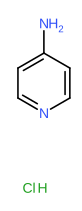 |
| Molecular structure drawn from PubChem coordinates |
| Physical properties [] | |
|---|---|
| Molecular mass | 94.11 g/mol [1] |
| Appearance | White crystals [1] |
| Odor | Odorless [1] |
| Density | 1.2607 at 77.54 °F (USCG, 1999) - Denser than water; will sink [1] |
| Melting point | 318 °F (EPA, 1998) [1] |
| Boiling point | 524.3 °F at 760 mmHg (EPA, 1998) [1] |
| Decomposition | When heated to decomposition it emits toxic fumes of /nitrogen oxides/. [1] |
| Solubility | 74 g/L [1] |
| Predicted LogP | 0.3 [1] |
| Structural Identifiers [] | |
|---|---|
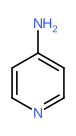
| Molecular formula | C5H6N2 |
| IUPAC name | pyridin-4-amine |
| SMILES | C1=CN=CC=C1N |
| InChI | InChI=1S/C5H6N2/c6-5-1-3-7-4-2-5/h1-4H,(H2,6,7) |
| InChIKey | NUKYPUAOHBNCPY-UHFFFAOYSA-N |
| CAS number | 504-24-5 |
| UNII | BH3B64OKL9 |
| PubChem CID | 1727 |
| Toxicity [] | |
|---|---|
| LD50 | Dog: - oral: 3.7 mg/kg Mouse: - oral: 50 mg/kg [1] |
4-Aminopyridine (also known as Fampridine, 4-Pyridinamine, Dalfampridine, 4-Pyridylamine, Avitrol, p-Aminopyridine, Ampyra, γ-Aminopyridine, Phillips 1861 or Amino-4 pyridine).
Chemistry
Salts []
Stereochemistry []
4-Aminopyridine is achiral.
Druglikeness
Lipinski's rule of five
4-Aminopyridine matches Lipinski's rule of five.Pharmacology
ATC Classification
- nervous system (N)
- other nervous system drugs (N07)
- other nervous system drugs (N07X)
- other nervous system drugs (N07XX)
- (N07XX07)
- fampridine (N07XX07)
MeSH Classification
- potassium channel blockers (M0379232)
Mechanism of action []
In MS, axons are progressively demyelinated which exposes potassium channels. As a result, there is a leak of potassium ions which results in the repolarization of cells and a decrease in neuronal excitability. The overall impact is the impairment of neuromuscular transmission as it is harder to trigger an action potential. Dalfampridine inhibits voltage-gated potassium channels in the CNS to maintain the transmembrane potential and prolong action potential. In other words, dalfampridine works to make sure that the current available is high enough to stimulate conduction in demyelinated axons that are exposed in MS patients. Furthermore, it facilitates neuromuscular and synaptic transmission by relieving conduction blocks in demyelinated axons. [1]
Medical side effects []
40 side effects listed on drug labels in SIDER 4.1 (4-AP).
- Urinary tract infection
- Insomnia
- Asthenia
- Dizziness
- Headache
- Nausea
- Back pain
- Balance disorder
- Nasopharyngitis
- Paraesthesia
- Multiple sclerosis relapse
- Constipation
- Dyspepsia
- Laryngeal pain
- Anaphylactic shock
- Angioedema
- Anxiety
- Mental disorder
- Infection
- Confusional state
- Feeling abnormal
- Connective tissue disorder
- Dyspnoea
- Dermatitis
- Rash
- Gastrointestinal disorder
- Hypersensitivity
- Hypotension
- Immune system disorder
- Mediastinal disorder
- Nervous system disorder
- Convulsion
- Tremor
- Urticaria
- Angiopathy
- Vomiting
- Skin disorder
- Chest pain
- Chest discomfort
- Infestation
Indications
- Multiple sclerosis
- Walking disability
External links []
- 4-Aminopyridine (Wikipedia)
- 4-Aminopyridine (PubChem)
- 4-Aminopyridine (Wikidata)
- 4-Aminopyridine (DrugBank)
- 4-Aminopyridine (ChEMBL)
- 4-Aminopyridine (ChEBI)
- 4-Aminopyridine (Common Chemistry)
- 4-Aminopyridine (KEGG)
- 4-Aminopyridine (EPA DSSTox)
- 4-Aminopyridine (Effect Index)
- 4-Aminopyridine (UNII)
- 4-Aminopyridine (SIDER)
References []
National Center for Biotechnology Information. PubChem Compound Summary for CID 1727, 4-Aminopyridine. Accessed November 21, 2026. https://pubchem.ncbi.nlm.nih.gov/compound/1727
U.S. Food and Drug Administration; National Center for Advancing Translational Sciences. 4-Aminopyridine. UNII: BH3B64OKL9. Global Substance Registration System. Accessed November 21, 2026. https://gsrs.ncats.nih.gov/ginas/app/beta/substances/BH3B64OKL9
Data sources []
| Source | Status | Updated (UTC) |
|---|---|---|
| dosing | missing (no dosing statistics) | 2026-11-20 11:00:47 |
| drugspro | missing (no DrugsPRO reagent data) | 2026-11-20 11:00:43 |
| erowid | missing (no Erowid substance of that name) | 2026-11-20 11:00:43 |
| gsrs | ok | 2026-11-20 11:00:44 |
| hmdb | missing (no HMDB id) | 2026-11-20 11:00:43 |
| kegg | ok | 2026-11-20 11:00:45 |
| pubchem | ok | 2026-11-20 11:00:43 |
| missing (no r/tripreports posts mention it) | 2026-11-20 11:00:43 | |
| sider | ok | 2026-11-20 11:00:43 |
| structure | ok | 2026-11-20 11:00:43 |
| wikipedia | ok | 2026-11-20 11:00:44 |