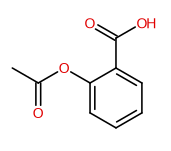
Acetylsalicylic acid
| ASA | |
|---|---|
 |
| Salts [] | |
|---|---|
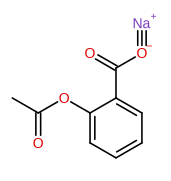
| Sodium acetylsalicylic acid | |
 |
| Molecular structure drawn from PubChem coordinates |
| Rotamer [] | |
|---|---|
| Conformer structure via 3Dmol.js |
| Physical properties [] | |
|---|---|
| Molecular mass | 180.16 g/mol [1] |
| Appearance | Monoclinic tablets or needle-like crystals [1] |
| Odor | Odorless, but in moist air it is gradually hydrolyzed and acquires odor of acetic acid [1] |
| Density | 1.4 (NTP, 1992) - Denser than water; will sink [1] |
| Melting point | 275 °F (NTP, 1992) [1] |
| Boiling point | 284 °F at 760 mmHg (decomposes) (NTP, 1992) [1] |
| Decomposition | When heated to decomposition it emits acrid smoke and fumes. [1] |
| Solubility | less than 1 mg/mL at 73 °F (NTP, 1992) [1] |
| Predicted LogP | 1.2 [1] |
| Structural Identifiers [] | |
|---|---|
| Molecular formula | C9H8O4 |
| IUPAC name | 2-acetyloxybenzoic acid |
| SMILES | CC(=O)OC1=CC=CC=C1C(=O)O |
| InChI | InChI=1S/C9H8O4/c1-6(10)13-8-5-3-2-4-7(8)9(11)12/h2-5H,1H3,(H,11,12) |
| InChIKey | BSYNRYMUTXBXSQ-UHFFFAOYSA-N |
| CAS number | 50-78-2 |
| UNII | R16CO5Y76E |
| PubChem CID | 2244 |
| Pharmacokinetics[] | |
|---|---|
| Elimination half-life | Dose-dependent; 2–3 h for low doses (100 mg or less), 15–30 h for larger doses. |
| Metabolism | Liver (CYP2C19 and possibly CYP3A), some is also hydrolysed to salicylate in the gut wall. |
| Excretion | Urine (80–100%), sweat, saliva, feces |
| Routes of administration | Oral, rectal |
| Toxicity [] | |
|---|---|
| LD50 | Mouse: - Oral: 250 mg/kg Rat: - oral: 1500 mg/kg - oral: 200 mg/kg [1] |
Acetylsalicylic acid (also known as 2-Acetoxybenzoic acid, 2-(Acetyloxy)benzoic acid, Acylpyrin, Acetophen, O-Acetylsalicylic acid, Acenterine, o-Acetoxybenzoic acid, Ecotrin, Aceticyl or Salicylic acid acetate) is a nonsteroidal anti-inflammatory drug and steroid substance of the phenol class.
Chemistry
Salts []
Stereochemistry []
Acetylsalicylic acid is achiral.
Druglikeness
Lipinski's rule of five
Acetylsalicylic acid matches Lipinski's rule of five.Pharmacology
ATC Classification
- alimentary tract and metabolism (A)
- stomatological preparations (A01)
- stomatological preparations (A01A)
- other agents for local oral treatment (A01AD)
- acetylsalicylic acid (A01AD05)
- blood and blood forming organs (B)
- antithrombotic agents (B01)
- antithrombotic agents (B01A)
- platelet aggregation inhibitors excl. heparin (B01AC)
- acetylsalicylic acid (B01AC06)
- nervous system (N)
- analgesics (N02)
- other analgesics and antipyretics (N02B)
- salicylic acid and derivatives (N02BA)
- (N02BA01)
- acetylsalicylic acid (N02BA01)
- (N02BA01; B01AC06)
MeSH Classification
- anti-inflammatory agents, non-steroidal (M0001335)
- fibrinolytic agents (M0008434)
- platelet aggregation inhibitors (M0017012)
- cyclooxygenase inhibitors (M0025664)
- antipyretics (M0028037)
Mechanism of action []
Acetylsalicylic acid (ASA) blocks prostaglandin synthesis. It is non-selective for COX-1 and COX-2 enzymes. Inhibition of COX-1 results in the inhibition of platelet aggregation for about 7-10 days (average platelet lifespan). The acetyl group of acetylsalicylic acid binds with a serine residue of the cyclooxygenase-1 (COX-1) enzyme, leading to irreversible inhibition. This prevents the production of pain-causing prostaglandins. This process also stops the conversion of arachidonic acid to thromboxane A2 (TXA2), which is a potent inducer of platelet aggregation. Platelet aggregation can result in clots and harmful venous and arterial thromboembolism, leading to conditions such as pulmonary embolism and stroke. It is important to note that there is 60% homology between the protein structures of COX-1 and COX-2. ASA binds to serine 516 residue on the active site of COX-2 in the same fashion as its binding to the serine 530 residue located on the active site of COX-1. The active site of COX-2 is, however, slightly larger than the active site of COX-1, so that arachidonic acid (which later becomes prostaglandins) manages to bypass the aspirin molecule inactivating COX-2. ASA, therefore, exerts more action on the COX-1 receptor rather than on the COX-2 receptor. A higher dose of acetylsalicylic acid is required for COX-2 inhibition. [1]
Interactions []
Medical side effects []
75 side effects listed on drug labels in SIDER 4.1 (aspirin).
- Respiratory alkalosis
- Anaphylactic shock
- Anaemia
- Angioedema
- Asthma
- Coagulopathy
- Breast feeding
- Varicella
- Coma
- Confusional state
- Feeling abnormal
- Contusion
- Diabetes mellitus
- Diabetic
- Diarrhoea
- Polyuria
- Somnolence
- Dyspepsia
- Heartburn
- Dyspnoea
- Dermatitis
- Rash
- Eruption
- Flushing
- Gastrointestinal haemorrhage
- Gout
- Haematemesis
- Haemorrhage
- Haemoglobin
- Haemorrhagic disorder
- Hypersensitivity
- Hypertension
- Hypoglycaemia
- Hypokalaemia
- Leukopenia
- Liver disorder
- Hepatocellular injury
- Foetor hepaticus
- Melaena
- Nausea
- Peptic ulcer
- Pruritus
- Purpura
- Vascular purpura
- Reye's syndrome
- Convulsion
- Hyperhidrosis
- Dizziness
- Lightheadedness
- Shock
- Syncope
- Loss of consciousness
- Tachycardia
- Thirst
- Thrombocytopenia
- Tinnitus
- Ear buzzing
- Ulcer
- Urticaria
- Vertigo
- Vomiting
- Renal impairment
- Metabolic acidosis
- Agitation
- Hepatotoxicity
- Chest pain
- Chest discomfort
- Acidosis
- Epigastric discomfort
- Arthralgia
- Influenza
- Respiratory failure
- Deafness
- Hearing impaired
- Blood cholesterol increased
Indications
- Acute myocardial infarction
- Angina unstable
- Arthritis
- Body temperature increased
- Bursitis
- Cardiac disorder
- Cerebral infarction
- Cerebrovascular accident
- Common cold
- Dysmenorrhoea
- Fracture
- Headache
- Inflammation
- Influenza
- Injury
- Migraine
- Musculoskeletal disorder
- Myocardial infarction
- Myositis
- Neck pain
- Neuralgia
- Osteoarthritis
- Pain
- Phonophobia
- Photophobia
- Rheumatic fever
- Rheumatism
- Rheumatoid arthritis
- Sensitisation
- Spondylitis
- Sprain
- Synovitis
- Toothache
- Transient ischaemic attack
- Venous thromboembolism
Subjective effects []
Legal status []
- Australia: Acetylsalicylic acid is a S6 / Schedule 5; Schedule 4; Schedule 2 Appendix F, clause 4.[3][4]
- Canada: Acetylsalicylic acid is a OTC.[5]
- United Kingdom: Acetylsalicylic acid is a GSL.
- United States: Acetylsalicylic acid is a OTC / Prescription only.
- Other: Acetylsalicylic acid is a SE: OTC.
External links []
- Acetylsalicylic acid (Wikipedia)
- Acetylsalicylic acid (PubChem)
- Acetylsalicylic acid (Wikidata)
- Acetylsalicylic acid (DrugBank)
- Acetylsalicylic acid (ChEMBL)
- Acetylsalicylic acid (ChEBI)
- Acetylsalicylic acid (Common Chemistry)
- Acetylsalicylic acid (HMDB)
- Acetylsalicylic acid (KEGG)
- Acetylsalicylic acid (EPA DSSTox)
- Acetylsalicylic acid (Effect Index)
- Acetylsalicylic acid (UNII)
- Acetylsalicylic acid (SIDER)
References []
National Center for Biotechnology Information. PubChem Compound Summary for CID 2244, Acetylsalicylic acid. Accessed November 24, 2026. https://pubchem.ncbi.nlm.nih.gov/compound/2244
U.S. Food and Drug Administration; National Center for Advancing Translational Sciences. Acetylsalicylic acid. UNII: R16CO5Y76E. Global Substance Registration System. Accessed November 24, 2026. https://gsrs.ncats.nih.gov/ginas/app/beta/substances/R16CO5Y76E
OTC medicine monograph: Aspirin tablets for oral use. Therapeutic Goods Administration (TGA). 21 June 2022. https://www.tga.gov.au/resources/publication/publications/otc-medicine-monograph-aspirin-tablets-oral-use
Therapeutic Goods (Poisons Standard— June 2025) Instrument 2025. Therapeutic Goods Administration (TGA). May 2025. https://www.legislation.gov.au/F2025L00599/asmade/2025-05-28/text/original/pdf
Aspirin Product information. Health Canada. 22 October 2009. https://health-products.canada.ca/dpd-bdpp/info?lang=eng&code=19474
Data sources []
| Source | Status | Updated (UTC) |
|---|---|---|
| dosing | missing (no dosing statistics) | 2026-11-20 07:01:31 |
| drugspro | missing (no DrugsPRO reagent data) | 2026-11-20 07:01:27 |
| erowid | missing (no Erowid substance of that name) | 2026-11-20 07:01:27 |
| gsrs | ok | 2026-11-20 07:01:28 |
| hmdb | missing (hmdb.ca refused automated access to HMDB0001879) | 2026-11-20 07:01:27 |
| kegg | ok | 2026-11-20 07:01:29 |
| pubchem | ok | 2026-11-20 07:01:27 |
| missing (no r/tripreports posts mention it) | 2026-11-20 07:01:27 | |
| sider | ok | 2026-11-20 07:01:27 |
| structure | ok | 2026-11-20 07:01:27 |
| wikipedia | ok | 2026-11-20 07:01:28 |