Alprazolam
| Xanax | |
|---|---|
 |
| Salts [] | |
|---|---|
| Alprazolam didihydrate | |
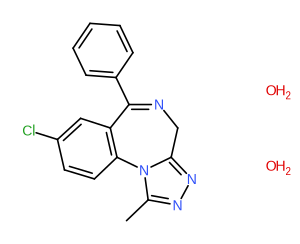 |
| Molecular structure drawn from PubChem coordinates |
| Rotamer [] | |
|---|---|
| Conformer structure via 3Dmol.js |
| Physical properties [] | |
|---|---|
| Molecular mass | 308.80 g/mol [1] |
| Appearance | Crystals from ethyl acetate [1] |
| Melting point | 228-229.5 °C [1] |
| Decomposition | When heated to decomposition it emits toxic fumes of /hydrogen chloride/ and /nitric oxides/. [1] |
| Solubility | Insoluble in water [1] |
| Predicted LogP | 2.1 [1] |
| Structural Identifiers [] | |
|---|---|
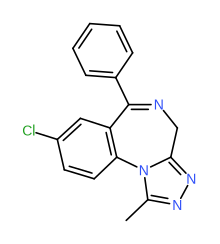
| Molecular formula | C17H13ClN4 |
| IUPAC name | 8-chloro-1-methyl-6-phenyl-4H-[1,2,4]triazolo[4,3-a][1,4]benzodiazepine |
| SMILES | CC1=NN=C2N1C3=C(C=C(C=C3)Cl)C(=NC2)C4=CC=CC=C4 |
| InChI | InChI=1S/C17H13ClN4/c1-11-20-21-16-10-19-17(12-5-3-2-4-6-12)14-9-13(18)7-8-15(14)22(11)16/h2-9H,10H2,1H3 |
| InChIKey | VREFGVBLTWBCJP-UHFFFAOYSA-N |
| CAS number | 28981-97-7 |
| UNII | YU55MQ3IZY |
| PubChem CID | 2118 |
| Pharmacokinetics[] | |
|---|---|
| Onset | 30–60 minutes[3] |
| Elimination half-life | Instant-release dosing:, 11–13 hours, Extended-release dosing:, 11–16 hours |
| Duration of action | Instant-release dosing:, 6 hours, Extended-release dosing:, 11.3 hours |
| Metabolism | Liver, via cytochrome P450 3A4 |
| Excretion | Kidney |
| Routes of administration | By mouth |
| Dependence liability | Very high |
| Addiction liability | High |
| Toxicity [] | |
|---|---|
| LD50 | Mouse: - oral: 812 mg/kg - ip: 380 mg/kg - Oral: 1020 mg/kg Rat: - oral: 1220 mg/kg - ip: 355 mg/kg [1] |
Alprazolam (also known as Niravam, Solanax, Tranquinal, Alplax, Xanor, Alpronax, Restyl, Xanax XR, Alprazolamum or Nu-Alpraz) is a depressant, opioid and steroid substance of the triazolobenzodiazepine class.
Chemistry
Salts []
Stereochemistry []
Alprazolam is achiral.
Druglikeness
Lipinski's rule of five
Alprazolam matches Lipinski's rule of five.Reagents
There are currently 6 reagent-interactions on DrugsPRO
| Reagent | Color change | Description |
|---|---|---|
| Marquis | no color change | |
| Mecke | no color change | |
| Mandelin | no color change | |
| Liebermann | no color change | |
| Morris | pale green | |
| Zimmermann | slow blue / violet |
Pharmacology
ATC Classification
- nervous system (N)
- psycholeptics (N05)
- anxiolytics (N05B)
- benzodiazepine derivatives (N05BA)
- (N05BA12)
- alprazolam (N05BA12)
MeSH Classification
Mechanism of action []
Neurotransmission relies on excitatory and inhibitory signalling. γ-aminobutyric acid (GABA) type-A receptors (GABA<sub>A</sub>Rs) are members of the pentameric ligand-gated ion channel (PLGIC) superfamily located synaptically and perisynaptically to mediate phasic inhibition and extrasynaptically to mediate tonic inhibition. GABA<sub>A</sub>Rs comprise a variety of subunits from a homologous family whose members are named based on sequence identity as one of α1-6, β1-3, γ1-3, δ, ε, θ, π, and ρ1-3. Each subunit possesses an extracellular (ECD), transmembrane (TMD), and intracellular (ICD) domain; inter-subunit interfaces are the primary points of neurotransmitter and modulator binding, described by coordination of the principal (+) and complementary (-) sites in each subunit. Binding of GABA to GABA<sub>A</sub>Rs induces pore opening, rapid flow of chloride ions, and synaptic hyperpolarization, which in turn manifests as an inhibitory signal. The most prevalent GABA<sub>A</sub>Rs _in vivo_ are the α1β2γ2 receptors, which contain both GABA (β+/α-) and benzodiazepine (BZD, α+/γ-) binding sites in the intersubunit interfaces of the relevant subunits. In general, any receptors containing an α<sub>x</sub>/γ<sub>z</sub> interface, where x = 1-3,5 and z = 1-3, have potential high-affinity BZD binding sites, although small sequence differences between subunits may alter binding affinity to individual molecules. The α4 and α6 subunits, in which an otherwise conserved histidine is replaced by arginine, do not bind traditional BZD ligands such as diazepam and hence are considered "diazepam-insensitive". GABA binding results in a series of conformational changes in the ECDs of GABA<sub>A</sub>R β subunits, "locking" each to its neighbouring α- interface. The binding of alprazolam in the high-affinity BZD site stabilizes the α+/γ- interface and facilitates the conformational changes that lead to pore opening, hence functioning as a positive allosteric modulator. The exact manner in which GABA<sub>A</sub>R allosteric modulation mediates the therapeutic and unwanted effects of benzodiazepines remains unclear. Earlier studies suggested that the primary factor was the α subunit composition, with α1-containing receptors mediating the sedative effects, α2/3-containing receptors the anxiolytic effects, and α5-containing receptors the memory effects of benzodiazepines. More recent studies suggest a more complex set of factors including subunit composition, physiological location, neuronal circuit, and nerve cell type. To further complicate matters, there may be up to five distinct BZD binding sites on GABA<sub>A</sub>Rs, with site 1 corresponding to the classical high-affinity α+/γ- interface. The effects of binding at sites 2-4 are not fully understood and likely impart greater complexity to benzodiazepine pharmacological action. [1]
Interactions []
Interaction mechanisms documented in KEGG DRUG (number of interacting drugs):
| CYP3A | metabolism / inhibition / induction | 63 |
|---|---|---|
| GABRA1 | shared target | 32 |
| GABRA2 | shared target | 30 |
| GABRA3 | shared target | 30 |
| GABRA4 | shared target | 30 |
| GABRA5 | shared target | 30 |
| GABRA6 | shared target | 30 |
| GABRB1 | shared target | 30 |
| GABRB2 | shared target | 30 |
| GABRB3 | shared target | 30 |
| GABRD | shared target | 30 |
| GABRE | shared target | 30 |
| GABRG1 | shared target | 30 |
| GABRG2 | shared target | 30 |
| GABRG3 | shared target | 30 |
| GABRP | shared target | 30 |
| GABRQ | shared target | 30 |
Medical side effects []
205 side effects listed on drug labels in SIDER 4.1 (alprazolam).
- Coordination abnormal
- Irritability
- Memory impairment
- Salivary hypersecretion
- Increased appetite
- Cognitive disorder
- Decreased appetite
- Anorexia
- Dysarthria
- Slurred speech
- Osteoarthritis
- Dizziness
- Syncope
- Abdominal discomfort
- Anxiety
- Somnolence
- Hyperhidrosis
- Sweating increased
- Dyskinesia
- Libido decreased
- Disturbance in sexual arousal
- Libido increased
- Headache
- Dysuria
- Strangury
- Depression
- Dermatitis
- Rash
- Chest pain
- Constipation
- Menstrual disorder
- Dry mouth
- Diarrhoea
- Confusional state
- Feeling abnormal
- Malaise
- Hyperventilation
- Nausea
- Vomiting
- Malnutrition
- Insomnia
- Muscle twitching
- Tachycardia
- Sexual dysfunction
- Nasal congestion
- Ataxia
- Mental retardation
- Mental disability
- Cerebration impaired
- Tinnitus
- Vision blurred
- Asthenia
- Fatigue
- Weight increased
- Abdominal pain
- Gastrointestinal pain
- Back pain
- Depersonalisation
- Dyspepsia
- Nervous system disorder
- Nightmare
- Palpitations
- Vertigo
- Discomfort
- Ill-defined disorder
- Oedema
- Hypotension
- Upper respiratory tract infection
- Weight decreased
- Muscle rigidity
- Nervousness
- Feeling jittery
- Tension
- Tremor
- Hypersensitivity
- Dysmenorrhoea
- Disturbance in attention
- Laryngeal pain
- Shock
- Loss of consciousness
- Agitation
- Disinhibition
- Arthralgia
- Musculoskeletal discomfort
- Myalgia
- Influenza
- Muscle spasms
- Paraesthesia
- Musculoskeletal stiffness
- Logorrhoea
- Derealisation
- Lethargy
- Premenstrual syndrome
- Akathisia
- Mental disorder
- Dyspnoea
- Incontinence
- Road traffic accident
- Disorientation
- Menopausal symptoms
- Hot flush
- Fear
- Infection
- Hyperaesthesia
- Hypoaesthesia
- Depressed mood
- Hypersomnia
- Pain in extremity
- Pruritus
- Rhinitis allergic
- Aggression
- Amnesia
- Amnesia transient
- Anger
- Connective tissue disorder
- Dysphagia
- Ear pain
- Epistaxis
- Eye disorder
- Body temperature increased
- Hallucination
- Mediastinal disorder
- Hypotonia
- Muscle relaxant therapy
- Mydriasis
- Panic disorder
- Convulsion
- Sleep apnoea syndrome
- Sinus tachycardia
- Thirst
- Pollakiuria
- Urinary incontinence
- Urethral disorder
- Urinary tract disorder
- Urticaria
- Angiopathy
- Stupor
- Depressed level of consciousness
- Apathy
- Flat affect
- Mood swings
- Affect lability
- Photophobia
- Skin disorder
- Hangover
- Chest discomfort
- Clumsiness
- Abnormal dreams
- Euphoric mood
- Cold sweat
- Sticky skin
- Suicidal ideation
- Psychomotor retardation
- Chills
- Homicidal ideation
- Energy increased
- Loss of control of legs
- Feeling of relaxation
- Feeling drunk
- Sleep talking
- Choking sensation
- Altered state of consciousness
- Bradyphrenia
- Sluggishness
- Nasopharyngitis
- Rhinorrhoea
- Dysphonia
- Feeling hot
- Hepatobiliary disease
- Angioedema
- Gastrointestinal disorder
- Gastrointestinal symptom NOS
- Gynaecomastia
- Hepatitis
- Hyperprolactinaemia
- Jaundice
- Erythema multiforme
- Stevens-Johnson syndrome
- Hepatic failure
- Oedema peripheral
- Menstruation irregular
- Photosensitivity reaction
- Galactorrhoea
- Hypomania
- Mania
- Breast disorder
- Diplopia
- Cardiac disorder
- Hostility
- Muscle spasticity
- Panic reaction
- Sleep disorder
- Withdrawal syndrome
- Completed suicide
- Urinary retention
- Hepatic function abnormal
- Liver function test abnormal
- Muscular weakness
- Intraocular pressure increased
- Drug withdrawal convulsions
- Blood bilirubin increased
- Balance disorder
- Substance abuse
- Infestation
- Major depression
Indications
- Abdominal distress
- Ache
- Aggression
- Agitation
- Agoraphobia
- Anxiety
- Anxiety depression
- Anxiety disorder
- Anxiety neurosis
- Anxiety state
- Apprehension
- Borderline personality disorder
- Cerebration impaired
- Chest pain
- Chills
- Choking
- Choking sensation
- Decreased interest
- Depersonalisation
- Depressed mood
- Depressive symptom
- Derealisation
- Diarrhoea
- Disability
- Discomfort
- Dizziness
- Dry mouth
- Dyspnoea
- Exaggerated startle response
- Fatigability
- Fatigue
- Fear of death
- Flushing
- Generalised anxiety disorder
- Heart pounding
- Hot flush
- Hyperkinesia
- Hyperthyroidism
- Insomnia
- Intoxication
- Irritability
- Lightheadedness
- Mass
- Mental disorder
- Muscle twitching
- Nausea
- Neurotic depression
- Numbness
- Palpitations
- Panic attack
- Panic disorder
- Paraesthesia
- Phobia
- Phobic avoidance
- Pollakiuria
- Post-traumatic stress disorder
- Reactive depression
- Shaky feelings
- Sickness
- Social phobia
- Substance abuse
- Suicide
- Sweating
- Syncope
- Tachycardia
- Tenderness
- Tension
- Tingling sensation
- Trembling
- Violent
Subjective effects []
| 0xea / Alprazolam [] | |
|---|---|
Routes:
| |
| a1ko / Alprazolam [] | |
|---|---|
Routes:
| |
| alina / Alprazolam [] | |
|---|---|
Routes:
| |
| bonzi / Alprazolam [] | |
|---|---|
Routes:
| |
| emily / Alprazolam [] | |
|---|---|
Routes:
| |
| magnus / Alprazolam [] | |
|---|---|
Routes:
| |
| Mere / Alprazolam [] | |
|---|---|
| nervewing / Alprazolam [] | |
|---|---|
| Pilz / Alprazolam [] | |
|---|---|
Routes:
| |
| vivi / Alprazolam [] | |
|---|---|
Routes:
| |
| x86pup / Alprazolam [] | |
|---|---|
Routes:
| |
Experience reports
- "I Have Tried Every Single Drug and Steroid" by Hangeth_Thy_Dong (51 upvotes)
- "1000+ug Ego Death trip report that changed my life. (Other drugs were used during this time)" by sykadelik31 (50 upvotes)
- "Accidental 1000 ug Trip Report ( Meant to take 100 ug )" by symerobinson (43 upvotes)
- "Doing Every Drug For The Last Time" by stjakey (39 upvotes)
- "I took too much gaboxadol and hallucinated that I was Hitler conquering China" by PsychedStrawberry (36 upvotes)
- "LSD trip from hell" by Meathippie (32 upvotes)
- "1,800ug LSD trip [AMA]" by anti-health (32 upvotes)
- "My full drug career to this point. (Feel free to skim )" by Solid-Ambition-6635 (28 upvotes)
- "Ego death on 6 grams of shrooms or what I thought to be shrooms (4 aco dmt) AMA" by zachisbofa- (27 upvotes)
- "First solo trip with 2C-B" by Sardoudoune (27 upvotes)
- "Every Drug I've taken so far (AMA)" by Used-Philosopher-408 (26 upvotes)
- "Cannabis joint soaked in alprazolam tincture" by LGPlatinum (26 upvotes)
- "LSD+Shrooms+DMT" by KLWTY (25 upvotes)
- "Weird encounter while really fucked up" by Doctormedicated (24 upvotes)
- "Ideal trip turned to the worst feeling ever experienced." by braucieno (21 upvotes)
- "1.25g tea - first shroom experience! I feel incredible." by artofcannabis (21 upvotes)
- "Attacked by a stove on mushrooms" by TheRyanOrange (18 upvotes)
- "Mind melting 200ug trip" by sub-context-is-key (17 upvotes)
- "4-Meo-pce" by ProfessionalAd3528 (15 upvotes)
- "Trip report from bicycle day lsd 150ug, 2g golden teachers, dxm polistorex, and weed." by stondddd (14 upvotes)
- "3g cubensis b+, went further than expected, long trip report" by Necessary-Virus (14 upvotes)
- "220ug weird trip... Has anyone else had this before?! (Long post sorry!)" by EA1806 (10 upvotes)
- "Pcp" by jayyyskek (10 upvotes)
- "Trip Report/ Leftovers of LSD Dropper and Ketamine" by psychedelicdreams83 (10 upvotes)
- "Our brains have a lot of receptors" by Xanaxinthecut (10 upvotes)
- "My stupid experience" by carspottingNFT (9 upvotes)
- "3rd Time Tripping Shrooms - 2.5g + 1.0g + 0.5g Booster Dose" by ChemistryNegative51 (9 upvotes)
- "I died, thought the world had ended, and went to hell." by Rektify9 (9 upvotes)
- "First time Tripping Ever" by Slitheringis (9 upvotes)
- "Dropped Acid 3 times within a 5 day timespan" by WiseAndHumbleDuck (9 upvotes)
- "Definition of F*cked up" by Larsumlau (8 upvotes)
- "Junkie in Wonderland" by PsilocinPsychosis (8 upvotes)
- "Bad trip on DPT." by obscurityzone2 (8 upvotes)
- "4 HO-MET and Pyrazolam Trip report" by TravelingSpaceWizard (7 upvotes)
- ""the light" a 250ug LSD + 3.5 gram penis envy mushroom + cannabis trip report" by ripkoikio (7 upvotes)
- "Dabbed a key bump of pure white DMT talked with my subconscious about slowing down my drug use and abuse cuz I’ll die if I don’t [trigger warnings for those abused, self harm and suicide]" by anoymus111223 (7 upvotes)
- "28mg of 25i-NBOMe Administered Nasally (x-post from /r/drugs)" by [deleted] (6 upvotes)
- "3Gs of penis envy mushrooms" by Objective_Fly_2942 (6 upvotes)
- "JimsonWeed (AKA Datura stramonium) Trip Report, Demons, Witches, and other crazy things....!" by Captian-Jack-Sparrow (6 upvotes)
- "Found an incomplete trip report from my robo blackout. Read and AMA." by toopsychedforlife (6 upvotes)
- "LSD Trip Report - I don’t feel it yet, I’m going to take more (gone right)." by DrugGodess (6 upvotes)
- "(D. Stramonium/LSD/n2O/Cannabis/Various. pharms) - A hazy recollection." by pulverstaden (6 upvotes)
- "500mg Doxylamine Trip report" by Urdadgirl69 (6 upvotes)
- "LSD trip 1000ug: Life Changing Ineffable Cosmic Beauty (60 hour trip)" by indianscammer69 (5 upvotes)
- "October 2017, Bad Mushroom Trip." by skeletoneddie (5 upvotes)
- "Whew, listening to music by a secretive dj while on acid" by allmypidata (5 upvotes)
- "Long Azz Trip Report- New Years Eve from my notes" by mizzSpeedAmp (5 upvotes)
- "1.5mg Xanax & Light Drinking Made Me Black Out for 4+ Hours." by coolio1116 (5 upvotes)
- "Xanman in space" by delsymchugger (5 upvotes)
- "black out on come up and a bad time" by Aggravating_Mail1685 (5 upvotes)
Legal status []
- Australia: Alprazolam is a Schedule 8.[4]
- Brazil: Alprazolam is a B1.
- Canada: Alprazolam is a Schedule IV Targeted (CDSA IV).[5]
- Germany: Alprazolam is a Anlage III (in doses higher than 1 mg) under the "Betäubungsmittelgesetz (BtMG)".
- New Zealand: Alprazolam is a Class C5.
- United Kingdom: Alprazolam is Prescription only / Class C.[6][7]
- United States: Alprazolam is a Schedule IV under the "Controlled Substances Act".[8][9][10]
- European Union: Alprazolam is Prescription only.[11]
- United Nations: Alprazolam is a Schedule IV psychotropic under the "Convention on Psychotropic Substances 1971".
- Other: Alprazolam is a SE: Förteckning IV , In general: Prescription only.[12]
External links []
References []
National Center for Biotechnology Information. PubChem Compound Summary for CID 2118, Alprazolam. Accessed November 24, 2026. https://pubchem.ncbi.nlm.nih.gov/compound/2118
U.S. Food and Drug Administration; National Center for Advancing Translational Sciences. Alprazolam. UNII: YU55MQ3IZY. Global Substance Registration System. Accessed November 24, 2026. https://gsrs.ncats.nih.gov/ginas/app/beta/substances/YU55MQ3IZY
Lilley LL, Snyder JS, Collins SR. Pharmacology for Canadian Health Care Practice. Elsevier Health Sciences. 2016. https://books.google.com/books?id=dNgoDwAAQBAJ&pg=PA329
Therapeutic Goods (Poisons Standard—June 2024) Instrument 2024. Federal Register of Legislation. 30 May 2024. https://www.legislation.gov.au/F2024L00589/latest/text
Xanax Product information. health-products.canada.ca. 20 April 2023. https://health-products.canada.ca/dpd-bdpp/info?lang=eng&code=4471
Xanax Summary of Product Characteristics (SmPC). medicines.org.uk. 28 July 2023. https://www.medicines.org.uk/emc/product/1657/smpc
List of most commonly encountered drugs currently controlled under the misuse of drugs legislation. gov.uk. 20 October 2016. https://www.gov.uk/government/publications/controlled-drugs-list--2/list-of-most-commonly-encountered-drugs-currently-controlled-under-the-misuse-of-drugs-legislation
Xanax- alprazolam tablet. DailyMed. https://dailymed.nlm.nih.gov/dailymed/drugInfo.cfm?setid=388e249d-b9b6-44c3-9f8f-880eced0239f
Xanax XR- alprazolam tablet, extended-release. DailyMed. 12 March 2021. https://dailymed.nlm.nih.gov/dailymed/drugInfo.cfm?setid=aa58fff3-c297-49be-838b-599c32ad9835
Xanax XR- alprazolam tablet, extended-release. DailyMed. 12 April 2023. https://dailymed.nlm.nih.gov/dailymed/drugInfo.cfm?setid=c8990714-c2f5-4b0c-9f1c-91d77156d962
List of nationally authorised medicinal products: alprazolam. ema.europa.eu. https://www.ema.europa.eu/en/documents/psusa/alprazolam-list-nationally-authorised-medicinal-products-psusa00000109202203_en.pdf
Xanor®, Tablett 2 mg. fass.se. https://fass.se/health/product/19910906000012/smpc#:~:text=Om%20l%C3%A4kemedlet-,Narkotikaklass%20IV,-S%C3%A4rskilt%20l%C3%A4kemedel
Data sources []
| Source | Status | Updated (UTC) |
|---|---|---|
| dosing | missing (no dosing statistics) | 2026-11-20 05:24:21 |
| drugspro | ok | 2026-11-20 05:24:17 |
| erowid | missing (no Erowid substance of that name) | 2026-11-20 05:24:17 |
| gsrs | ok | 2026-11-20 05:24:18 |
| hmdb | missing (hmdb.ca refused automated access to HMDB0014548) | 2026-11-20 05:24:17 |
| kegg | ok | 2026-11-20 05:24:20 |
| pubchem | ok | 2026-11-20 05:24:17 |
| ok | 2026-11-20 05:24:17 | |
| sider | ok | 2026-11-20 05:24:18 |
| structure | ok | 2026-11-20 05:24:17 |
| wikipedia | ok | 2026-11-20 05:24:17 |