Amisulpride
| AST, APD-421, APD421, APD-403, APD403, DAN-2163, DAN2163 | |
|---|---|
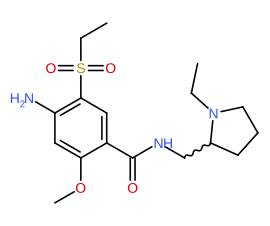 |
| Molecular structure drawn from PubChem coordinates |
| Physical properties [] | |
|---|---|
| Molecular mass | 369.50 g/mol [1] |
| Melting point | 126-127 [1] |
| Solubility | Insoluble [1] |
| Predicted LogP | 1.5 [1] |
| Structural Identifiers [] | |
|---|---|
| Molecular formula | C17H27N3O4S |
| IUPAC name | 4-amino-N-[(1-ethylpyrrolidin-2-yl)methyl]-5-ethylsulfonyl-2-methoxybenzamide |
| SMILES | CCN1CCCC1CNC(=O)C2=CC(=C(C=C2OC)N)S(=O)(=O)CC |
| InChI | InChI=1S/C17H27N3O4S/c1-4-20-8-6-7-12(20)11-19-17(21)13-9-16(25(22,23)5-2)14(18)10-15(13)24-3/h9-10,12H,4-8,11,18H2,1-3H3,(H,19,21) |
| InChIKey | NTJOBXMMWNYJFB-UHFFFAOYSA-N |
| CAS number | 71675-85-9 |
| UNII | 8110R61I4U |
| PubChem CID | 2159 |
| Pharmacokinetics[] | |
|---|---|
| Elimination half-life | 12 hours |
| Metabolism | Liver (minimal; most excreted unchanged) |
| Excretion | Kidney (23–46%), Faecal[3][4] |
| Routes of administration | By mouth, intravenous |
Amisulpride (also known as Aminosultopride, Solian, Amisulprida, Deniban, Amisulpridum, 4-Amino-N-[(1-ethyl-2-pyrrolidinyl)methyl]-5-(ethylsulfonyl)-2-methoxybenzamide, Sulamid, 4-Amino-N-((1-ethyl-2-pyrrolidinyl)methyl)-5-(ethylsulfonyl)-o-anisamide, 4-Amino-N-((1-ethyl-2-pyrrolidinyl)methyl)-5-(ethylsulfonyl)-2-methoxybenzamide or 4-amino-5-(ethanesulfonyl)-N-[(1-ethylpyrrolidin-2-yl)methyl]-2-methoxybenzamide and brand names including Socian, Barhemsys) is a antipsychotic and opioid substance of the benzamide and benzylamine class.
Chemistry
Stereochemistry []
Amisulpride is a racemic mixture of the enantiomers (optical activity ( + / - )).
Druglikeness
Lipinski's rule of five
Amisulpride matches Lipinski's rule of five.Pharmacology
ATC Classification
- nervous system (N)
- psycholeptics (N05)
- antipsychotics (N05A)
- benzamides (N05AL)
- (N05AL05)
- amisulpride (N05AL05)
MeSH Classification
- antipsychotic agents (M0021770)
- dopamine antagonists (M0027734)
- antidepressive agents, second-generation (M0028000)
Mechanism of action []
Dopamine is an essential and critical neurotransmitter produced in the substantia nigra and ventral tegmental regions of the brain. Dopaminergic projection function in the nigrostriatal, mesolimbic, and mesocortical systems. Hyperactive dopamine transmission in the mesolimbic areas, or dopamine dysregulation in various major brain regions, is understood as the key driver of positive and negative symptoms of schizophrenia. Many antipsychotic agents act as D2 receptor antagonists, as with amisulpride. Amisulpride is a selective dopamine D2 and D3 receptor antagonist. It has high preferential activity towards dopamine receptors in the limbic system rather than the striatum, leading to a lower risk of extrapyramidal side effects than other atypical antipsychotic agents. At low doses, amisulpride reduces negative symptoms of schizophrenia by blocking pre-synaptic dopamine D2 and D3 receptors, increasing the levels of dopamine in the synaptic cleft and facilitating dopaminergic transmission. At higher doses, amisulpride blocks postsynaptic receptors, inhibiting dopaminergic hyperactivity: this explains the drug improving positive symptoms. Amisulpride also works as an antagonist at 5-HT<sub>7A</sub> receptors and 5-HT<sub>2A</sub> receptors, which may be related to its antidepressant effects. The chemoreceptor trigger zone (CTZ), also commonly known as the area postrema (AP), is an important brain region located within the dorsal surface of the medulla oblongata. CTZ is involved in emesis: it contains receptors, such as dopamine receptors, that are activated in response to emetic agents in the blood and relay information to the vomiting center, which is responsible for inducing the vomiting reflex. Amisulpride is an antiemetic agent that works to limit signals that promote nausea and vomiting. Amisulpride binds to D2 and D3 receptors in the CTZ, leading to reduced dopaminergic signalling into the vomiting center. [1]
Interactions []
Medical side effects []
84 side effects listed on drug labels in SIDER 4.1 (amisulpride).
- Extrapyramidal disorder
- Extrapyramidal symptoms
- Hypokinesia
- Akathisia
- Insomnia
- Anxiety
- Dyskinesia
- Movements involuntary
- Endocrine disorder
- Gastrointestinal disorder
- Muscle rigidity
- Muscle spasms
- Trismus
- Weight increased
- Agitation
- Dystonia
- Constipation
- Tremor
- Somnolence
- Headache
- Amenorrhoea
- Nausea
- Nervousness
- Tension
- Salivary hypersecretion
- Vomiting
- Dry mouth
- Galactorrhoea
- Depression
- Suicide attempt
- Weight decreased
- Abdominal pain
- Gastrointestinal pain
- Diarrhoea
- Asthenia
- Fatigue
- Hypotension
- Vaginal inflammation
- Vaginal infection
- Oculogyric crisis
- Aggression
- Cardiovascular disorder
- Hyperglycaemia
- Hypersensitivity
- Immune system disorder
- Bradycardia
- Tardive dyskinesia
- Dizziness
- Dyspepsia
- Hypertension
- Orthostatic hypotension
- Menstrual disorder
- Pruritus
- Skin disorder
- Unspecified disorder of skin and subcutaneous tissue
- Hyperhidrosis
- Agranulocytosis
- Angioedema
- Sudden death
- Cardiac arrest
- Cardiac disorder
- Leukopenia
- Nervous system disorder
- Central nervous system disorder
- Neuroleptic malignant syndrome
- Neutropenia
- Pregnancy
- Pulmonary embolism
- Torsade de pointes
- Urticaria
- Angiopathy
- Ventricular fibrillation
- Ventricular tachycardia
- Ventricular arrhythmia
- Deep vein thrombosis
- Drug withdrawal syndrome
- Embolism venous
- Mental disorder
- Gynaecomastia
- Breast pain
- Neuropathy peripheral
- Convulsion
- Malnutrition
- Erectile dysfunction
Indications
- Blunted affect
- Chronic schizophrenia
- Delusion
- Hallucination
- Schizophrenia
- Social withdrawal
Subjective effects []
| 0xea / Amisulpride [] | |
|---|---|
Routes:
| |
Experience reports
Legal status []
External links []
- Amisulpride (Wikipedia)
- Amisulpride (PubChem)
- Amisulpride (Wikidata)
- Amisulpride (DrugBank)
- Amisulpride (ChEMBL)
- Amisulpride (ChEBI)
- Amisulpride (Common Chemistry)
- Amisulpride (HMDB)
- Amisulpride (KEGG)
- Amisulpride (EPA DSSTox)
- Amisulpride (Effect Index)
- Amisulpride (UNII)
- Amisulpride (SIDER)
- Amisulpride (Erowid)
References []
National Center for Biotechnology Information. PubChem Compound Summary for CID 2159, Amisulpride. Accessed November 20, 2026. https://pubchem.ncbi.nlm.nih.gov/compound/2159
U.S. Food and Drug Administration; National Center for Advancing Translational Sciences. Amisulpride. UNII: 8110R61I4U. Global Substance Registration System. Accessed November 20, 2026. https://gsrs.ncats.nih.gov/ginas/app/beta/substances/8110R61I4U
Caccia S. Biotransformation of post-clozapine antipsychotics: pharmacological implications. Clinical Pharmacokinetics. May 2000; 38(5):393–414. PMID 10843459. https://doi.org/10.2165/00003088-200038050-00002
Noble S, Benfield P. Amisulpride: A Review of its Clinical Potential in Dysthymia. CNS Drugs. December 1999; 12(6):471–483. https://doi.org/10.2165/00023210-199912060-00005
RDC Nº 784 - Listas de Substâncias Entorpecentes, Psicotrópicas, Precursoras e Outras sob Controle Especial. Diário Oficial da União. 2023-03-31. https://www.in.gov.br/en/web/dou/-/resolucao-rdc-n-784-de-31-de-marco-de-2023-474904992
Amisulpride 100 mg Tablets - Summary of Product Characteristics (SmPC). (emc). 5 July 2019. https://www.medicines.org.uk/emc/product/2726/smpc
Data sources []
| Source | Status | Updated (UTC) |
|---|---|---|
| dosing | missing (no dosing statistics) | 2026-11-20 09:20:34 |
| drugspro | missing (no DrugsPRO reagent data) | 2026-11-20 09:20:30 |
| erowid | ok | 2026-11-20 09:20:32 |
| gsrs | ok | 2026-11-20 09:20:30 |
| hmdb | missing (hmdb.ca refused automated access to HMDB0015633) | 2026-11-20 09:20:30 |
| kegg | ok | 2026-11-20 09:20:31 |
| pubchem | ok | 2026-11-20 09:20:29 |
| missing (no r/tripreports posts mention it) | 2026-11-20 09:20:30 | |
| sider | ok | 2026-11-20 09:20:30 |
| structure | ok | 2026-11-20 09:20:30 |
| wikipedia | ok | 2026-11-20 09:20:30 |