Amlodipine
| Amlodipine | |
|---|---|
 |
| Salts [] | |
|---|---|
| Amlodipine besylate | |
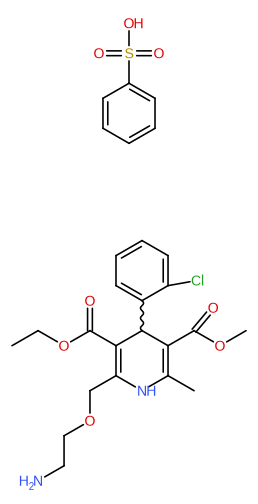 | |
| Amlodipine adipate | |
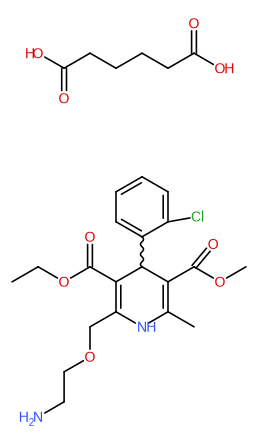 | |
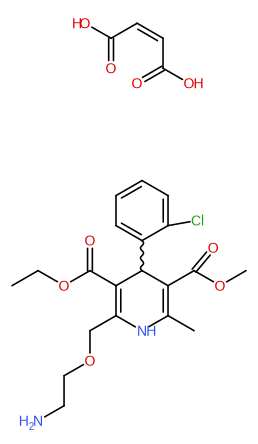
| Amlodipine maleate | |
 | |
| Amlodipine mesylate | |
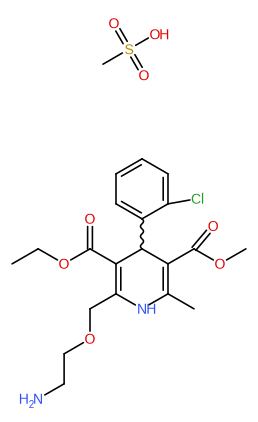 |
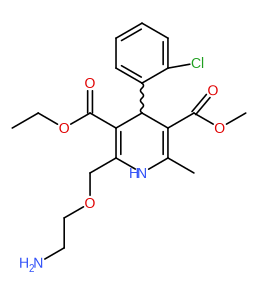
| Molecular structure drawn from PubChem coordinates |
| Physical properties [] | |
|---|---|
| Molecular mass | 408.90 g/mol [1] |
| Melting point | 199-201 [1] |
| Boiling point | 527.2 [1] |
| Decomposition | Hazardous decomposition products formed under fire conditions - Carbon oxides, nitrogen oxides (NOx), sulfur oxides, hydrogen chloride gas. /Amlodipine besylate/ [1] |
| Solubility | slightly soluble in water [1] |
| Predicted LogP | 3 [1] |
| Structural Identifiers [] | |
|---|---|
| Molecular formula | C20H25ClN2O5 |
| IUPAC name | 3-O-ethyl 5-O-methyl 2-(2-aminoethoxymethyl)-4-(2-chlorophenyl)-6-methyl-1,4-dihydropyridine-3,5-dicarboxylate |
| SMILES | CCOC(=O)C1=C(NC(=C(C1C2=CC=CC=C2Cl)C(=O)OC)C)COCCN |
| InChI | InChI=1S/C20H25ClN2O5/c1-4-28-20(25)18-15(11-27-10-9-22)23-12(2)16(19(24)26-3)17(18)13-7-5-6-8-14(13)21/h5-8,17,23H,4,9-11,22H2,1-3H3 |
| InChIKey | HTIQEAQVCYTUBX-UHFFFAOYSA-N |
| CAS number | 88150-42-9 |
| UNII | 1J444QC288 |
| PubChem CID | 2162 |
| Pharmacokinetics[] | |
|---|---|
| Onset | Highest availability 6–12 hours after oral dose |
| Elimination half-life | 30–50 hours |
| Duration of action | At least 24 hours |
| Metabolism | Liver |
| Excretion | Urine |
| Routes of administration | Oral |
Amlodipine (also known as Amlodipino, Amlodipinum, Amlodipine Free Base, amlodipina, Astudal 5, Hgp0904, Hgp-0904, Ckd-330 component amlodipine, Amlodipine Maleate (1:1) or C08ca01) is a substance of the carboxylic acid class.
Chemistry
Salts []
Stereochemistry []
Amlodipine is a racemic mixture of the enantiomers (optical activity ( + / - )).
Druglikeness
Lipinski's rule of five
Amlodipine matches Lipinski's rule of five.Pharmacology
ATC Classification
- cardiovascular system (C)
- calcium channel blockers (C08)
- selective calcium channel blockers with mainly vascular effects (C08C)
- dihydropyridine derivatives (C08CA)
- (C08CA01)
- amlodipine (C08CA01)
MeSH Classification
Mechanism of action []
**Mechanism of action on blood pressure** Amlodipine is considered a peripheral arterial vasodilator that exerts its action directly on vascular smooth muscle to lead to a reduction in peripheral vascular resistance, causing a decrease in blood pressure. Amlodipine is a dihydropyridine calcium antagonist (calcium ion antagonist or slow-channel blocker) that inhibits the influx of calcium ions into both vascular smooth muscle and cardiac muscle. Experimental studies imply that amlodipine binds to both _dihydropyridine_ and _nondihydropyridine_ binding sites, located on cell membranes. The contraction of cardiac muscle and vascular smooth muscle are dependent on the movement of extracellular calcium ions into these cells by specific ion channels. Amlodipine blocks calcium ion influx across cell membranes with selectivity. A stronger effect of amlodipine is exerted on vascular smooth muscle cells than on cardiac muscle cells. Direct actions of amlodipine on vascular smooth muscle result in reduced blood pressure. **Mechanism of action in angina** The exact mechanism by which amlodipine relieves the symptoms of angina have not been fully elucidated to this date, however, the mechanism of action is likely twofold: Amlodipine has a dilating effect on peripheral arterioles, reducing the total peripheral resistance (afterload) against which the cardiac muscle functions. Since the heart rate remains stable during amlodipine administration, the reduced work of the heart reduces both myocardial energy use and oxygen requirements. Dilatation of the main coronary arteries and coronary arterioles, both in healthy and ischemic areas, is another possible mechanism of amlodipine reduction of blood pressure. The dilatation causes an increase in myocardial oxygen delivery in patients experiencing coronary artery spasm (Prinzmetal's or variant angina) and reduces coronary vasoconstriction caused by smoking. [1]
Interactions []
Medical side effects []
147 side effects listed on drug labels in SIDER 4.1 (amlodipine).
- Headache
- Oedema
- Asthenia
- Fatigue
- Dizziness
- Syncope
- Nausea
- Abdominal pain
- Gastrointestinal pain
- Flushing
- Palpitations
- Somnolence
- Cholestasis
- Diabetes mellitus
- Gynaecomastia
- Cardiac failure congestive
- Hepatitis
- Jaundice
- Chronic obstructive pulmonary disease
- Bronchial hyperreactivity
- Peripheral vascular disorder
- Coronary artery disease
- Alopecia
- Amnesia
- Angioedema
- Decreased appetite
- Anxiety
- Arrhythmia
- Arthralgia
- Musculoskeletal discomfort
- Myalgia
- Ataxia
- Atrial fibrillation
- Back pain
- Mental disorder
- Coagulopathy
- Breast disorder
- Chest pain
- Conjunctivitis
- Connective tissue disorder
- Constipation
- Cough
- Dysphagia
- Depersonalisation
- Dermatitis
- Rash
- Diarrhoea
- Loose stools
- Diplopia
- Dysgeusia
- Dyspepsia
- Dyspnoea
- Dysuria
- Epistaxis
- Erythema multiforme
- Eye disorder
- Flatulence
- Gastritis
- Gastrointestinal disorder
- Gingival hyperplasia
- Cardiac disorder
- Haemorrhage
- Haemoglobin
- Hyperglycaemia
- Hypersensitivity
- Hypoaesthesia
- Orthostatic hypotension
- Immune system disorder
- Arthropathy
- Osteoarthritis
- Leukopenia
- Mediastinal disorder
- Muscle spasms
- Hypertonia
- Nervous system disorder
- Nervousness
- Tension
- Nocturia
- Pain
- Pancreatitis
- Paraesthesia
- Neuropathy peripheral
- Polyuria
- Urine output increased
- Pruritus
- Purpura
- Vascular purpura
- Rhinitis
- Shock
- Loss of consciousness
- Tachycardia
- Thirst
- Thrombocytopenia
- Tinnitus
- Tremor
- Pollakiuria
- Micturition disorder
- Urethral disorder
- Urinary tract disorder
- Urticaria
- Angiopathy
- Vasculitis
- Ventricular tachycardia
- Vertigo
- Vomiting
- Weight increased
- Weight decreased
- Xerophthalmia
- Dry mouth
- Agitation
- Apathy
- Flat affect
- Mood swings
- Affect lability
- Oedema peripheral
- Migraine
- Muscular weakness
- Eye pain
- Skin discolouration
- Dry skin
- Accommodation disorder
- Malnutrition
- Skin disorder
- Malaise
- Discomfort
- Feeling abnormal
- Ill-defined disorder
- Muscle twitching
- Increased appetite
- Abnormal dreams
- Rash erythematous
- Dizziness postural
- Peripheral ischaemia
- Cold sweat
- Erectile dysfunction
- Extrasystoles
- Rash maculo-papular
- Chills
- Bradycardia
- Visual impairment
- Abnormal vision
- Sexual dysfunction
- Menopausal symptoms
- Hot flush
- Hyperhidrosis
- Insomnia
- Parosmia
Indications
- Acute hypotension
- Angina pectoris
- Anginal attack
- Arteriospasm coronary
- Cardiac failure
- Cardiac failure congestive
- Chronic obstructive pulmonary disease
- Coronary artery disease
- Diabetes mellitus
- Electrocardiogram ST segment depression
- Hypertension
- Myocardial ischaemia
- Peripheral vascular disorder
- Prinzmetal angina
- Pulmonary oedema
- Stable angina pectoris
- Vascular resistance systemic
- Vasospasm
Subjective effects []
| 0xea / Amlodipine [] | |
|---|---|
Routes:
| |
Legal status []
See also []
External links []
References []
National Center for Biotechnology Information. PubChem Compound Summary for CID 2162, Amlodipine. Accessed November 24, 2026. https://pubchem.ncbi.nlm.nih.gov/compound/2162
U.S. Food and Drug Administration; National Center for Advancing Translational Sciences. Amlodipine. UNII: 1J444QC288. Global Substance Registration System. Accessed November 24, 2026. https://gsrs.ncats.nih.gov/ginas/app/beta/substances/1J444QC288
Poisons Standard June 2017. legislation.gov.au. 29 May 2017. https://www.legislation.gov.au/Details/F2017L00605
Norvasc Product and Consumer Medicine Information Licence. TGA eBS. https://www.ebs.tga.gov.au/ebs/picmi/picmirepository.nsf/pdf?OpenAgent&id=CP-2021-PI-01265-1
Norvasc product information. Health Canada. 25 April 2012. https://health-products.canada.ca/dpd-bdpp/info.do?lang=en&code=12938
Norliqva- amlodipine solution. DailyMed. 28 February 2022. https://dailymed.nlm.nih.gov/dailymed/drugInfo.cfm?setid=c1730a51-4383-4c61-a9a1-7e1326bd0abe
Amlodipine. List of nationally authorised medicinal products. https://www.ema.europa.eu/en/documents/psusa/amlodipine-list-nationally-authorised-medicinal-products-psusa/00000174/201703_en.pdf
Data sources []
| Source | Status | Updated (UTC) |
|---|---|---|
| dosing | missing (no dosing statistics) | 2026-11-20 10:13:59 |
| drugspro | missing (no DrugsPRO reagent data) | 2026-11-20 10:13:55 |
| erowid | missing (no Erowid substance of that name) | 2026-11-20 10:13:55 |
| gsrs | ok | 2026-11-20 10:13:59 |
| hmdb | missing (hmdb.ca refused automated access to HMDB0005018) | 2026-11-20 10:13:55 |
| kegg | ok | 2026-11-20 10:13:58 |
| pubchem | ok | 2026-11-20 10:13:53 |
| missing (no r/tripreports posts mention it) | 2026-11-20 10:13:55 | |
| sider | ok | 2026-11-20 10:13:55 |
| structure | ok | 2026-11-20 10:13:55 |
| wikipedia | ok | 2026-11-20 10:13:55 |