Amobarbital
| Amobarbital | |
|---|---|
 |
| Salts [] | |
|---|---|
| Sodium amobarbital | |
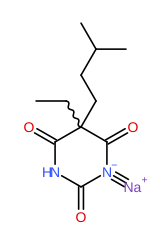 |
| Molecular structure drawn from PubChem coordinates |
| Physical properties [] | |
|---|---|
| Molecular mass | 226.27 g/mol [1] |
| Appearance | Crystals [1] |
| Odor | Odorless [1] |
| Taste | Slightly bitter [1] |
| Melting point | 313 to 316 °F (NTP, 1992) [1] |
| Decomposition | When heated to decomposition, it emits toxic fumes of /nitric oxides/. [1] |
| Solubility | less than 1 mg/mL at 65.3 °F (NTP, 1992) [1] |
| Predicted LogP | 2.1 [1] |
| Structural Identifiers [] | |
|---|---|
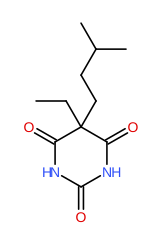
| Molecular formula | C11H18N2O3 |
| IUPAC name | 5-ethyl-5-(3-methylbutyl)-1,3-diazinane-2,4,6-trione |
| SMILES | CCC1(C(=O)NC(=O)NC1=O)CCC(C)C |
| InChI | InChI=1S/C11H18N2O3/c1-4-11(6-5-7(2)3)8(14)12-10(16)13-9(11)15/h7H,4-6H2,1-3H3,(H2,12,13,14,15,16) |
| InChIKey | VIROVYVQCGLCII-UHFFFAOYSA-N |
| CAS number | 57-43-2 |
| UNII | GWH6IJ239E |
| PubChem CID | 2164 |
| Pharmacokinetics[] | |
|---|---|
| Elimination half-life | 8–42 hours |
| Metabolism | Hepatic |
| Excretion | Renal |
| Routes of administration | By mouth, intramuscular, intravenous, rectal |
| Toxicity [] | |
|---|---|
| LD50 | Mouse: - oral: 345 mg/kg Rat: - oral: 250 mg/kg - ip: 115 mg/kg /Amobarbital - sc: 190 mg/kg [1] |
Amobarbital (also known as Amylobarbitone, Isomytal, Amylobarbital, Barbamil, Barbamyl, Amytal, Amobarbitone, Amylbarbitone, Barbamyl acid or Pentymalum) is a substance of the barbiturate class.
Chemistry
Salts []
Stereochemistry []
Amobarbital is achiral.
Druglikeness
Lipinski's rule of five
Amobarbital matches Lipinski's rule of five.Pharmacology
ATC Classification
- nervous system (N)
- psycholeptics (N05)
- hypnotics and sedatives (N05C)
- barbiturates, plain (N05CA)
- amobarbital (N05CA02)
MeSH Classification
Mechanism of action []
Amobarbital (like all barbiturates) works by binding to the GABAA receptor at either the alpha or the beta sub unit. These are binding sites that are distinct from GABA itself and also distinct from the benzodiazepine binding site. Like benzodiazepines, barbiturates potentiate the effect of GABA at this receptor. This GABAA receptor binding decreases input resistance, depresses burst and tonic firing, especially in ventrobasal and intralaminar neurons, while at the same time increasing burst duration and mean conductance at individual chloride channels; this increases both the amplitude and decay time of inhibitory postsynaptic currents. In addition to this GABA-ergic effect, barbiturates also block the AMPA receptor, a subtype of glutamate receptor. Glutamate is the principal excitatory neurotransmitter in the mammalian CNS. Amobarbital also appears to bind neuronal nicotinic acetylcholine receptors. [1]
Interactions []
Interaction mechanisms documented in KEGG DRUG (number of interacting drugs):
| CYP3A | induction | 41 (1 contraindicated) |
|---|---|---|
| GABRA1 | shared target | 33 |
| GABRA2 | shared target | 33 |
| GABRA3 | shared target | 33 |
| GABRA4 | shared target | 33 |
| GABRA5 | shared target | 33 |
| GABRA6 | shared target | 33 |
| GABRB1 | shared target | 33 |
| GABRB2 | shared target | 33 |
| GABRB3 | shared target | 33 |
| GABRD | shared target | 33 |
| GABRE | shared target | 33 |
| GABRG1 | shared target | 33 |
| GABRG2 | shared target | 33 |
| GABRG3 | shared target | 33 |
| GABRP | shared target | 33 |
| GABRQ | shared target | 33 |
Medical side effects []
40 side effects listed on drug labels in SIDER 4.1 (amobarbital).
- Anaemia megaloblastic
- Angioedema
- Anxiety
- Apnoea
- Ataxia
- Atelectasis
- Pneumothorax
- Confusional state
- Feeling abnormal
- Constipation
- Dermatitis exfoliative
- Dizziness
- Syncope
- Dermatitis
- Rash
- Body temperature increased
- Hallucination
- Headache
- Hypersensitivity
- Hypotension
- Nausea
- Nervousness
- Tension
- Nightmare
- Shock
- Loss of consciousness
- Vomiting
- Agitation
- Hyperkinesia
- Depressed level of consciousness
- Injection site reaction
- Hepatocellular injury
- Liver injury
- Thinking abnormal
- Mental disability
- Bradycardia
- Somnolence
- Hypoxia
- Respiratory failure
- Hypoventilation
Indications
- Insomnia
Legal status []
- Brazil: Amobarbital is a B1.[3]
- Canada: Amobarbital is a Schedule IV.
- Germany: Amobarbital is a Anlage III under the "Betäubungsmittelgesetz (BtMG)".
- United States: Amobarbital is a Schedule II / Schedule III under the "Controlled Substances Act".
- United Kingdom: Amobarbital is a Class B under the "Misuse of Drugs Act 1971".
- United Nations: Amobarbital is a Schedule III psychotropic under the "Convention on Psychotropic Substances 1971".
- Other: Amobarbital is a SE: Förteckning IV.
See also []
External links []
References []
National Center for Biotechnology Information. PubChem Compound Summary for CID 2164, Amobarbital. Accessed November 21, 2026. https://pubchem.ncbi.nlm.nih.gov/compound/2164
U.S. Food and Drug Administration; National Center for Advancing Translational Sciences. Amobarbital. UNII: GWH6IJ239E. Global Substance Registration System. Accessed November 21, 2026. https://gsrs.ncats.nih.gov/ginas/app/beta/substances/GWH6IJ239E
RDC Nº 784 - Listas de Substâncias Entorpecentes, Psicotrópicas, Precursoras e Outras sob Controle Especial. Diário Oficial da União. 2023-03-31. https://www.in.gov.br/en/web/dou/-/resolucao-rdc-n-784-de-31-de-marco-de-2023-474904992
Data sources []
| Source | Status | Updated (UTC) |
|---|---|---|
| dosing | missing (no dosing statistics) | 2026-11-20 18:01:25 |
| drugspro | missing (no DrugsPRO reagent data) | 2026-11-20 18:01:21 |
| erowid | missing (no Erowid substance of that name) | 2026-11-20 18:01:21 |
| gsrs | ok | 2026-11-20 18:01:22 |
| hmdb | missing (hmdb.ca refused automated access to HMDB0015440) | 2026-11-20 18:01:21 |
| kegg | ok | 2026-11-20 18:01:23 |
| pubchem | ok | 2026-11-20 18:01:21 |
| missing (no r/tripreports posts mention it) | 2026-11-20 18:01:21 | |
| sider | ok | 2026-11-20 18:01:21 |
| structure | ok | 2026-11-20 18:01:21 |
| wikipedia | ok | 2026-11-20 18:01:21 |