Anethole trithione
| Anethole trithione | |
|---|---|
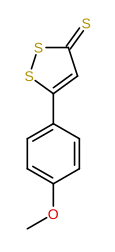 |
| Molecular structure drawn from PubChem coordinates |
| Physical properties [] | |
|---|---|
| Molecular mass | 240.40 g/mol [1] |
| Predicted LogP | 2.8 [1] |
| Structural Identifiers [] | |
|---|---|
| Molecular formula | C10H8OS3 |
| IUPAC name | 5-(4-methoxyphenyl)dithiole-3-thione |
| SMILES | COC1=CC=C(C=C1)C2=CC(=S)SS2 |
| InChI | InChI=1S/C10H8OS3/c1-11-8-4-2-7(3-5-8)9-6-10(12)14-13-9/h2-6H,1H3 |
| InChIKey | KYLIZBIRMBGUOP-UHFFFAOYSA-N |
| CAS number | 532-11-6 |
| UNII | QUY32964DJ |
| PubChem CID | 2194 |
Anethole trithione (also known as anetholtrithion, Sulfralem, Anetholetrithione, 3-(p-Methoxyphenyl)trithione, 5-(p-Methoxyphenyl)-3H-1,2-dithiole-3-thione, Sufralem, Op2113, Op-2113, anethole dithiolthione or 3-(p-anisyl)trithione) is a substance of the phenol class.
Chemistry
Stereochemistry []
Anethole trithione is achiral.
Druglikeness
Lipinski's rule of five
Anethole trithione matches Lipinski's rule of five.Pharmacology
ATC Classification
- alimentary tract and metabolism (A)
- other alimentary tract and metabolism products (A16)
- other alimentary tract and metabolism products (A16A)
- various alimentary tract and metabolism products (A16AX)
- (A16AX02)
- anethole trithione (A16AX02)
Mechanism of action []
Epidemiological studies demonstrate that the prevalence of xerostomia and salivary gland hypofunction (SGH) rises with age, and is largely associated with medications and health. In particular, anethole trithione (ATT) is believed to cause an increase in salivary secretion by upregulating the number of muscarinic receptor (whose stimulation is known to increase salivary secretion) sites on the salivary acinar cells. Moreover, the combination use of ATT and pilocarpine is also thought to be effective in a synergistic manner - as ATT increases the number of cell surface receptors on salivary acinar cells, the pilocarpine, which is a parasympathetic agent, stimulates the newly formed receptors. In addition, studies have also shown that the administration of ATT can also enhance the upregulation and release of substance P and alpha-calcitonin gene-related peptide. As receptors for peptides like alpha-calcitonin gene-related peptide are found throughout the body, the increase in these such proteins may modulate a variety of physiological functions in various body systems, even in the gastrointestinal or salivary actions. Regardless, it has been shown that the use of ATT in patients can cause an increase in salivary flow rate in patients with xerostomia caused by senile hypofunction, medication side effects, and oral cancer therapy and has been indicated for use in treating xerostomia associated with conditions like Sjogren's syndrome. Nevertheless, there exist also studies that suggest ATT is generally only effective in managing the symptoms of mild salivary gland hypofunction but is not particularly useful for treating severe salivary gland hypofunction or severe cases of Sjogren's syndrome. ATT is also used as an adjunctive therapy for cholecystitis, gallstone, indigestion, and acute/chronic hepatitis in certain countries like France, Germany, and China. With regards to this particular indication, it is believed that ATT can facilitate raises in the level of glutathione in the liver, and raises in the activity of glutamylcysteine synthetase, glutathione reductase, and glutathione S transferase. All of these effects are consequently intimately involved in the cellular antioxidant activity of glutathione where glutamylcysteine synthetase is the first enzyme involved in the cellular glutathione biosynthesis pathway; where glutathione reductase is necessary for catalyzing the reduction of pathway intermediates to glutathione; and glutathione S transferase catalyze the conjugation of the reduced form of glutathione to xenobiotic substrates for the purpose of detoxification. Finally, glutathione itself is an important antioxidant found in plants, animals, fungi, and some bacteria where it assists in preventing damage to cellular components caused by reactive oxygen species, free radicals, etc. Taken altogether, these various actions are suitable for treating cholecystitis, gall stones, indigestion, and may be used in the assisting treatment of acute and chronic hepatosis. Although the specific mechanism of action for which ATT is seemingly capable of inhibiting tumorigenesis to a certain degree remains to be elucidated, some potential plausible mechanisms have been discussed. One such potential mechanism suggests that ATT has the capability to alter the metabolism of carcinogens by increasing the rate of detoxification of carcinogens in target organs like the liver and colon, thereby decreasing the generation of carcinogen metabolites and reducing parent-carcinogen induced carcinogenesis by way of those agents. And finally, a second potential mechanism proposes that ATT can strikingly increase the antioxidant activities of colonic and liver GST, NAD(P)H:QR, and UDP-GT, therefore eliciting a chemoprotective action. [1]
See also []
External links []
- Anethole trithione (Wikipedia)
- Anethole trithione (PubChem)
- Anethole trithione (Wikidata)
- Anethole trithione (DrugBank)
- Anethole trithione (ChEMBL)
- Anethole trithione (ChEBI)
- Anethole trithione (Common Chemistry)
- Anethole trithione (HMDB)
- Anethole trithione (KEGG)
- Anethole trithione (EPA DSSTox)
- Anethole trithione (Effect Index)
- Anethole trithione (UNII)
References []
National Center for Biotechnology Information. PubChem Compound Summary for CID 2194, Anethole trithione. Accessed November 21, 2026. https://pubchem.ncbi.nlm.nih.gov/compound/2194
U.S. Food and Drug Administration; National Center for Advancing Translational Sciences. Anethole trithione. UNII: QUY32964DJ. Global Substance Registration System. Accessed November 21, 2026. https://gsrs.ncats.nih.gov/ginas/app/beta/substances/QUY32964DJ
Data sources []
| Source | Status | Updated (UTC) |
|---|---|---|
| dosing | missing (no dosing statistics) | 2026-11-20 20:02:00 |
| drugspro | missing (no DrugsPRO reagent data) | 2026-11-20 20:01:56 |
| erowid | missing (no Erowid substance of that name) | 2026-11-20 20:01:56 |
| gsrs | ok | 2026-11-20 20:01:56 |
| hmdb | missing (hmdb.ca refused automated access to HMDB0248420) | 2026-11-20 20:01:56 |
| kegg | ok | 2026-11-20 20:01:58 |
| pubchem | ok | 2026-11-20 20:01:55 |
| missing (no r/tripreports posts mention it) | 2026-11-20 20:01:56 | |
| sider | missing (not in SIDER) | 2026-11-20 20:01:56 |
| structure | ok | 2026-11-20 20:01:56 |
| wikipedia | ok | 2026-11-20 20:01:56 |