Arbutamine
| Arbutamine | |
|---|---|
 |
| Salts [] | |
|---|---|
| Arbutamine hydrochloride | |
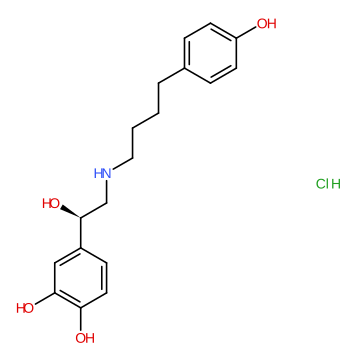 |
| Molecular structure drawn from PubChem coordinates |
| Physical properties [] | |
|---|---|
| Molecular mass | 317.40 g/mol [1] |
| Solubility | 8.42e-02 g/L [1] |
| Predicted LogP | 0.9 [1] |
| Structural Identifiers [] | |
|---|---|
| Molecular formula | C18H23NO4 |
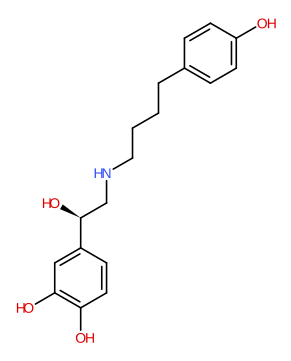
| IUPAC name | 4-[(1R)-1-hydroxy-2-[4-(4-hydroxyphenyl)butylamino]ethyl]benzene-1,2-diol |
| SMILES | C1=CC(=CC=C1CCCCNC[C@@H](C2=CC(=C(C=C2)O)O)O)O |
| InChI | InChI=1S/C18H23NO4/c20-15-7-4-13(5-8-15)3-1-2-10-19-12-18(23)14-6-9-16(21)17(22)11-14/h4-9,11,18-23H,1-3,10,12H2/t18-/m0/s1 |
| InChIKey | IIRWWTKISYTTBL-SFHVURJKSA-N |
| CAS number | 128470-16-6 |
| UNII | B07L15YAEV |
| PubChem CID | 60789 |
Arbutamine (also known as Arbutamina, Arbutaminum, 4-[(1R)-1-hydroxy-2-{[4-(4-hydroxyphenyl)butyl]amino}ethyl]benzene-1,2-diol, 4-((1R)-1-hydroxy-2-((4-(4-hydroxyphenyl)butyl)amino)ethyl)benzene-1,2-diol, (-)-Arbutamine, C01ca22, 1,2-Benzenediol, 4-[(1R)-1-hydroxy-2-[[4-(4-hydroxyphenyl)butyl]amino]ethyl]-, orb1710395, Ebc-26772 or Ms-24685) is a sympathomimetic substance of the catecholamine and phenylethanolamine class.
Chemistry
Salts []
Stereochemistry []
Arbutamine is a single defined stereoisomer.
Druglikeness
Lipinski's rule of five
Arbutamine matches Lipinski's rule of five.Pharmacology
ATC Classification
- cardiovascular system (C)
- cardiac therapy (C01)
- cardiac stimulants excl. cardiac glycosides (C01C)
- adrenergic and dopaminergic agents (C01CA)
- arbutamine (C01CA22)
MeSH Classification
Mechanism of action []
Arbutamine is a synthetic catecholamine with positive chronotropic and inotropic properties. The chronotropic (increase in heart rate) and inotropic (increase in force of contraction) effects of arbutamine serve to mimic exercise by increasing cardiac work (producing stress) and provoke myocardial ischemia in patients with compromised coronary arteries. The increase in heart rate caused by arbutamine is thought to limit regional subendocardial perfusion, thereby limiting tissue oxygenation. In functional assays, arbutamine is more selective for beta-adrenergic receptors than for alpha-adrenergic receptors. The beta-agonist activity of arbutamine provides cardiac stress by increasing heart rate, cardiac contractility, and systolic blood pressure. The degree of hypotension that occurs for a given chronotropic activity is less with arbutamine than, for example, with isoproterenol because alpha receptor activity is retained. [1]
Subjective effects []
External links []
References []
National Center for Biotechnology Information. PubChem Compound Summary for CID 60789, Arbutamine. Accessed November 20, 2026. https://pubchem.ncbi.nlm.nih.gov/compound/60789
U.S. Food and Drug Administration; National Center for Advancing Translational Sciences. Arbutamine. UNII: B07L15YAEV. Global Substance Registration System. Accessed November 20, 2026. https://gsrs.ncats.nih.gov/ginas/app/beta/substances/B07L15YAEV
Data sources []
| Source | Status | Updated (UTC) |
|---|---|---|
| dosing | missing (no dosing statistics) | 2026-11-20 09:00:11 |
| drugspro | missing (no DrugsPRO reagent data) | 2026-11-20 09:00:07 |
| erowid | missing (no Erowid substance of that name) | 2026-11-20 09:00:07 |
| gsrs | ok | 2026-11-20 09:00:08 |
| hmdb | missing (hmdb.ca refused automated access to HMDB0015234) | 2026-11-20 09:00:07 |
| kegg | missing (no KEGG DRUG entry) | 2026-11-20 09:00:09 |
| pubchem | ok | 2026-11-20 09:00:07 |
| missing (no r/tripreports posts mention it) | 2026-11-20 09:00:07 | |
| sider | missing (not in SIDER) | 2026-11-20 09:00:07 |
| structure | ok | 2026-11-20 09:00:07 |
| wikipedia | ok | 2026-11-20 09:00:07 |