Atropine
| Atropine | |
|---|---|
 |
| Salts [] | |
|---|---|
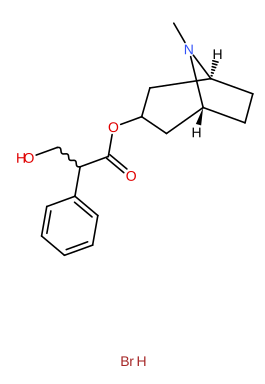
| Atropine hydrobromide | |
 | |
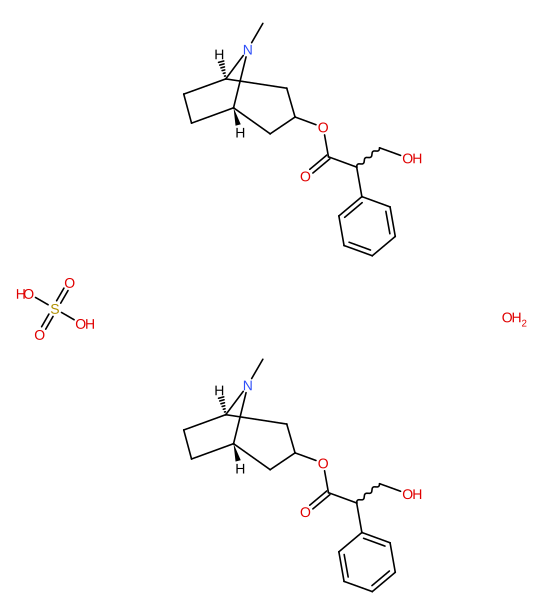
| Atropine hemisulfate | |
 | |
| Atropine tartrate | |
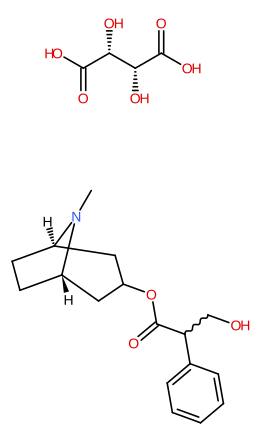 | |
| Atropine hydrochloride | |
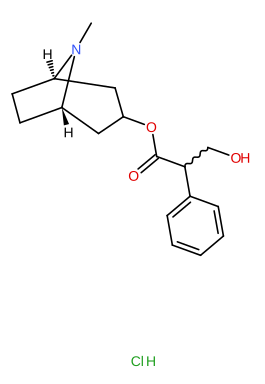 |
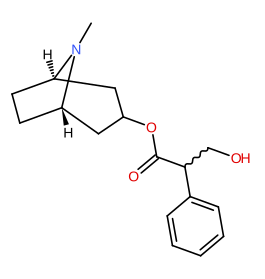
| Molecular structure drawn from PubChem coordinates |
| Physical properties [] | |
|---|---|
| Molecular mass | 289.40 g/mol [1] |
| Melting point | 118.5 °C [1] |
| Solubility | 2200 mg/L (at 25 °C) [1] |
| Predicted LogP | 1.8 [1] |
| Structural Identifiers [] | |
|---|---|
| Molecular formula | C17H23NO3 |
| IUPAC name | [(1S,5R)-8-methyl-8-azabicyclo[3.2.1]octan-3-yl] 3-hydroxy-2-phenylpropanoate |
| SMILES | CN1[C@@H]2CC[C@H]1CC(C2)OC(=O)C(CO)C3=CC=CC=C3 |
| InChI | InChI=1S/C17H23NO3/c1-18-13-7-8-14(18)10-15(9-13)21-17(20)16(11-19)12-5-3-2-4-6-12/h2-6,13-16,19H,7-11H2,1H3/t13-,14+,15?,16? |
| InChIKey | RKUNBYITZUJHSG-PJPHBNEVSA-N |
| CAS number | 51-55-8 |
| UNII | 7C0697DR9I |
| PubChem CID | 174174 |
| Pharmacokinetics[] | |
|---|---|
| Onset | c. 1 minute |
| Elimination half-life | 2 hours |
| Duration of action | 30–60 min |
| Metabolism | ≥50% hydrolysed to tropine and tropic acid |
| Excretion | 15–50% excreted unchanged in urine |
| Routes of administration | By mouth, intravenous, intramuscular, rectal, ophthalmic |
Atropine (also known as dl-Hyoscyamine, Atropen, Atropin, Tropine tropate, dl-Tropyltropate, Atropinol, Eyesules, Isopto-atropine, Troyl tropate or Atropina) is a anticholinergic substance.
Chemistry
Salts []
Stereochemistry []
Atropine is a racemic mixture of the enantiomers (optical activity ( + / - )).
Druglikeness
Lipinski's rule of five
Atropine matches Lipinski's rule of five.Reagents
There are currently 1 reagent-interactions on DrugsPRO
| Reagent | Color change | Description |
|---|---|---|
| Liebermann | orange / red (?) |
Pharmacology
ATC Classification
- (A03BA01)
Mechanism of action []
Atropine binds to and inhibits muscarinic acetylcholine receptors, competitively blocking the effects of acetylcholine and other choline esters. It acts as a reversible non-specific antagonist of muscarinic receptors, showing affinity for the M1, M2, M3, M4 and M5 receptor subtypes. Atropine antagonizes the effects of acetylcholine on tissues innervated by postganglionic cholinergic nerves, such as smooth muscle, cardiac tissue, exocrine glands and the central nervous system. Also, it acts in less innervated smooth muscle that responds to endogenous acetylcholine. The actions of atropine can be overcome by increasing the concentration of acetylcholine at receptor sites (for instance, the use of anticholinesterase agents that inhibit the hydrolysis of acetylcholine). [1]
Interactions []
Medical side effects []
184 side effects listed on drug labels in SIDER 4.1 (atropine).
- Mydriasis
- Tachycardia
- Flushing
- Vision blurred
- Abdominal distension
- Bloated feeling
- Arrhythmia
- Asthenia
- Fatigue
- Confusional state
- Feeling abnormal
- Dysphagia
- Dermatitis
- Rash
- Dizziness
- Syncope
- Somnolence
- Oedema
- Body temperature increased
- Angle closure glaucoma
- Acute angle-closure glaucoma
- Hallucination
- Hyperaemia
- Hypotension
- Swelling
- Thirst
- Excessive thirst
- Conjunctivitis
- Blepharoconjunctivitis
- Conjunctivitis papillary
- Clumsiness
- Dysarthria
- Intraocular pressure increased
- Respiratory depression
- Pulmonary function test decreased
- Heart rate irregular
- Balance disorder
- Abdominal pain
- Gastrointestinal pain
- Amnesia
- Short-term memory loss
- Anaphylactic shock
- Angina pectoris
- Angioedema
- Anhidrosis
- Anxiety
- Ataxia
- Atrial fibrillation
- Atrioventricular dissociation
- Mental disorder
- Blepharitis
- Chest pain
- Retrosternal pain
- Clonus
- Coma
- Conjunctivitis allergic
- Constipation
- Cyanosis
- Dehydration
- Delirium
- Depression
- Dermatitis contact
- Diarrhoea
- Osteoarthritis
- Eczema
- Gastrooesophageal reflux disease
- Headache
- Cardiac arrest
- Dyspepsia
- Blood disorder
- Hyperglycaemia
- Hypersensitivity
- Hypoglycaemia
- Hypokalaemia
- Hyponatraemia
- Irritability
- Keratitis
- Dry eye
- Laryngospasm
- Laryngitis
- Left ventricular failure
- Pulmonary oedema
- Lethargy
- Leukocytosis
- Hypertonia
- Myocardial infarction
- Acute coronary syndrome
- Myopia
- Nasal congestion
- Nausea
- Nervousness
- Tension
- Palpitations
- Ileus paralytic
- Petechiae
- Supraventricular extrasystoles
- Pruritus
- Extensor plantar response
- Convulsion
- Shock
- Strabismus
- Cyclophoria
- Hyperhidrosis
- Cardiac syncope
- Loss of consciousness
- Supraventricular tachycardia
- Sinus tachycardia
- Urticaria
- Ventricular fibrillation
- Ventricular tachycardia
- Vertigo
- Vomiting
- Dry mouth
- Urinary retention
- Arrhythmia supraventricular
- Ventricular arrhythmia
- Stupor
- Depressed level of consciousness
- Agitation
- Excitement
- Hyperkinesia
- Photophobia
- Oral disorder
- Blood urea increased
- Ventricular extrasystoles
- Injection site reaction
- Eye pain
- Electrocardiogram QT prolonged
- Hyperreflexia
- Dry skin
- Hot dry skin
- Urinary hesitation
- Ventricular flutter
- Haemoglobin decreased
- Scab
- Rash macular
- Temperature intolerance
- Muscle twitching
- Tachypnoea
- Nasal dryness
- Nodal rhythm
- Gastrointestinal sounds abnormal
- Disorientation
- Speech disorder
- Cerebellar syndrome
- Visual acuity reduced
- Rash erythematous
- Erythema
- Skin warm
- Accommodation disorder
- Cycloplegia
- Lacrimation decreased
- Skin exfoliation
- Dysuria
- Strangury
- Erectile dysfunction
- Rash scarlatiniform
- Enuresis
- Mania
- Extrasystoles
- Hyperpyrexia
- Rash maculo-papular
- Labile blood pressure
- Bradycardia
- Electrocardiogram QRS complex
- Blindness
- Blood pressure increased
- Paralysis
- Haemoglobin increased
- Dyspnoea
- Hypohidrosis
- Pain
- Stridor
- Poisoning
- Impaired gastric emptying
- Dysgeusia
- Insomnia
- Respiratory failure
- Psychotic disorder
- Paranoia
- Rash papular
- Ageusia
- Feeling hot
- Loss of libido
Indications
- Abdominal colic
- Abdominal cramps
- Acute enterocolitis
- Acute myocardial infarction
- Angle closure glaucoma
- Arrhythmia
- Atrioventricular block
- Automatic bladder
- Biliary colic
- Block heart
- Bradycardia
- Common cold
- Conjunctivitis bacterial
- Cycloplegia
- Cystitis
- Diverticulitis
- Dysentery
- Dyspnoea
- Enterocolitis
- Eye infection
- Fasciculation
- Flushing
- Functional gastrointestinal disorder
- Hyperhidrosis
- Hypotension
- Infantile colic
- Intoxication
- Irritability
- Irritable bowel syndrome
- Lacrimation
- Muscarinic effects
- Muscle rigidity
- Muscle spasms
- Mydriasis
- Neurogenic bladder
- Neurogenic bowel
- Open angle glaucoma
- Pain
- Pancreatitis
- Paralysis
- Parkinsonism
- Peptic ulcer
- Pylorospasm
- Renal colic
- Salivary hypersecretion
- Salivation
- Sinus bradycardia
- Splenic flexure syndrome
- Tachycardia
- Tremor
- Unspecified disorder of intestine
- Wheezing
Experience reports
Legal status []
See also []
External links []
References []
National Center for Biotechnology Information. PubChem Compound Summary for CID 174174, Atropine. Accessed November 20, 2026. https://pubchem.ncbi.nlm.nih.gov/compound/174174
U.S. Food and Drug Administration; National Center for Advancing Translational Sciences. Atropine. UNII: 7C0697DR9I. Global Substance Registration System. Accessed November 20, 2026. https://gsrs.ncats.nih.gov/ginas/app/beta/substances/7C0697DR9I
AusPAR: Atropine sulfate monohydrate. Therapeutic Goods Administration (TGA). 31 May 2022. https://www.tga.gov.au/auspar/auspar-atropine-sulfate-monohydrate
Therapeutic Goods (Poisons Standard— June 2025) Instrument 2025. Therapeutic Goods Administration (TGA). May 2025. https://www.legislation.gov.au/F2025L00599/asmade/2025-05-28/text/original/pdf
Atropine- atropine sulfate solution/ drops. DailyMed. 22 February 2022. https://dailymed.nlm.nih.gov/dailymed/drugInfo.cfm?setid=127a7e32-a150-01d6-a66a-b7708d85809f
Data sources []
| Source | Status | Updated (UTC) |
|---|---|---|
| dosing | missing (no dosing statistics) | 2026-11-20 14:02:10 |
| drugspro | ok | 2026-11-20 14:02:06 |
| erowid | ok | 2026-11-20 14:02:08 |
| gsrs | ok | 2026-11-20 14:02:09 |
| hmdb | missing (no HMDB id) | 2026-11-20 14:02:06 |
| kegg | ok | 2026-11-20 14:02:09 |
| pubchem | ok | 2026-11-20 14:02:04 |
| ok | 2026-11-20 14:02:06 | |
| sider | ok | 2026-11-20 14:02:06 |
| structure | ok | 2026-11-20 14:02:06 |
| wikipedia | ok | 2026-11-20 14:02:06 |