Benzydamine
| Benzydamine | |
|---|---|
 |
| Salts [] | |
|---|---|
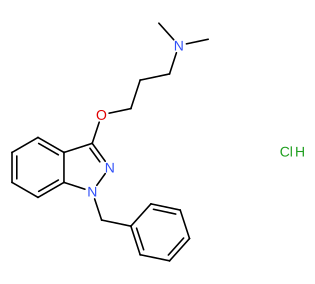
| Benzydamine hydrochloride | |
 | |
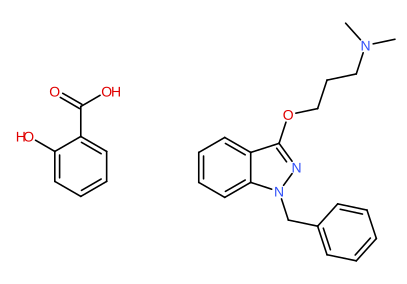
| Benzydamine salicylate | |
 |
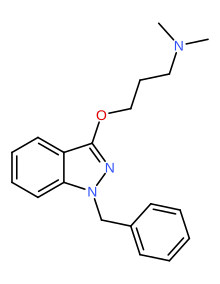
| Molecular structure drawn from PubChem coordinates |
| Physical properties [] | |
|---|---|
| Molecular mass | 309.40 g/mol [1] |
| Melting point | 320°F [1] |
| Solubility | Miscible [1] |
| Predicted LogP | 3.9 [1] |
| Structural Identifiers [] | |
|---|---|
| Molecular formula | C19H23N3O |
| IUPAC name | 3-(1-benzylindazol-3-yl)oxy-N,N-dimethylpropan-1-amine |
| SMILES | CN(C)CCCOC1=NN(C2=CC=CC=C21)CC3=CC=CC=C3 |
| InChI | InChI=1S/C19H23N3O/c1-21(2)13-8-14-23-19-17-11-6-7-12-18(17)22(20-19)15-16-9-4-3-5-10-16/h3-7,9-12H,8,13-15H2,1-2H3 |
| InChIKey | CNBGNNVCVSKAQZ-UHFFFAOYSA-N |
| CAS number | 642-72-8 |
| UNII | 4O21U048EF |
| PubChem CID | 12555 |
| Pharmacokinetics[] | |
|---|---|
| Elimination half-life | 13 hours |
| Excretion | Kidney |
| Routes of administration | Oral, topical |
Benzydamine (also known as Benzidamine, Benzindamine, Bencidamina, Benzydaminum, Benzidamina, Apo-Benzydamine, 1-Benzyl-3-(3-(dimethylamino)propoxy)-1H-indazole, 1-Benzyl-3-[3-(dimethylamino)propoxy]-1H-indazole, {3-[(1-benzyl-1H-indazol-3-yl)oxy]propyl}dimethylamine or 1-Propanamine, N,N-dimethyl-3-((1-(phenylmethyl)-1H-indazol-3-yl)oxy)-) is a substance of the benzamide and benzylamine class.
Chemistry
Salts []
Stereochemistry []
Benzydamine is achiral.
Druglikeness
Lipinski's rule of five
Benzydamine matches Lipinski's rule of five.Pharmacology
ATC Classification
- alimentary tract and metabolism (A)
- stomatological preparations (A01)
- stomatological preparations (A01A)
- other agents for local oral treatment (A01AD)
- benzydamine (A01AD02)
- genito urinary system and sex hormones (G)
- other gynecologicals (G02)
- other gynecologicals (G02C)
- antiinflammatory products for vaginal administration (G02CC)
- benzydamine (G02CC03)
- musculo-skeletal system (M)
- antiinflammatory and antirheumatic products (M01)
- antiinflammatory and antirheumatic products, non-steroids (M01A)
- other antiinflammatory and antirheumatic agents, non-steroids (M01AX)
- benzydamine (M01AX07)
- topical products for joint and muscular pain (M02)
- topical products for joint and muscular pain (M02A)
- antiinflammatory preparations, non-steroids for topical use (M02AA)
- benzydamine (M02AA05)
- respiratory system (R)
- throat preparations (R02)
- throat preparations (R02A)
- other throat preparations (R02AX)
- benzydamine (R02AX03)
MeSH Classification
- anti-inflammatory agents (M0001333)
Mechanism of action []
Despite being categorized as a non-steroidal anti-inflammatory drug (NSAID), benzydamine demonstrates various mechanisms of action that differ from those of traditional aspirin-like NSAIDs. In particular, benzydamine predominantly acts by inhibiting the synthesis of pro inflammatory cytokines like tumour necrosis factor-alpha (TNF-α) and interleukin-1β (IL-1β) without largely affecting other pro inflammatory cytokines (ie. such as IL-6 and IL-8) or anti-inflammatory cytokines (ie. like IL-10 or IL-1 receptor antagonist). Moreover, benzydamine is largely a weak inhibitor of prostaglandin synthesis as it has been shown to effectively inhibit cyclooxygenase (COX) and lipoxygenase enzyme activity only at concentrations of 1mM or greater. Considering most contemporary usages of benzydamine are topical applications that are generally not well absorbed through the skin and/or non-specialized mucosae, benzydamine does not often achieve the kind of absorption or blood concentrations necessary to cause any extraneous distant systemic effects or COX inhibition, allowing it to localize its action. Additionally, it is also hypothesized that benzydamine is capable of inhibiting the oxidative burst of neutrophils and membrane stabilization. These actions are exhibited by the substance’s ability to inhibit the release of granules from neutrophils and to stabilize lysosomes. Furthermore, benzydamine is capable of a local anaesthetic effect that may be related to its capability for inhibiting the release of inflammatory mediators like substance P and calcitonin gene related peptide from sensory nerve endings. Since substance P is capable of causing the release of histamine from mast cells, benzydamine’s prevention of substance P release further contributes to an anti-inflammatory effect. Benzydamine also demonstrates a non-specific antibacterial activity against various bacterial strains that are resistant to broad-spectrum antibiotics such as ampicillin, chloramphenicol, and tetracycline at concentrations of about 3 mmol/L. Combinatorial use of benzydamine and other antibiotics like tetracycline and chloramphenicol are also synergistic against antibiotic resistant strains of *Staphylococcus aureus* and *Pseudomonas aeruginosa*. [1]
Interactions []
Medical side effects []
10 side effects listed on drug labels in SIDER 4.1 (benzydamine).
- Hypoaesthesia
- Sensory loss
- Pain
- Vomiting
- Cough
- Somnolence
- Headache
- Nausea
- Thirst
- Throat irritation
Indications
- Pain
- Pharyngeal mucositis
- Throat sore
Experience reports
Erowid
There are currently 10 experience reports involving benzydamine on Erowid: []- "Benzydamine in-Depth Review" by kkpm6fhf8f
- "Beyond All Expectations" by Erakh
- "Paranoid and Confused" by Semo
- "I See the Most Vivid Hallucinations" by nickop01
- "The Most Poetic Drug" by hoffmann
- "Benzydamine Day, Benzydamine Night." by Szymon Rostkowski
- "Salty, Trippy, Buzzy, Numb" by Trance
- "The Deliriants Enthusiast" by LifelongPsychonaut
- "Tracers in the Dark" by c9
- "Peering Into Hell" by nickop01
Legal status []
See also []
External links []
- Benzydamine (Wikipedia)
- Benzydamine (PubChem)
- Benzydamine (Wikidata)
- Benzydamine (DrugBank)
- Benzydamine (ChEMBL)
- Benzydamine (ChEBI)
- Benzydamine (Common Chemistry)
- Benzydamine (HMDB)
- Benzydamine (KEGG)
- Benzydamine (EPA DSSTox)
- Benzydamine (Effect Index)
- Benzydamine (UNII)
- Benzydamine (SIDER)
- Benzydamine (Erowid)
References []
National Center for Biotechnology Information. PubChem Compound Summary for CID 12555, Benzydamine. Accessed November 21, 2026. https://pubchem.ncbi.nlm.nih.gov/compound/12555
U.S. Food and Drug Administration; National Center for Advancing Translational Sciences. Benzydamine. UNII: 4O21U048EF. Global Substance Registration System. Accessed November 21, 2026. https://gsrs.ncats.nih.gov/ginas/app/beta/substances/4O21U048EF
Therapeutic Goods (Poisons Standard— June 2025) Instrument 2025. Therapeutic Goods Administration (TGA). May 2025. https://www.legislation.gov.au/F2025L00599/asmade/2025-05-28/text/original/pdf
RDC Nº 784 - Listas de Substâncias Entorpecentes, Psicotrópicas, Precursoras e Outras sob Controle Especial. Diário Oficial da União. 31 March 2023. https://www.in.gov.br/en/web/dou/-/resolucao-rdc-n-784-de-31-de-marco-de-2023-474904992
Benzydamine hydrochloride Medicinal forms. BNF. https://bnf.nice.org.uk/drugs/benzydamine-hydrochloride/medicinal-forms/
Data sources []
| Source | Status | Updated (UTC) |
|---|---|---|
| dosing | missing (no dosing statistics) | 2026-11-20 14:40:52 |
| drugspro | missing (no DrugsPRO reagent data) | 2026-11-20 14:40:48 |
| erowid | ok | 2026-11-20 14:40:50 |
| gsrs | ok | 2026-11-20 14:40:50 |
| hmdb | missing (hmdb.ca refused automated access to HMDB0249061) | 2026-11-20 14:40:48 |
| kegg | ok | 2026-11-20 14:40:50 |
| pubchem | ok | 2026-11-20 14:40:48 |
| ok | 2026-11-20 14:40:48 | |
| sider | ok | 2026-11-20 14:40:48 |
| structure | ok | 2026-11-20 14:40:48 |
| wikipedia | ok | 2026-11-20 14:40:48 |