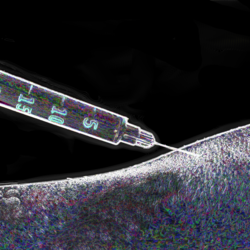
Betamethasone
| Betamethasone | |
|---|---|
 |
| Salts [] | |
|---|---|
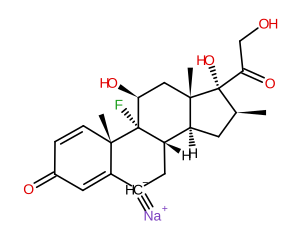
| Sodium betamethasone | |
 |
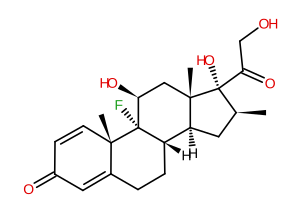
| Molecular structure drawn from PubChem coordinates |
| Physical properties [] | |
|---|---|
| Molecular mass | 392.50 g/mol [1] |
| Appearance | Crystals from ethyl acetate [1] |
| Odor | ODORLESS [1] |
| Melting point | 178°C [1] |
| Boiling point | 568.2°C [1] |
| Solubility | 66.5 mg/L (at 25 °C) [1] |
| Predicted LogP | 1.9 [1] |
| Structural Identifiers [] | |
|---|---|
| Molecular formula | C22H29FO5 |
| IUPAC name | (8S,9R,10S,11S,13S,14S,16S,17R)-9-fluoro-11,17-dihydroxy-17-(2-hydroxyacetyl)-10,13,16-trimethyl-6,7,8,11,12,14,15,16-octahydrocyclopenta[a]phenanthren-3-one |
| SMILES | C[C@H]1C[C@H]2[C@@H]3CCC4=CC(=O)C=C[C@@]4([C@]3([C@H](C[C@@]2([C@]1(C(=O)CO)O)C)O)F)C |
| InChI | InChI=1S/C22H29FO5/c1-12-8-16-15-5-4-13-9-14(25)6-7-19(13,2)21(15,23)17(26)10-20(16,3)22(12,28)18(27)11-24/h6-7,9,12,15-17,24,26,28H,4-5,8,10-11H2,1-3H3/t12-,15-,16-,17-,19-,20-,21-,22-/m0/s1 |
| InChIKey | UREBDLICKHMUKA-DVTGEIKXSA-N |
| CAS number | 378-44-9 |
| UNII | 9842X06Q6M |
| PubChem CID | 9782 |
| Pharmacokinetics[] | |
|---|---|
| Elimination half-life | 36-54 hours |
| Metabolism | Liver CYP3A4 |
| Excretion | Kidney (in urine) |
| Routes of administration | By mouth, topical, intramuscular |
Betamethasone (also known as βmethasone, βdexamethasone, Flubenisolone, Rinderon, Visuβ, Celestene, Betnelan, Desacort-β, βmetasone or β-Methasone).
Chemistry
Salts []
Stereochemistry []
Betamethasone is a single defined stereoisomer.
Druglikeness
Lipinski's rule of five
Betamethasone matches Lipinski's rule of five.Pharmacology
ATC Classification
- alimentary tract and metabolism (A)
- antidiarrheals, intestinal antiinflammatory/antiinfective agents (A07)
- intestinal antiinflammatory agents (A07E)
- corticosteroids acting locally (A07EA)
- betamethasone (A07EA04)
- cardiovascular system (C)
- vasoprotectives (C05)
- agents for treatment of hemorrhoids and anal fissures for topical use (C05A)
- corticosteroids (C05AA)
- betamethasone (C05AA05)
- dermatologicals (D)
- corticosteroids, dermatological preparations (D07)
- corticosteroids, plain (D07A)
- corticosteroids, potent (group iii) (D07AC)
- (D07AC01)
- betamethasone (D07AC01)
- corticosteroids, other combinations (D07X)
- corticosteroids, potent, other combinations (D07XC)
- betamethasone (D07XC01)
- systemic hormonal preparations, excl. sex hormones and insulins (H)
- corticosteroids for systemic use (H02)
- corticosteroids for systemic use, plain (H02A)
- glucocorticoids (H02AB)
- betamethasone (H02AB01)
- respiratory system (R)
- nasal preparations (R01)
- decongestants and other nasal preparations for topical use (R01A)
- corticosteroids (R01AD)
- betamethasone (R01AD06)
- drugs for obstructive airway diseases (R03)
- other drugs for obstructive airway diseases, inhalants (R03B)
- glucocorticoids (R03BA)
- betamethasone (R03BA04)
- sensory organs (S)
- ophthalmologicals (S01)
- antiinflammatory agents (S01B)
- corticosteroids, plain (S01BA)
- betamethasone (S01BA06)
- antiinflammatory agents and antiinfectives in combination (S01C)
- corticosteroids/antiinfectives/mydriatics in combination (S01CB)
- betamethasone (S01CB04)
- otologicals (S02)
- corticosteroids (S02B)
- corticosteroids (S02BA)
- betamethasone (S02BA07)
- ophthalmological and otological preparations (S03)
- corticosteroids (S03B)
- corticosteroids (S03BA)
- betamethasone (S03BA03)
MeSH Classification
Mechanism of action []
Glucocorticoids inhibit neutrophil apoptosis and demargination, and inhibit NF-Kappa B and other inflammatory transcription factors. They also inhibit phospholipase A2, leading to decreased formation of arachidonic acid derivatives. In addition, glucocorticoids promote anti-inflammatory genes like interleukin-10. Corticosteroids like betamethasone can act through nongenomic and genomic pathways. The genomic pathway is slower and occurs when glucocorticoids activate glucocorticoid receptors and initiate downstream effects that promote transcription of anti-inflammatory genes including phosphoenolpyruvate carboxykinase (PEPCK), IL-1-receptor antagonist, and tyrosine amino transferase (TAT). On the other hand, the nongenomic pathway is able to elicit a quicker response by modulating T-cell, platelet and monocyte activity through the use of existing membrane-bound receptors and second messengers. [1]
Interactions []
Medical side effects []
21 side effects listed on drug labels in SIDER 4.1 (betamethasone).
- Pruritus
- Cushing's syndrome
- Hypersensitivity
- Skin striae
- Endocrine disorder
- Folliculitis
- Hypertrichosis
- Immune system disorder
- Miliaria
- Telangiectasia
- Erythema
- Skin atrophy
- Pustular psoriasis
- Dermatitis contact
- Leukoderma
- Dermatitis acneiform
- Skin disorder
- Rash follicular
- Dermatitis
- Infection
- Paraesthesia
Indications
- Dandruff
- Dermatitis atopic
- Dermatitis contact
- Eczema infantile
- Eczema nummular
- Inflammation
- Neurodermatitis
- Psoriasis
- Seborrhoeic dermatitis
- Senile pruritus
- Skin disorder
- Solar dermatitis
- Stasis dermatitis
Legal status []
- Australia: Betamethasone is a Schedule 4.
- United Kingdom: Betamethasone is Prescription only.[3]
- United States: Betamethasone is Prescription only.
- Other: Betamethasone is a Rx-only.
External links []
- Betamethasone (Wikipedia)
- Betamethasone (PubChem)
- Betamethasone (Wikidata)
- Betamethasone (DrugBank)
- Betamethasone (ChEMBL)
- Betamethasone (ChEBI)
- Betamethasone (Common Chemistry)
- Betamethasone (HMDB)
- Betamethasone (KEGG)
- Betamethasone (EPA DSSTox)
- Betamethasone (Effect Index)
- Betamethasone (UNII)
- Betamethasone (SIDER)
References []
National Center for Biotechnology Information. PubChem Compound Summary for CID 9782, Betamethasone. Accessed November 21, 2026. https://pubchem.ncbi.nlm.nih.gov/compound/9782
U.S. Food and Drug Administration; National Center for Advancing Translational Sciences. Betamethasone. UNII: 9842X06Q6M. Global Substance Registration System. Accessed November 21, 2026. https://gsrs.ncats.nih.gov/ginas/app/beta/substances/9842X06Q6M
Betamethasone 500 microgram Soluble Tablets - Summary of Product Characteristics (SmPC). (emc). 5 April 2018. https://www.medicines.org.uk/emc/product/9098/smpc
Data sources []
| Source | Status | Updated (UTC) |
|---|---|---|
| dosing | missing (no dosing statistics) | 2026-11-20 19:01:08 |
| drugspro | missing (no DrugsPRO reagent data) | 2026-11-20 19:01:04 |
| erowid | missing (no Erowid substance of that name) | 2026-11-20 19:01:04 |
| gsrs | ok | 2026-11-20 19:01:05 |
| hmdb | missing (hmdb.ca refused automated access to HMDB0014586) | 2026-11-20 19:01:04 |
| kegg | ok | 2026-11-20 19:01:11 |
| pubchem | ok | 2026-11-20 19:01:04 |
| missing (no r/tripreports posts mention it) | 2026-11-20 19:01:04 | |
| sider | ok | 2026-11-20 19:01:04 |
| structure | ok | 2026-11-20 19:01:04 |
| wikipedia | ok | 2026-11-20 19:01:04 |