Buphenine
| Buphenine | |
|---|---|
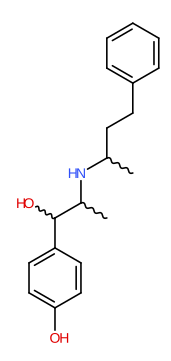 |
| Molecular structure drawn from PubChem coordinates |
| Physical properties [] | |
|---|---|
| Molecular mass | 299.40 g/mol [1] |
| Appearance | Crystals from methanol [1] |
| Odor | ODORLESS [1] |
| Taste | TASTELESS [1] |
| Melting point | 217 [1] |
| Solubility | Mol wt 335.88. Crystals. Sparingly sol in water; slightly sol in alcohol. Practically insol in ether, chloroform, benzene /Hydrochloride/ [1] |
| Predicted LogP | 3.5 [1] |
| Structural Identifiers [] | |
|---|---|
| Molecular formula | C19H25NO2 |
| IUPAC name | 4-[1-hydroxy-2-(4-phenylbutan-2-ylamino)propyl]phenol |
| SMILES | CC(CCC1=CC=CC=C1)NC(C)C(C2=CC=C(C=C2)O)O |
| InChI | InChI=1S/C19H25NO2/c1-14(8-9-16-6-4-3-5-7-16)20-15(2)19(22)17-10-12-18(21)13-11-17/h3-7,10-15,19-22H,8-9H2,1-2H3 |
| InChIKey | PTGXAUBQBSGPKF-UHFFFAOYSA-N |
| CAS number | 447-41-6 |
| UNII | 695DKH33EI |
| PubChem CID | 4567 |
Buphenine (also known as Buphenin, Nilidrine, Suprifen-psb, Bufenina, Bupheninum, Phenyl-sec-butyl norsuprifen, p-Hydroxy-N-(1-methyl-3-phenylpropyl)norephedrine, Benzenemethanol, 4-hydroxy-α-(1-((1-methyl-3-phenylpropyl)amino)ethyl)-, 1-(p-Hydroxyphenyl)-2-(1'-methyl-3'-phenylpropylamino)-1-propanol or 4-Hydroxy-α-(1-((1-methyl-3-phenylpropyl)amino)ethyl)benzenemethanol) is a substance of the amphetamine and phenylethanolamine class.
Chemistry
Stereochemistry []
Buphenine is a racemic mixture.
Druglikeness
Lipinski's rule of five
Buphenine matches Lipinski's rule of five.Pharmacology
ATC Classification
- cardiovascular system (C)
- peripheral vasodilators (C04)
- peripheral vasodilators (C04A)
- 2-amino-1-phenylethanol derivatives (C04AA)
- buphenine (C04AA02)
- genito urinary system and sex hormones (G)
- other gynecologicals (G02)
- other gynecologicals (G02C)
- sympathomimetics, labour repressants (G02CA)
- buphenine (G02CA02)
MeSH Classification
- adrenergic beta-agonists (M0000494)
- sympathomimetics (M0020947)
- vasodilator agents (M0022559)
- tocolytic agents (M0023285)
Mechanism of action []
This drug is classified as a beta receptor agonist.The β2-adrenergic receptor belongs to the widely expressed _7-transmembrane receptors superfamily_, which signals through heterotrimeric _G-proteins_. They are frequently referred to as G-protein-coupled receptors because they accomplish signal transduction to the interior of the cell by interactions with _guanine nucleotide regulatory binding proteins_. The receptor-coupled G-proteins work as “molecular switches” which alternate from an inactive guanosine-diphosphate to an active guanosine-triphosphate (GTP) state, which then act to modulate all downstream cell processes. Signaling by various hormones and neurotransmitters, as well as photons and odors, follows the same general pathway, (i.e., by binding of an extracellular ligand to the receptor, which then interacts with the membrane-bound G-protein). This complex, often referred to as the ternary complex, then acts through the activated G-protein to regulate an effector, such as _adenylyl cyclase_, _phospholipase C_, or ion channels. The main effects of Nylidrin may be divided into 3 categories: **Blood vessels** Vascular smooth muscle has β2-adrenoceptors that have a high binding affinity for circulating epinephrine and a lower affinity to norepinephrine released by sympathetic adrenergic nerves. When nylidrin binds to the beta-adrenergic receptors, it prevents the binding of epinephrine, leading to decreased blood vessel contractility as epinephrine is unable to bind. **Heart:** Increased intracellular cAMP by beta-2-agonists inhibits _myosin light chain kinase_, leading to relaxation These receptors, like the receptors in the heart, are coupled to a Gs-protein, which acts stimulate the formation of cAMP. Although increased cAMP increases cardiac myocyte contraction, in vascular smooth muscle, an increase in cAMP causes smooth muscle relaxation. The reason for this is the fact that cAMP inhibits myosin light chain kinase that is responsible for phosphorylating smooth muscle myosin. Increases in intracellular cAMP caused by β2-agonists inhibit myosin light chain kinase thereby producing less contractile force (i.e., promoting relaxation). **Other tissues** Activation of _β2-adrenoceptors_ in the lungs causes bronchodilation. β2-adrenoceptor activation leads to hepatic glycogenolysis and the pancreatic secretion of glucagon, increasing plasma glucose concentrations. β1-adrenoceptor stimulation in the kidneys promotes the release of renin, stimulating the production of angiotensin II and the subsequent release of aldosterone by the adrenal cortex. [1]
External links []
References []
National Center for Biotechnology Information. PubChem Compound Summary for CID 4567, Buphenine. Accessed November 20, 2026. https://pubchem.ncbi.nlm.nih.gov/compound/4567
U.S. Food and Drug Administration; National Center for Advancing Translational Sciences. Buphenine. UNII: 695DKH33EI. Global Substance Registration System. Accessed November 20, 2026. https://gsrs.ncats.nih.gov/ginas/app/beta/substances/695DKH33EI
Data sources []
| Source | Status | Updated (UTC) |
|---|---|---|
| dosing | missing (no dosing statistics) | 2026-11-20 09:01:25 |
| drugspro | missing (no DrugsPRO reagent data) | 2026-11-20 09:01:21 |
| erowid | missing (no Erowid substance of that name) | 2026-11-20 09:01:21 |
| gsrs | ok | 2026-11-20 09:01:21 |
| hmdb | missing (hmdb.ca refused automated access to HMDB0255826) | 2026-11-20 09:01:21 |
| kegg | ok | 2026-11-20 09:01:23 |
| pubchem | ok | 2026-11-20 09:01:21 |
| missing (no r/tripreports posts mention it) | 2026-11-20 09:01:21 | |
| sider | missing (not in SIDER) | 2026-11-20 09:01:21 |
| structure | ok | 2026-11-20 09:01:21 |
| wikipedia | ok | 2026-11-20 09:01:21 |