Buprenorphine
| Buprenorphine | |
|---|---|
 |
| Salts [] | |
|---|---|
| Buprenorphine hydrochloride | |
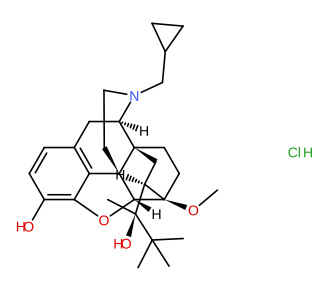 |
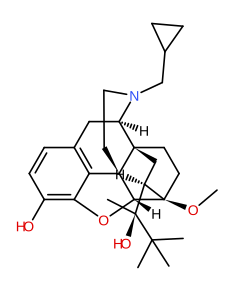
| Molecular structure drawn from PubChem coordinates |
| Physical properties [] | |
|---|---|
| Molecular mass | 467.60 g/mol [1] |
| Solubility | 1.68e-02 g/L [1] |
| Predicted LogP | 5 [1] |
| Structural Identifiers [] | |
|---|---|
| Molecular formula | C29H41NO4 |
| IUPAC name | (1S,2S,6R,14R,15R,16R)-5-(cyclopropylmethyl)-16-[(2S)-2-hydroxy-3,3-dimethylbutan-2-yl]-15-methoxy-13-oxa-5-azahexacyclo[13.2.2.12,8.01,6.02,14.012,20]icosa-8(20),9,11-trien-11-ol |
| SMILES | C[C@]([C@H]1C[C@@]23CC[C@@]1([C@H]4[C@@]25CCN([C@@H]3CC6=C5C(=C(C=C6)O)O4)CC7CC7)OC)(C(C)(C)C)O |
| InChI | InChI=1S/C29H41NO4/c1-25(2,3)26(4,32)20-15-27-10-11-29(20,33-5)24-28(27)12-13-30(16-17-6-7-17)21(27)14-18-8-9-19(31)23(34-24)22(18)28/h8-9,17,20-21,24,31-32H,6-7,10-16H2,1-5H3/t20-,21-,24-,26+,27-,28+,29-/m1/s1 |
| InChIKey | RMRJXGBAOAMLHD-IHFGGWKQSA-N |
| CAS number | 52485-79-7 |
| UNII | 40D3SCR4GZ |
| PubChem CID | 644073 |
| Pharmacokinetics[] | |
|---|---|
| Onset | Within 30 minutes |
| Elimination half-life | 37 hours (range 20–70 hours) |
| Duration of action | Up–24 hours |
| Metabolism | Liver (CYP3A4, CYP2C8) |
| Excretion | Bile duct and kidney |
| Routes of administration | Sublingual, buccal, intramuscular, intravenous, transdermal, intranasal, rectal, subcutaneous |
| Dependence liability | Psychological: High , Physical: Moderate[3] |
Buprenorphine (also known as Temgesic, Buprenophine, Buprenorfina, Buprenorphinum, Butrans, (-)-buprenorphine, buprenorphin, Sublocade, Brixadi or Cam2038) is a depressant, hormone and opioid substance of the 2-benzylpiperidine and morphinan class.
Chemistry
Salts []
Stereochemistry []
Buprenorphine is a single defined stereoisomer (optical activity ( - )).
Druglikeness
Lipinski's rule of five
Buprenorphine matches Lipinski's rule of five.Reagents
There are currently 4 reagent-interactions on DrugsPRO
| Reagent | Color change | Description |
|---|---|---|
| Marquis | violet or no color change | |
| Liebermann | black or no color change | |
| Froehde | slow purple | |
| Scott | no color change |
Pharmacology
ATC Classification
- nervous system (N)
- analgesics (N02)
- opioids (N02A)
- oripavine derivatives (N02AE)
- buprenorphine (N02AE01)
- other nervous system drugs (N07)
- drugs used in addictive disorders (N07B)
- drugs used in opioid dependence (N07BC)
- buprenorphine (N07BC01)
MeSH Classification
Mechanism of action []
Buprenorphine is a partial agonist at the mu-opioid receptor and an antagonist at the kappa-opioid receptor. It demonstrates a high affinity for the mu-opioid receptor but has lower intrinsic activity compared to other full mu-opioid agonists such as [heroin], [oxycodone], or [methadone]. This means that buprenorphine preferentially binds the opioid receptor and displaces lower affinity opioids without activating the receptor to a comparable degree. Clinically, this results in a slow onset of action and a clinical phenomenon known as the "ceiling effect" where once a certain dose is reached buprenorphine's effects plateau. This effect can be beneficial, however, as dose-related side effects such as respiratory depression, sedation, and intoxication also plateau at around 32mg, resulting in a lower risk of overdose compared to [methadone] and other full agonist opioids. It also means that opioid-dependent patients do not experience sedation or euphoria at the same rate that they might experience with more potent opioids, improving quality of life for patients with severe pain and reducing the reinforcing effects of opioids which can lead to drug-seeking behaviours. Buprenorphine's high affinity, but low intrinsic activity for the mu-opioid receptor also means that if it is started in opioid-dependent individuals, it will displace the other opioids without creating an equal opioid effect and cause a phenomenon known as "precipitated withdrawal" which is characterized by a rapid and intense onset of withdrawal symptoms (i.e. anxiety, restlessness, gastrointestinal distress, diaphoresis, intense drug cravings, and tachycardia). Individuals must therefore be in a state of mild to moderate withdrawal before starting therapy with buprenorphine. Buprenorphine is commercially available as the brand name product Suboxone which is formulated in a 4:1 fixed-dose combination product along with [naloxone], a non-selective competitive opioid receptor antagonist. Combination of an opioid agonist with an opioid antagonist may seem counterintuitive, however this combination with naloxone is intended to reduce the abuse potential of Suboxone, as naloxone is poorly absorbed by the oral route (and has no effect when taken orally), but would reverse the opioid agonist effects of buprenorphine if injected intravenously. [1]
Interactions []
Medical side effects []
208 side effects listed on drug labels in SIDER 4.1 (buprenorphine).
- Headache
- Insomnia
- Pain
- Withdrawal syndrome
- Infection
- Asthenia
- Fatigue
- Back pain
- Hyperhidrosis
- Anxiety
- Nausea
- Depression
- Rhinitis
- Application site pruritus
- Constipation
- Nervousness
- Tension
- Influenza
- Application site erythema
- Dry mouth
- Application site rash
- Chills
- Rigors
- Vomiting
- Somnolence
- Diarrhoea
- Dizziness
- Syncope
- Vasodilation procedure
- Pharyngitis
- Dyspepsia
- Heartburn
- Cough
- Dyspnoea
- Pain in extremity
- Pruritus
- Urinary tract infection
- Oedema peripheral
- Joint swelling
- Body temperature increased
- Decreased appetite
- Appetite absent
- Arthralgia
- Musculoskeletal discomfort
- Myalgia
- Confusional state
- Feeling abnormal
- Malaise
- Dermatitis
- Rash
- Hypoaesthesia
- Numbness
- Paraesthesia
- Tremor
- Abdominal discomfort
- Application site irritation
- Abscess
- Abdominal distension
- Abdominal pain
- Gastrointestinal pain
- Amblyopia
- Anaphylactic shock
- Angina pectoris
- Angioedema
- Apnoea
- Mental disorder
- Breast disorder
- Bronchospasm
- Bronchitis
- Neck pain
- Chest pain
- Coma
- Conjunctivitis
- Connective tissue disorder
- Cyanosis
- Libido decreased
- Disturbance in sexual arousal
- Dysphagia
- Dehydration
- Depersonalisation
- Dermatitis contact
- Diplopia
- Diverticulitis
- Drug hypersensitivity
- Dysarthria
- Slurred speech
- Osteoarthritis
- Dysgeusia
- Dysmenorrhoea
- Ear pain
- Oedema
- Eye disorder
- Muscle contractions involuntary
- Flatulence
- Flushing
- Gastrointestinal disorder
- Hallucination
- Cardiac disorder
- Hiccups
- Hypersensitivity
- Hypertension
- Hyperventilation
- Hypotension
- Hypotensive
- Orthostatic hypotension
- Immune system disorder
- Inflammation
- Lethargy
- Mediastinal disorder
- Miosis
- Muscle spasms
- Musculoskeletal pain
- Nasopharyngitis
- Nervous system disorder
- Nightmare
- Sensory loss
- Pallor
- Palpitations
- Psychotic disorder
- Convulsion
- Shock
- Sinusitis
- Loss of consciousness
- Tachycardia
- Tinnitus
- Erythema
- Upper respiratory tract infection
- Urinary incontinence
- Urethral disorder
- Urinary tract disorder
- Urticaria
- Angiopathy
- Vertigo
- Poor quality sleep
- Weight decreased
- Wheezing
- Urinary retention
- Agitation
- Apathy
- Flat affect
- Mood swings
- Affect lability
- Migraine
- Application site reaction
- Depressed level of consciousness
- Injection site reaction
- Injury
- Muscular weakness
- Biliary colic
- Alanine aminotransferase increased
- Dry skin
- Urinary hesitation
- Drug withdrawal syndrome
- Eyelid oedema
- Malnutrition
- Skin disorder
- Discomfort
- Ill-defined disorder
- Abdominal pain upper
- Retching
- Disorientation
- Disturbance in attention
- Cerebration impaired
- Dysphoria
- Memory impairment
- Respiratory depression
- Pulmonary function test decreased
- Euphoric mood
- Sedation
- Mental disability
- Swollen tongue
- Rash pustular
- Atrioventricular block second degree
- Hepatobiliary disease
- Balance disorder
- Dry eye
- Vision blurred
- Depressed mood
- Feeling hot
- Bradycardia
- Pruritus generalised
- Respiratory distress
- Blood pressure increased
- Coordination abnormal
- Influenza like illness
- Face oedema
- Visual impairment
- Altered state of consciousness
- Asthma
- Sexual dysfunction
- Gait disturbance
- Menopausal symptoms
- Hot flush
- Drug interaction
- Cardiovascular disorder
- Infestation
- Sleep disorder
- Oropharyngeal swelling
- Electrocardiogram QT prolonged
- Mental status changes
- Laryngeal pain
- Respiratory failure
- Hypoventilation
- Ileus
- Respiratory disorder
- Respiration abnormal
- Mental retardation
- Hypoxia
Indications
- Acute pain
- Chronic pain
- Dependence on opiates
- Opioid naive
- Pain
- Postoperative pain
Subjective effects []
Experience reports
- "Every Drug I've taken so far (AMA)" by Used-Philosopher-408 (26 upvotes)
- "25gr Hollandia truffels , very seriously serious things" by Rico_Montana (10 upvotes)
- "Description, comparison and rating of 14 opioids " by PsychedStrawberry (9 upvotes)
- "(D. Stramonium/LSD/n2O/Cannabis/Various. pharms) - A hazy recollection." by pulverstaden (6 upvotes)
- "1 gram of 2-FDCK, a helping girlfriend, and fractured ribs" by VMysteriousOwlV (6 upvotes)
- "A Short Glimpse into an Alternate Dimension" by PsilocinPsychosis (4 upvotes)
- "300ug AL-LAD and 7mg IV 4-AcO-DMT" by tylsergic (3 upvotes)
- "2m2b usage, a cautionary tale" by musiciansmallet (3 upvotes)
- "Suboxone + Kratom + etizolam Trip Report" by Indigobrew (1 upvotes)
- "Weird subo one trip report from several years ago" by psychonaut4020 (1 upvotes)
Legal status []
- Australia: Buprenorphine is a Schedule 8.
- Brazil: Buprenorphine is a A1.[4]
- Canada: Buprenorphine is a Schedule I.[5][6]
- Germany: Buprenorphine is a Anlage III under the "Betäubungsmittelgesetz (BtMG)".
- United Kingdom: Buprenorphine is a Class C under the "Misuse of Drugs Act 1971".
- United States: Buprenorphine is a Schedule III under the "Controlled Substances Act".[7][8][9][10][11]
- European Union: Buprenorphine is Prescription only.[12]
- United Nations: Buprenorphine is a Schedule III psychotropic under the "Convention on Psychotropic Substances 1971".
- Other: Buprenorphine is a SE: Förteckning IV.[13]
External links []
- Buprenorphine (Wikipedia)
- Buprenorphine (PubChem)
- Buprenorphine (Wikidata)
- Buprenorphine (DrugBank)
- Buprenorphine (ChEMBL)
- Buprenorphine (ChEBI)
- Buprenorphine (Common Chemistry)
- Buprenorphine (HMDB)
- Buprenorphine (KEGG)
- Buprenorphine (EPA DSSTox)
- Buprenorphine (Effect Index)
- Buprenorphine (UNII)
- Buprenorphine (SIDER)
References []
National Center for Biotechnology Information. PubChem Compound Summary for CID 644073, Buprenorphine. Accessed November 20, 2026. https://pubchem.ncbi.nlm.nih.gov/compound/644073
U.S. Food and Drug Administration; National Center for Advancing Translational Sciences. Buprenorphine. UNII: 40D3SCR4GZ. Global Substance Registration System. Accessed November 20, 2026. https://gsrs.ncats.nih.gov/ginas/app/beta/substances/40D3SCR4GZ
Bonewit-West K, Hunt AS, Applegate E. Today's Medical Assistant: Clinical and Administrative Procedures. Elsevier Health Sciences. 2012. https://books.google.com/books?id=YalYPI1KqTQC&pg=PA571
RDC Nº 784 – Listas de Substâncias Entorpecentes, Psicotrópicas, Precursoras e Outras sob Controle Especial. Diário Oficial da União. 31 March 2023. https://www.in.gov.br/en/web/dou/-/resolucao-rdc-n-784-de-31-de-marco-de-2023-474904992
ARCHIVED – Report Stakeholder Workshop on a National Buprenorphine Program. Health Canada. 6 December 2004. https://www.canada.ca/en/health-canada/services/drugs-health-products/reports-publications/drug-products/report-stakeholder-workshop-national-buprenorphine-program-november-18-2004-health-canada.html
Neurological therapies. Health Canada. 9 May 2018. https://www.canada.ca/en/services/health/drug-health-products/drug-medical-device-highlights-2017/approved-drugs/neurological-therapies.html
Subutex (buprenorphine sublingual tablets), CIII Initial U.S. Approval: 1981. DailyMed. https://dailymed.nlm.nih.gov/dailymed/archives/fdaDrugInfo.cfm?archiveid=660696
Sublocade- buprenorphine solution. DailyMed. 15 March 2023. https://dailymed.nlm.nih.gov/dailymed/drugInfo.cfm?setid=6189fb21-9432-45f8-8481-0bfaf3ccde95
Butrans- buprenorphine patch, extended release. DailyMed. 26 June 2022. https://dailymed.nlm.nih.gov/dailymed/drugInfo.cfm?setid=794aa355-66de-41b8-aedf-f2c40f6bc664
Brixadi- buprenorphine injection. DailyMed. 21 June 2023. https://dailymed.nlm.nih.gov/dailymed/drugInfo.cfm?setid=5d8a8fd0-8619-422a-a664-d1d2e8970f48
FDA Approves New Buprenorphine Treatment Option for Opioid Use Disorder. U.S. Food and Drug Administration. 23 May 2023. https://www.fda.gov/news-events/press-announcements/fda-approves-new-buprenorphine-treatment-option-opioid-use-disorder
Buvidal EPAR. European Medicines Agency (EMA). 20 November 2018. https://www.ema.europa.eu/en/medicines/human/EPAR/buvidal
Buprenorfin Actavis, Resoriblett, sublingual 2 mg. FASS. 6 November 2024. https://fass.se/health/product/19910906000029/fass-text
Data sources []
| Source | Status | Updated (UTC) |
|---|---|---|
| dosing | missing (no dosing statistics) | 2026-11-20 16:02:07 |
| drugspro | ok | 2026-11-20 16:02:02 |
| erowid | missing (no Erowid substance of that name) | 2026-11-20 16:02:02 |
| gsrs | ok | 2026-11-20 16:02:04 |
| hmdb | missing (hmdb.ca refused automated access to HMDB0015057) | 2026-11-20 16:02:02 |
| kegg | ok | 2026-11-20 16:02:06 |
| pubchem | ok | 2026-11-20 16:02:02 |
| ok | 2026-11-20 16:02:02 | |
| sider | ok | 2026-11-20 16:02:03 |
| structure | ok | 2026-11-20 16:02:02 |
| wikipedia | ok | 2026-11-20 16:02:03 |