Capsaicin
| Capsaicin | |
|---|---|
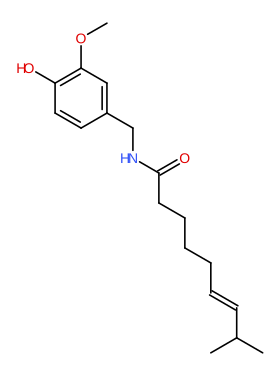 |
| Molecular structure drawn from PubChem coordinates |
| Physical properties [] | |
|---|---|
| Molecular mass | 305.40 g/mol [1] |
| Appearance | Pure dark red solid [1] |
| Odor | Highly volatile with a pungent odor [1] |
| Taste | Burning taste detectable in 1 part in 100,000 [1] |
| Melting point | 65 [1] |
| Boiling point | 210-220 [1] |
| Decomposition | When heated to decomposition it emits toxic fumes of /nitrogen oxides/. [1] |
| Solubility | Insoluble in cold water [1] |
| Predicted LogP | 3.6 [1] |
| Structural Identifiers [] | |
|---|---|
| Molecular formula | C18H27NO3 |
| IUPAC name | (E)-N-[(4-hydroxy-3-methoxyphenyl)methyl]-8-methylnon-6-enamide |
| SMILES | CC(C)/C=C/CCCCC(=O)NCC1=CC(=C(C=C1)O)OC |
| InChI | InChI=1S/C18H27NO3/c1-14(2)8-6-4-5-7-9-18(21)19-13-15-10-11-16(20)17(12-15)22-3/h6,8,10-12,14,20H,4-5,7,9,13H2,1-3H3,(H,19,21)/b8-6+ |
| InChIKey | YKPUWZUDDOIDPM-SOFGYWHQSA-N |
| CAS number | 404-86-4 |
| UNII | S07O44R1ZM |
| PubChem CID | 1548943 |
| Toxicity [] | |
|---|---|
| LD50 | Mouse: - oral: 47200 μg/kg - ip: 6500 μg/kg - Oral: 47200 μg/kg Rat: - ip: 9500 μg/kg [1] |
Capsaicin (also known as Zostrix, Capsaicine, trans-Capsaicin, Qutenza, Styptysat, Axsain, Ausanil, Isodecenoic acid vanillylamide, Mioton or trans-8-Methyl-N-vanillyl-6-nonenamide) is a substance of the benzylamine class.
Chemistry
Stereochemistry []
Capsaicin is achiral.
Druglikeness
Lipinski's rule of five
Capsaicin matches Lipinski's rule of five.Pharmacology
ATC Classification
- musculo-skeletal system (M)
- topical products for joint and muscular pain (M02)
- topical products for joint and muscular pain (M02A)
- capsaicin and similar agents (M02AB)
- capsaicin (M02AB01)
- nervous system (N)
- anesthetics (N01)
- anesthetics, local (N01B)
- other local anesthetics (N01BX)
- (N01BX04)
- capsaicin (N01BX04)
MeSH Classification
Mechanism of action []
Capsaicin has been shown to reduce the amount of substance P associated with inflammation - however this is not believed to be its main mechanism in the relief of pain. Capsaicin's mechanism of action is attributed to "defunctionalization" of nociceptor fibers by inducing a topical hypersensitivity reaction on the skin. This alteration in pain mechanisms is due to many of the following: temporary loss of membrane potential, inability to transport neurotrophic factors leading to altered phenotype, and reversible retraction of epidermal and dermal nerve fiber terminals. [1]
Medical side effects []
62 side effects listed on drug labels in SIDER 4.1 (capsaicin).
- Application site erythema
- Application site pain
- Application site burn
- Instillation site pain
- Application site pruritus
- Application site vesicles
- Application site papules
- Application site oedema
- Nasopharyngitis
- Nausea
- Sinusitis
- Vomiting
- Application site dryness
- Application site swelling
- Bronchitis
- Hypertension
- Cough
- Dysgeusia
- Herpes zoster
- Hypoaesthesia
- Pain in extremity
- Palpitations
- Pruritus
- Muscle spasms
- Tachycardia
- Burning sensation
- Oedema peripheral
- Application site reaction
- Eye irritation
- Blood pressure increased
- Application site irritation
- Application site rash
- Throat irritation
- Application site haematoma
- Application site paraesthesia
- Application site inflammation
- Application site hyperaesthesia
- Application site urticaria
- Infection
- Connective tissue disorder
- Dizziness
- Eye disorder
- Gastrointestinal disorder
- Headache
- Cardiac disorder
- Hyperaesthesia
- Mediastinal disorder
- Nervous system disorder
- Erythema
- Angiopathy
- HIV associated nephropathy
- Peripheral sensory neuropathy
- Eye pain
- Skin disorder
- Skin odour abnormal
- Application site anaesthesia
- Burns second degree
- Neuropathy peripheral
- Infestation
- Application site warmth
- Application site erosion
- Application site exfoliation
Indications
- Diabetic
- Neuralgia
- Pain
- Post herpetic neuralgia
Experience reports
See also []
External links []
References []
National Center for Biotechnology Information. PubChem Compound Summary for CID 1548943, Capsaicin. Accessed November 21, 2026. https://pubchem.ncbi.nlm.nih.gov/compound/1548943
U.S. Food and Drug Administration; National Center for Advancing Translational Sciences. Capsaicin. UNII: S07O44R1ZM. Global Substance Registration System. Accessed November 21, 2026. https://gsrs.ncats.nih.gov/ginas/app/beta/substances/S07O44R1ZM
Data sources []
| Source | Status | Updated (UTC) |
|---|---|---|
| dosing | missing (no dosing statistics) | 2026-11-20 06:50:09 |
| drugspro | missing (no DrugsPRO reagent data) | 2026-11-20 06:50:05 |
| erowid | ok | 2026-11-20 06:50:09 |
| gsrs | ok | 2026-11-20 06:50:05 |
| hmdb | missing (hmdb.ca refused automated access to HMDB0002227) | 2026-11-20 06:50:05 |
| kegg | ok | 2026-11-20 06:50:06 |
| pubchem | ok | 2026-11-20 06:50:04 |
| missing (no r/tripreports posts mention it) | 2026-11-20 06:50:05 | |
| sider | ok | 2026-11-20 06:50:05 |
| structure | ok | 2026-11-20 06:50:05 |
| wikipedia | missing (no Wikipedia article with a drug infobox) | 2026-11-20 06:50:05 |