Carbidopa
| Carbidopa | |
|---|---|
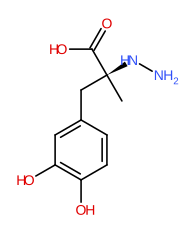 |
| Molecular structure drawn from PubChem coordinates |
| Physical properties [] | |
|---|---|
| Molecular mass | 226.23 g/mol [1] |
| Melting point | 203-208 °C [1] |
| Boiling point | Decomposes [1] |
| Solubility | 3.8 mg/L [1] |
| Predicted LogP | -2.2 [1] |
| Structural Identifiers [] | |
|---|---|
| Molecular formula | C10H14N2O4 |
| IUPAC name | (2S)-3-(3,4-dihydroxyphenyl)-2-hydrazinyl-2-methylpropanoic acid |
| SMILES | C[C@](CC1=CC(=C(C=C1)O)O)(C(=O)O)NN |
| InChI | InChI=1S/C10H14N2O4/c1-10(12-11,9(15)16)5-6-2-3-7(13)8(14)4-6/h2-4,12-14H,5,11H2,1H3,(H,15,16)/t10-/m0/s1 |
| InChIKey | TZFNLOMSOLWIDK-JTQLQIEISA-N |
| CAS number | 28860-95-9 |
| UNII | KR87B45RGH |
| PubChem CID | 34359 |
| Pharmacokinetics[] | |
|---|---|
| Elimination half-life | 2 hours |
| Metabolism | 7 metabolites known, not metabolized extensively |
Carbidopa (also known as Lodosyn, Carbidopa anhydrous, N-Aminomethyldopa, (S)-(-)-carbidopa, α-Methyldopahydrazine, Carbidopum, L-α-Methyldopahydrazine, Carbidopa (anhydrous), (S)-carbidopa or Mk 486) is a substance of the phentermine, amino acid and catecholamine class.
Chemistry
Stereochemistry []
Carbidopa is a single defined stereoisomer (optical activity ( - )).
Druglikeness
Lipinski's rule of five
Carbidopa matches Lipinski's rule of five.Pharmacology
MeSH Classification
- antiparkinson agents (M0001494)
- dopamine agents (M0023499)
- aromatic amino acid decarboxylase inhibitors (M0587359)
Mechanism of action []
Carbidopa is an inhibitor of the DDC which in order, inhibits the peripheral metabolism of levodopa. DDC is very important in the biosynthesis of L-tryptophan to serotonin and the modification of L-DOPA to dopamine. DDC can be found in the body periphery and in the blood-brain barrier. The action of carbidopa is focused on peripheral DDC as this drug cannot cross the blood-brain barrier. Hence, it will prevent the metabolism of [levodopa] in the periphery but it will not have any activity on the generation of dopamine in the brain. [1]
Medical side effects []
126 side effects listed on drug labels in SIDER 4.1 (carbidopa).
- Dyskinesia
- Movements involuntary
- Nausea
- Hallucination
- Confusional state
- Feeling abnormal
- Malaise
- Dizziness
- Syncope
- Urinary tract infection
- Headache
- Vomiting
- Depression
- Upper respiratory tract infection
- Dry mouth
- Decreased appetite
- Back pain
- Insomnia
- Orthostatic hypotension
- Dyspnoea
- Paraesthesia
- Pollakiuria
- Chest pain
- Diarrhoea
- Muscle spasms
- Constipation
- Dyspepsia
- Heartburn
- Musculoskeletal pain
- Abdominal pain
- Gastrointestinal pain
- Agranulocytosis
- Alopecia
- Anaemia
- Haemolytic anaemia
- Angioedema
- Anxiety
- Asthenia
- Fatigue
- Ataxia
- Blepharospasm
- Blister
- Dermatitis bullous
- Bruxism
- Chorea
- Choreiform
- Nasopharyngitis
- Rhinitis
- Cough
- Dysphagia
- Delusion
- Diplopia
- Duodenal ulcer
- Oedema
- Dermatitis
- Rash
- Extrapyramidal disorder
- Flatulence
- Flushing
- Gastrointestinal haemorrhage
- Hiccups
- Dysphonia
- Horner's syndrome
- Hypersensitivity
- Hypertension
- Hypotension
- Libido increased
- Disturbance in sexual arousal
- Pain in extremity
- Leukopenia
- Malignant melanoma
- Mydriasis
- Myocardial infarction
- Acute coronary syndrome
- Nervousness
- Tension
- Neuroleptic malignant syndrome
- Nightmare
- Hypoaesthesia
- Sensory loss
- Pain
- Palpitations
- Pathological gambling
- Pemphigus
- Neuropathy peripheral
- Phlebitis
- Priapism
- Pruritus
- Henoch-Schonlein purpura
- Convulsion
- Salivary hypersecretion
- Shock
- Loss of consciousness
- Thrombocytopenia
- Tremor
- Trismus
- Urinary incontinence
- Urticaria
- Weight increased
- Weight decreased
- Urinary retention
- Agitation
- Oculogyric crisis
- Blood urea increased
- Haemoglobin decreased
- Depression suicidal
- Discomfort
- Ill-defined disorder
- Emotional distress
- Muscle twitching
- Disorientation
- Memory impairment
- Euphoric mood
- Glossodynia
- Hypersexuality
- Psychotic disorder
- Vision blurred
- Dementia
- Gait disturbance
- Menopausal symptoms
- Hot flush
- Blood creatinine increased
- Hyperhidrosis
- White blood cell count decreased
- Sleep disorder
- Somnolence
Indications
- Intoxication
- Nausea
- Parkinson's disease
- Parkinsonism
- Parkinsonism post encephalitic
- Secondary parkinsonism
- Vomiting
Experience reports
Legal status []
- United Kingdom: Carbidopa is Prescription only.
- United States: Carbidopa is Prescription only.
External links []
References []
National Center for Biotechnology Information. PubChem Compound Summary for CID 34359, Carbidopa. Accessed November 21, 2026. https://pubchem.ncbi.nlm.nih.gov/compound/34359
U.S. Food and Drug Administration; National Center for Advancing Translational Sciences. Carbidopa. UNII: KR87B45RGH. Global Substance Registration System. Accessed November 21, 2026. https://gsrs.ncats.nih.gov/ginas/app/beta/substances/KR87B45RGH
Data sources []
| Source | Status | Updated (UTC) |
|---|---|---|
| dosing | missing (no dosing statistics) | 2026-11-20 07:06:39 |
| drugspro | missing (no DrugsPRO reagent data) | 2026-11-20 07:06:35 |
| erowid | ok | 2026-11-20 07:06:38 |
| gsrs | ok | 2026-11-20 07:06:35 |
| hmdb | missing (hmdb.ca refused automated access to HMDB0014336) | 2026-11-20 07:06:35 |
| kegg | ok | 2026-11-20 07:06:37 |
| pubchem | ok | 2026-11-20 07:06:35 |
| missing (no r/tripreports posts mention it) | 2026-11-20 07:06:35 | |
| sider | ok | 2026-11-20 07:06:35 |
| structure | ok | 2026-11-20 07:06:35 |
| wikipedia | ok | 2026-11-20 07:06:35 |