Carisoprodol
| Carisoprodol | |
|---|---|
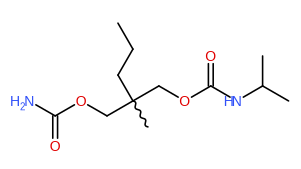 |
| Molecular structure drawn from PubChem coordinates |
| Physical properties [] | |
|---|---|
| Molecular mass | 260.33 g/mol [1] |
| Appearance | Crystals [1] |
| Taste | Slightly bitter taste [1] |
| Melting point | 198 to 199 °F (NTP, 1992) [1] |
| Boiling point | 423.412 [1] |
| Solubility | less than 1 mg/mL at 67.1 °F (NTP, 1992) [1] |
| Predicted LogP | 1.9 [1] |
| Structural Identifiers [] | |
|---|---|
| Molecular formula | C12H24N2O4 |
| IUPAC name | [2-(carbamoyloxymethyl)-2-methylpentyl] N-propan-2-ylcarbamate |
| SMILES | CCCC(C)(COC(=O)N)COC(=O)NC(C)C |
| InChI | InChI=1S/C12H24N2O4/c1-5-6-12(4,7-17-10(13)15)8-18-11(16)14-9(2)3/h9H,5-8H2,1-4H3,(H2,13,15)(H,14,16) |
| InChIKey | OFZCIYFFPZCNJE-UHFFFAOYSA-N |
| CAS number | 78-44-4 |
| UNII | 21925K482H |
| PubChem CID | 2576 |
| Pharmacokinetics[] | |
|---|---|
| Onset | Rapid (30 minutes)[3] |
| Elimination half-life | 2.5 hours [12 hours] |
| Metabolism | Liver (CYP2C19-mediated) |
| Excretion | Kidney |
| Routes of administration | By mouth |
| Addiction liability | Moderate - High[4] |
| Dosing[] |
|---|
| Oral [] | |
|---|---|
| Light | ≤ 125 mg(4x - 80.0%) |
| Common | 125 mg |
| Strong | 125 mg |
| Heavy | 125 - 290 mg |
| Extreme | 290 mg +(1x - 20.0%) |
| Intrarectal [] | |
|---|---|
| Light | ≤ 125 mg(14x - 87.5%) |
| Common | 125 mg |
| Strong | 125 mg |
| Heavy | 125 - 156.5 mg |
| Extreme | 156.5 mg +(2x - 12.5%) |
Statistically derived dosages via DBI-IGS (archived by anodyne.wiki) We do not take any responsibility for medical complications or loss of life sustained by following these dosages blindly. |
Carisoprodol (also known as Isomeprobamate, Carisoprodate, SOMA, Carisoprodatum, Carisoma, Isobamate, Isoprothane, Sanoma, Flexartal or Isoprotane).
Chemistry
Stereochemistry []
Carisoprodol is a racemic mixture of the enantiomers (optical activity ( + / - )).
Druglikeness
Lipinski's rule of five
Carisoprodol matches Lipinski's rule of five.Reagents
There are currently 3 reagent-interactions on DrugsPRO
| Reagent | Color change | Description |
|---|---|---|
| Marquis | no color change | |
| Mecke | no color change | |
| Mandelin | no color change |
Pharmacology
ATC Classification
- musculo-skeletal system (M)
- muscle relaxants (M03)
- muscle relaxants, centrally acting agents (M03B)
- carbamic acid esters (M03BA)
- carisoprodol (M03BA02)
MeSH Classification
- muscle relaxants, central (M0014240)
Mechanism of action []
The mechanism of action of carisoprodol in relieving discomfort associated with acute painful musculoskeletal conditions has not been confirmed. In studies using animal models, the muscle relaxation that is induced by carisoprodol is associated with a change in the interneuronal activity of the spinal cord and of the descending reticular formation, located in the brain. The abuse potential of this drug is attributed to its ability to alter GABAA function. This drug has been shown to modulate a variety of GABAA receptor subunits. GABAA receptor modulation can lead to anxiolysis due to inhibitory effects on neurotransmission. [1]
Interactions []
Medical side effects []
26 side effects listed on drug labels in SIDER 4.1 (carisoprodol).
- Somnolence
- Dizziness
- Syncope
- Headache
- Ataxia
- Flushing
- Orthostatic hypotension
- Irritability
- Leukopenia
- Nausea
- Pancytopenia
- Convulsion
- Shock
- Loss of consciousness
- Tachycardia
- Tremor
- Vertigo
- Vomiting
- Agitation
- Insomnia
- Epigastric discomfort
- Blood disorder
- Hiccups
- Back pain
- Viral infection
- Dyspepsia
Indications
- Discomfort
Subjective effects []
| bonzi / Carisoprodol [] | |
|---|---|
Experience reports
Legal status []
External links []
References []
National Center for Biotechnology Information. PubChem Compound Summary for CID 2576, Carisoprodol. Accessed November 23, 2026. https://pubchem.ncbi.nlm.nih.gov/compound/2576
U.S. Food and Drug Administration; National Center for Advancing Translational Sciences. Carisoprodol. UNII: 21925K482H. Global Substance Registration System. Accessed November 23, 2026. https://gsrs.ncats.nih.gov/ginas/app/beta/substances/21925K482H
Carrasco A. Diccionario de Especialidades Farmaceúticas PLM. PLM Latinoamérica. 13 September 2019.
Drug Scheduling. U.S. Drug Enforcement Administration (DEA). https://www.dea.gov/drug-information/drug-scheduling
Soma Product information. Health Canada. 14 March 2003. https://health-products.canada.ca/dpd-bdpp/info?lang=eng&code=205
Notice of consultation: Removing carisoprodol from the Prescription Drug List (PDL). Health Canada. 18 February 2025. https://www.canada.ca/en/health-canada/services/drugs-health-products/drug-products/prescription-drug-list/notices-changes/consultation-removal-carisoprodol.html
Consolidated federal laws of Canada, Controlled Drugs and Substances Act. Laws-lois.justice.gc.ca. 17 April 2026. https://laws-lois.justice.gc.ca/eng/acts/c-38.8/page-12.html
Soma- carisoprodol tablet. DailyMed. 15 May 2023. https://dailymed.nlm.nih.gov/dailymed/drugInfo.cfm?setid=6297cf20-830a-11dc-94c8-0002a5d5c51b
Somadril®, Tablett 350 mg. FASS.se. https://fass.se/health/product/19620228000026
Data sources []
| Source | Status | Updated (UTC) |
|---|---|---|
| dosing | ok | 2026-11-20 06:06:02 |
| drugspro | ok | 2026-11-20 06:05:58 |
| erowid | missing (no Erowid substance of that name) | 2026-11-20 06:05:58 |
| gsrs | ok | 2026-11-20 06:05:58 |
| hmdb | missing (hmdb.ca refused automated access to HMDB0014539) | 2026-11-20 06:05:58 |
| kegg | ok | 2026-11-20 06:06:00 |
| pubchem | ok | 2026-11-20 06:05:57 |
| ok | 2026-11-20 06:05:58 | |
| sider | ok | 2026-11-20 06:05:58 |
| structure | ok | 2026-11-20 06:05:58 |
| wikipedia | ok | 2026-11-20 06:05:58 |