Chloroform
| Chloroform | |
|---|---|
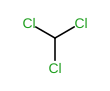 |
| Molecular structure drawn from PubChem coordinates |
| Rotamer [] | |
|---|---|
| Conformer structure via 3Dmol.js |
| Physical properties [] | |
|---|---|
| Molecular mass | 119.37 g/mol [1] |
| Appearance | Highly refractive, nonflammable, heavy, very volatile liquid [1] |
| Odor | Pleasant, etheric, nonirritating [1] |
| Taste | Sweet taste [1] |
| Density | 1.4832 at 68 °F (EPA, 1998) - Denser than water; will sink [1] |
| Melting point | -82.3 °F (EPA, 1998) [1] |
| Boiling point | 143 °F at 760 mmHg (EPA, 1998) [1] |
| Decomposition | When heated to decomposition forms phosgene gas. [1] |
| Solubility | less than 1 mg/mL at 66 °F (NTP, 1992) [1] |
| Predicted LogP | 2.3 [1] |
| Structural Identifiers [] | |
|---|---|
| Molecular formula | CHCl3 |
| IUPAC name | chloroform |
| SMILES | C(Cl)(Cl)Cl |
| InChI | InChI=1S/CHCl3/c2-1(3)4/h1H |
| InChIKey | HEDRZPFGACZZDS-UHFFFAOYSA-N |
| CAS number | 67-66-3 |
| UNII | 7V31YC746X |
| PubChem CID | 6212 |
| Toxicity [] | |
|---|---|
| LD50 | Dog: - oral: 2250 mg/kg Mouse: - Oral: 36 mg/kg Rabbit: - oral: 9827 mg/kg Rat: - intragastric: 2000 mg/kg - oral: 2180 mg/kg [1] |
Chloroform (also known as Trichloromethane, Trichlormethan, Trichloroform, Formyl trichloride, Methane, trichloro-, Methenyl trichloride, Methyl trichloride, Methane trichloride, Chloroforme or CHCl3) is a anaesthetic substance.
Chemistry
Stereochemistry []
Chloroform is achiral.
Druglikeness
Lipinski's rule of five
Chloroform matches Lipinski's rule of five.Pharmacology
ATC Classification
- nervous system (N)
- anesthetics (N01)
- anesthetics, general (N01A)
- halogenated hydrocarbons (N01AB)
- chloroform (N01AB02)
MeSH Classification
- solvents (M0020141)
Mechanism of action []
The feasibility of an oxygen-independent mechanism of chloroform bioactivation was indicated by the covalent binding to lipid and protein occurring in anaerobic incubations of chloroform and microsomes in the presence of NADPH. Under these conditions, the loss of cytochrome p450 and the inhibition of related mono-oxygenases were also observed. The chloroform anoxic biotransformation was negligible in uninduced microsomes and seemed to be catalyzed mainly by phenobarbital-inducible p450 isozymes. Biotransformation could also be supported by NADH as the source of reducing equivalents. Anaerobic metabolism of chloroform led to decreased levels of the main phenobarbital-induced p450 isozymes even at low chloroform concentration, and did not affect benzo(a)pyrene hydroxylase activity. These effects were not decreased by thiolic compounds. The oxidation products of chloroform caused a general impairment of the monoxygenase system, probably related to the formation of protein aggregates with very high molecular weight. In the presence of physiological concentrations of GSH, the targets of aerobically-produced metabolite were lipids, and, to a smaller extent, p450. At low chloroform concentrations and/or in the presence of GSH, the most changes to microsomal structures seemed to be produced by the reductively-formed intermediates. [1]
Experience reports
Erowid
There are currently 12 experience reports involving chloroform on Erowid: []- "I Almost Died" by Desiredkink
- "Sweet Joy" by Annonymous Jock
- "Persistent Misery" by Phthalo
- "Nauseous Bliss" by Disqus
- "Ups & Downs" by Drew
- "Its Alluring Sickness" by Stranger
- "Just Experimenting" by Pdawg
- "A Friend I Don't See Very Often" by Gin
- "Once a Solvent Always a Solvent" by Mao
- "Longer Lasting Nitrous" by DazedAndConfuzed
- "Drugs Don't Hurt People, People Hurt People" by Zebo
- "Dizzy & Floaty" by Jake
See also []
External links []
References []
National Center for Biotechnology Information. PubChem Compound Summary for CID 6212, Chloroform. Accessed November 21, 2026. https://pubchem.ncbi.nlm.nih.gov/compound/6212
U.S. Food and Drug Administration; National Center for Advancing Translational Sciences. Chloroform. UNII: 7V31YC746X. Global Substance Registration System. Accessed November 21, 2026. https://gsrs.ncats.nih.gov/ginas/app/beta/substances/7V31YC746X
Data sources []
| Source | Status | Updated (UTC) |
|---|---|---|
| dosing | missing (no dosing statistics) | 2026-11-20 06:40:40 |
| drugspro | missing (no DrugsPRO reagent data) | 2026-11-20 06:40:36 |
| erowid | ok | 2026-11-20 06:40:38 |
| gsrs | ok | 2026-11-20 06:40:36 |
| hmdb | missing (hmdb.ca refused automated access to HMDB0029596) | 2026-11-20 06:40:36 |
| kegg | missing (no KEGG DRUG entry) | 2026-11-20 06:40:40 |
| pubchem | ok | 2026-11-20 06:40:35 |
| ok | 2026-11-20 06:40:36 | |
| sider | missing (not in SIDER) | 2026-11-20 06:40:36 |
| structure | ok | 2026-11-20 06:40:36 |
| wikipedia | missing (no Wikipedia article with a drug infobox) | 2026-11-20 06:40:36 |