Citric acid
| Citric acid | |
|---|---|
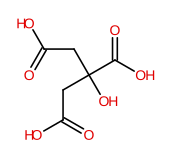 |
| Molecular structure drawn from PubChem coordinates |
| Physical properties [] | |
|---|---|
| Molecular mass | 192.12 g/mol [1] |
| Appearance | Crystals; monoclinic holohedra; crystallizes from hot concentrated aqueous solution [1] |
| Odor | Odorless [1] |
| Taste | Strongly acidic taste [1] |
| Density | 1.54 at 68 °F (USCG, 1999) - Denser than water; will sink [1] |
| Melting point | 307 °F (anhydrous) (NTP, 1992) [1] |
| Boiling point | Decomposes (NTP, 1992) [1] |
| Decomposition | When heated to decomposition it emits acrid smoke and fumes. [1] |
| Solubility | greater than or equal to 100 mg/mL at 72 °F (NTP, 1992) [1] |
| Predicted LogP | -1.7 [1] |
| Structural Identifiers [] | |
|---|---|
| Molecular formula | C6H8O7 |
| IUPAC name | 2-hydroxypropane-1,2,3-tricarboxylic acid |
| SMILES | C(C(=O)O)C(CC(=O)O)(C(=O)O)O |
| InChI | InChI=1S/C6H8O7/c7-3(8)1-6(13,5(11)12)2-4(9)10/h13H,1-2H2,(H,7,8)(H,9,10)(H,11,12) |
| InChIKey | KRKNYBCHXYNGOX-UHFFFAOYSA-N |
| CAS number | 77-92-9 |
| UNII | XF417D3PSL |
| PubChem CID | 311 |
| Toxicity [] | |
|---|---|
| LD50 | Mouse: - iv: 42 mg/kg /From - oral: 5040 mg/kg /From Rat: - oral: 3000 mg/kg; - oral: 6730 mg/kg [1] |
Citric acid (also known as Citric acid, anhydrous, Aciletten, Anhydrous citric acid, Citretten, Citro, Citric acid anhydrous, Chemfill, Hydrocerol A, 1,2,3-Propanetricarboxylic acid, 2-hydroxy- or 2-hydroxy-1,2,3-propanetricarboxylic acid).
Chemistry
Stereochemistry []
Citric acid is achiral.
Druglikeness
Lipinski's rule of five
Citric acid matches Lipinski's rule of five.Pharmacology
ATC Classification
- alimentary tract and metabolism (A)
- digestives, incl. enzymes (A09)
- digestives, incl. enzymes (A09A)
- acid preparations (A09AB)
- citric acid (A09AB04)
MeSH Classification
Mechanism of action []
... The NK(2), and to a lesser extent the NK(1), receptors have been shown to be involved with citric acid-induced bronchoconstriction in the guinea pig, which is in part mediated by endogenously released bradykinin. Tachykinins and bradykinin could also modulate citric acid-induced bronchoconstriction. ... Bronchoconstriction induced by citric acid inhalation in the guinea pig, mainly caused by the tachykinin NK(2) receptor, is counteracted by bronchoprotective NO after activation of bradykinin B(2) and tachykinin NK(1) receptors in airway epithelium. [1]
Medical side effects []
27 side effects listed on drug labels in SIDER 4.1 (citric).
- Diarrhoea
- Loose stools
- Nausea
- Vomiting
- Abdominal discomfort
- Gastrointestinal tract irritation
- Asthenia
- Confusional state
- Feeling abnormal
- Hyperkalaemia
- Hypocalcaemia
- Hypotension
- Paraesthesia
- Tingling of extremity
- Tingling sensation
- Chills
- Apathy
- Flat affect
- Dysarthria
- Abdominal pain upper
- Electrocardiogram ST segment
- Electrocardiogram QRS complex
- Electrocardiogram abnormal
- Poisoning
- Blood calcium decreased
- Citrate toxicity
- Liver disorder
Indications
- Acidosis
- Agitation
- Alkalosis
- Chronic renal insufficiency
- Gout
- Metabolic acidosis
- Nephrolithiasis
- Nephropathy
- pH urine decreased
- Renal tubular acidosis
External links []
References []
National Center for Biotechnology Information. PubChem Compound Summary for CID 311, Citric acid. Accessed November 21, 2026. https://pubchem.ncbi.nlm.nih.gov/compound/311
U.S. Food and Drug Administration; National Center for Advancing Translational Sciences. Citric acid. UNII: XF417D3PSL. Global Substance Registration System. Accessed November 21, 2026. https://gsrs.ncats.nih.gov/ginas/app/beta/substances/XF417D3PSL
Data sources []
| Source | Status | Updated (UTC) |
|---|---|---|
| dosing | missing (no dosing statistics) | 2026-11-20 21:00:53 |
| drugspro | missing (no DrugsPRO reagent data) | 2026-11-20 21:00:49 |
| erowid | missing (no Erowid substance of that name) | 2026-11-20 21:00:49 |
| gsrs | ok | 2026-11-20 21:00:49 |
| hmdb | missing (hmdb.ca refused automated access to HMDB0000094) | 2026-11-20 21:00:49 |
| kegg | ok | 2026-11-20 21:00:51 |
| pubchem | ok | 2026-11-20 21:00:49 |
| missing (no r/tripreports posts mention it) | 2026-11-20 21:00:49 | |
| sider | ok | 2026-11-20 21:00:49 |
| structure | ok | 2026-11-20 21:00:49 |
| wikipedia | missing (no Wikipedia article with a drug infobox) | 2026-11-20 21:00:49 |