Citrulline
| Citrulline | |
|---|---|
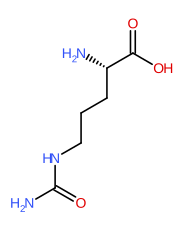 |
| Molecular structure drawn from PubChem coordinates |
| Physical properties [] | |
|---|---|
| Molecular mass | 175.19 g/mol [1] |
| Melting point | 235.5 °C [1] |
| Solubility | 200 g/L (at 20 °C) [1] |
| Predicted LogP | -4.3 [1] |
| Structural Identifiers [] | |
|---|---|
| Molecular formula | C6H13N3O3 |
| IUPAC name | (2S)-2-amino-5-(carbamoylamino)pentanoic acid |
| SMILES | C(C[C@@H](C(=O)O)N)CNC(=O)N |
| InChI | InChI=1S/C6H13N3O3/c7-4(5(10)11)2-1-3-9-6(8)12/h4H,1-3,7H2,(H,10,11)(H3,8,9,12)/t4-/m0/s1 |
| InChIKey | RHGKLRLOHDJJDR-BYPYZUCNSA-N |
| CAS number | 372-75-8 |
| UNII | 29VT07BGDA |
| PubChem CID | 9750 |
Citrulline (also known as L-citrulline, Sitrulline, Δ-Ureidonorvaline, N5-Carbamoyl-L-ornithine, L-Cytrulline, (S)-2-Amino-5-ureidopentanoic acid, Citrulline, L-, N5-(Aminocarbonyl)-L-ornithine, N(Δ)-Carbamylornithine or N5-(Aminocarbonyl)ornithine) is a substance of the amino acid class.
Chemistry
Stereochemistry []
Citrulline is a single defined stereoisomer.
Druglikeness
Lipinski's rule of five
Citrulline matches Lipinski's rule of five.Pharmacology
Mechanism of action []
L-citrulline is converted to L-arginine by argininosuccinate synthase. L-arginine is in turn responsible for citrulline's therapeutic affects. Many of L-arginine's activities, including its possible anti-atherogenic actions, may be accounted for by its role as the precursor to nitric oxide or NO. NO is produced by all tissues of the body and plays very important roles in the cardiovascular system, immune system and nervous system. NO is formed from L-arginine via the enzyme nitric oxide synthase or synthetase (NOS), and the effects of NO are mainly mediated by 3',5' -cyclic guanylate or cyclic GMP. NO activates the enzyme guanylate cyclase, which catalyzes the synthesis of cyclic GMP from guanosine triphosphate or GTP. Cyclic GMP is converted to guanylic acid via the enzyme cyclic GMP phosphodiesterase. NOS is a heme-containing enzyme with some sequences similar to cytochrome P-450 reductase. Several isoforms of NOS exist, two of which are constitutive and one of which is inducible by immunological stimuli. The constitutive NOS found in the vascular endothelium is designated eNOS and that present in the brain, spinal cord and peripheral nervous system is designated nNOS. The form of NOS induced by immunological or inflammatory stimuli is known as iNOS. iNOS may be expressed constitutively in select tissues such as lung epithelium. All the nitric oxide synthases use NADPH (reduced nicotinamide adenine dinucleotide phosphate) and oxygen (O<sub>2</sub>) as cosubstrates, as well as the cofactors FAD (flavin adenine dinucleotide), FMN (flavin mononucleotide), tetrahydrobiopterin and heme. Interestingly, ascorbic acid appears to enhance NOS activity by increasing intracellular tetrahydrobiopterin. eNOS and nNOS synthesize NO in response to an increased concentration of calcium ions or in some cases in response to calcium-independent stimuli, such as shear stress. _In vitro_ studies of NOS indicate that the Km of the enzyme for L-arginine is in the micromolar range. The concentration of L-arginine in endothelial cells, as well as in other cells, and in plasma is in the millimolar range. What this means is that, under physiological conditions, NOS is saturated with its L-arginine substrate. In other words, L-arginine would not be expected to be rate-limiting for the enzyme, and it would not appear that supraphysiological levels of L-arginine which could occur with oral supplementation of the amino acid would make any difference with regard to NO production. The reaction would appear to have reached its maximum level. However, _in vivo_ studies have demonstrated that, under certain conditions, e.g. hypercholesterolemia, L-arginine could enhance endothelial-dependent vasodilation and NO production. [1]
See also []
External links []
References []
National Center for Biotechnology Information. PubChem Compound Summary for CID 9750, Citrulline. Accessed November 20, 2026. https://pubchem.ncbi.nlm.nih.gov/compound/9750
U.S. Food and Drug Administration; National Center for Advancing Translational Sciences. Citrulline. UNII: 29VT07BGDA. Global Substance Registration System. Accessed November 20, 2026. https://gsrs.ncats.nih.gov/ginas/app/beta/substances/29VT07BGDA
Data sources []
| Source | Status | Updated (UTC) |
|---|---|---|
| dosing | missing (no dosing statistics) | 2026-11-20 07:06:34 |
| drugspro | missing (no DrugsPRO reagent data) | 2026-11-20 07:06:29 |
| erowid | missing (no Erowid substance of that name) | 2026-11-20 07:06:29 |
| gsrs | ok | 2026-11-20 07:06:30 |
| hmdb | missing (hmdb.ca refused automated access to HMDB0000904) | 2026-11-20 07:06:29 |
| kegg | ok | 2026-11-20 07:06:31 |
| pubchem | ok | 2026-11-20 07:06:29 |
| missing (no r/tripreports posts mention it) | 2026-11-20 07:06:29 | |
| sider | missing (not in SIDER) | 2026-11-20 07:06:29 |
| structure | ok | 2026-11-20 07:06:29 |
| wikipedia | missing (no Wikipedia article with a drug infobox) | 2026-11-20 07:06:30 |