Clindamycin
| Clindamycin | |
|---|---|
 |
| Salts [] | |
|---|---|
| Clindamycin hydrochloride | |
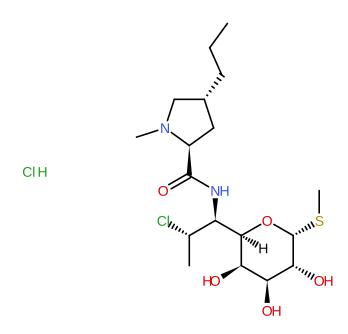 |
| Molecular structure drawn from PubChem coordinates |
| Physical properties [] | |
|---|---|
| Molecular mass | 425.00 g/mol [1] |
| Appearance | Yellow, amorphous solid [1] |
| Melting point | 141-143C [1] |
| Decomposition | When heated to decomposition it emits toxic fumes of /chlorine, oxides of sulfur, and oxides of nitrogen/. [1] |
| Solubility | Water soluble [1] |
| Predicted LogP | 2.2 [1] |
| Structural Identifiers [] | |
|---|---|
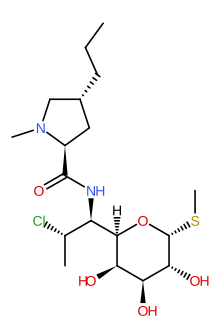
| Molecular formula | C18H33ClN2O5S |
| IUPAC name | (2S,4R)-N-[(1S,2S)-2-chloro-1-[(2R,3R,4S,5R,6R)-3,4,5-trihydroxy-6-methylsulfanyloxan-2-yl]propyl]-1-methyl-4-propylpyrrolidine-2-carboxamide |
| SMILES | CCC[C@@H]1C[C@H](N(C1)C)C(=O)N[C@@H]([C@@H]2[C@@H]([C@@H]([C@H]([C@H](O2)SC)O)O)O)[C@H](C)Cl |
| InChI | InChI=1S/C18H33ClN2O5S/c1-5-6-10-7-11(21(3)8-10)17(25)20-12(9(2)19)16-14(23)13(22)15(24)18(26-16)27-4/h9-16,18,22-24H,5-8H2,1-4H3,(H,20,25)/t9-,10+,11-,12+,13-,14+,15+,16+,18+/m0/s1 |
| InChIKey | KDLRVYVGXIQJDK-AWPVFWJPSA-N |
| CAS number | 18323-44-9 |
| UNII | 3U02EL437C |
| PubChem CID | 446598 |
| Pharmacokinetics[] | |
|---|---|
| Elimination half-life | 2–3 hour |
| Metabolism | Liver |
| Excretion | Bile duct and kidney (around 20%) |
| Routes of administration | By mouth, topical, intravenous, intravaginal |
| Toxicity [] | |
|---|---|
| LD50 | Mouse: - ip: 361 mg/kg /Clindamycin Rat: - subcutaneous: 2618 mg/kg - oral: 2619 mg/kg /Clindamycin [1] |
Clindamycin (also known as Chlolincocin, Clindamicina, Clinimycin, Clindamycine, 7-Chlorolincomycin, 7(S)-Chloro-7-deoxylincomycin, Clindamycinum, 7-Deoxy-7(S)-chlorolincomycin, U-21251 or U-21,251) is a antibiotic substance of the pyrrolidine class.
Chemistry
Salts []
Stereochemistry []
Clindamycin is a single defined stereoisomer.
Druglikeness
Lipinski's rule of five
Clindamycin matches Lipinski's rule of five.Pharmacology
ATC Classification
- dermatologicals (D)
- anti-acne preparations (D10)
- anti-acne preparations for topical use (D10A)
- antiinfectives for treatment of acne (D10AF)
- clindamycin (D10AF01)
- genito urinary system and sex hormones (G)
- gynecological antiinfectives and antiseptics (G01)
- antiinfectives and antiseptics, excl. combinations with corticosteroids (G01A)
- antibiotics (G01AA)
- clindamycin (G01AA10)
- antiinfectives for systemic use (J)
- antibacterials for systemic use (J01)
- macrolides, lincosamides and streptogramins (J01F)
- lincosamides (J01FF)
- (J01FF01)
- clindamycin (J01FF01)
MeSH Classification
Mechanism of action []
Clindamycin inhibits bacterial protein synthesis by binding to 23S RNA of the 50S subunit of the bacterial ribosome. It impedes both the assembly of the ribosome and the translation process. The molecular mechanism through which this occurs is thought to be due to clindamycin's three-dimensional structure, which closely resembles the 3'-ends of L-Pro-Met-tRNA and deacylated-tRNA during the peptide elongation cycle - in acting as a structural analog of these tRNA molecules, clindamycin impairs peptide chain initiation and may stimulate dissociation of peptidyl-tRNA from bacterial ribosomes. The mechanism through which topical clindamycin treats acne vulgaris is unclear, but may be related to its activity against _Propionibacterium acnes_, a bacteria that has been associated with acne. [1]
Medical side effects []
148 side effects listed on drug labels in SIDER 4.1 (clindamycin).
- Acne
- Other acne
- Pimples
- Exacerbation of acne
- Erythema
- Redness
- Localized erythema
- Seborrhoeic dermatitis
- Skin exfoliation
- Skin scaly
- Pruritus
- Vulvovaginal candidiasis
- Vulvovaginal mycotic infection
- Application site pain
- Application site burn
- Vulvovaginal disorder
- Vulvovaginitis
- Dysgeusia
- Taste metallic
- Headache
- Back pain
- Application site pruritus
- Constipation
- Urinary tract infection
- Application site dryness
- Vomiting
- Fungal infection
- Application site reaction
- Sunburn
- Photosensitivity reaction
- Abnormal labour
- Dyspnoea
- Body temperature increased
- Hypotension
- Leukocytosis
- Vulvovaginal pain
- Candida infection
- Vulvovaginitis trichomonal
- Dermatitis
- Rash
- Dermatitis contact
- Fungal skin infection
- Abdominal pain
- Abdominal cramps
- Abdominal pain generalised
- Abdominal pain localised
- Gastrointestinal pain
- Colitis
- Diarrhoea
- Watery diarrhoea
- Dizziness
- Folliculitis
- Haematochezia
- Hypersensitivity
- Nausea
- Urticaria
- Diarrhoea haemorrhagic
- Vaginal discharge
- Dyspepsia
- Gastrointestinal disorder
- Gastrointestinal symptom NOS
- Abdominal discomfort
- Pain of skin
- Vulvovaginal erythema
- Vulval erythema
- Instillation site pain
- Application site rash
- Vulvovaginal swelling
- Application site erythema
- Pseudomembranous colitis
- Vaginal haemorrhage
- Abscess
- Agranulocytosis
- Anaemia
- Bacterial infection
- Dermatitis exfoliative
- Dysuria
- Localised oedema
- Endometriosis
- Eosinophilia
- Toxic epidermal necrolysis
- Epistaxis
- Erythema multiforme
- Stevens-Johnson syndrome
- Oesophagitis
- Asthenia
- Fatigue
- Flank pain
- Flatulence
- Abdominal bloating
- Flushing
- Breath odour
- Cardiac arrest
- Hypertension
- Hyperthyroidism
- Jaundice
- Leukopenia
- Measles
- Menstrual disorder
- Metrorrhagia
- Muscle spasms
- Neutropenia
- Oliguria
- Pain
- Generalized aching
- Stinging
- Pelvic pain
- Proteinuria
- Protein urine present
- Prurigo
- Pyelonephritis
- Superinfection
- Swelling
- Thrombocytopenia
- Thrombophlebitis
- Ulcer
- Upper respiratory tract infection
- Vaginal inflammation
- Vaginal infection
- Vertigo
- Vulvitis
- Clostridium difficile colitis
- Rash pustular
- Dermatitis bullous
- Dry skin
- Oesophageal ulcer
- Skin irritation
- Polyarthritis
- Discomfort
- Tenderness
- Rash erythematous
- Inflammation
- Vulvovaginal burning sensation
- Azotaemia
- Induration
- Anaphylactic shock
- Anaphylactoid reaction
- Abdominal pain upper
- Rash maculo-papular
- Vulvovaginal discomfort
- Vaginal irritation
- Vulvovaginal dryness
- Injection site irritation
- Cardio-respiratory arrest
- Local reaction
- Acute generalised exanthematous pustulosis
- Abdominal distension
- Thrombophlebitis superficial
Indications
- Abdominal abscess
- Abdominal infection
- Abscess
- Acne
- Acne vulgaris
- Acquired immunodeficiency syndrome
- Arthritis bacterial
- Bone and joint infections
- Cellulitis
- Comedone
- Diarrhoea
- Diarrhoea haemorrhagic
- Empyema
- Endometritis
- Gonorrhoea
- Gynecological infection
- Herpes simplex
- Infection
- Lower respiratory tract infection
- Lung abscess
- Myocarditis
- Osteomyelitis
- Parametritis
- Pelvic inflammatory disease
- Peritonitis
- Pneumocystis jirovecii pneumonia
- Pneumonia
- Pseudomembranous colitis
- Respiratory tract infection
- Salpingitis
- Sensitisation
- Septicemia
- Soft tissue infection
- Tubo-ovarian abscess
- Vaginal discharge
- Vaginitis bacterial
- Vulvovaginitis
- Wound infection
Subjective effects []
| 0xea / Clindamycin [] | |
|---|---|
Routes:
| |
Legal status []
- Australia: Clindamycin is a Schedule 4.
- Canada: Clindamycin is Prescription only.[3]
- United Kingdom: Clindamycin is Prescription only.
- United States: Clindamycin is Prescription only.
See also []
External links []
References []
National Center for Biotechnology Information. PubChem Compound Summary for CID 446598, Clindamycin. Accessed November 21, 2026. https://pubchem.ncbi.nlm.nih.gov/compound/446598
U.S. Food and Drug Administration; National Center for Advancing Translational Sciences. Clindamycin. UNII: 3U02EL437C. Global Substance Registration System. Accessed November 21, 2026. https://gsrs.ncats.nih.gov/ginas/app/beta/substances/3U02EL437C
Product monograph brand safety updates. Health Canada. 6 June 2024. https://www.canada.ca/en/health-canada/services/drugs-health-products/drug-products/drug-product-database/label-safety-assessment-update/product-monograph-brand-safety-updates.html
Data sources []
| Source | Status | Updated (UTC) |
|---|---|---|
| dosing | missing (no dosing statistics) | 2026-11-20 09:50:37 |
| drugspro | missing (no DrugsPRO reagent data) | 2026-11-20 09:50:33 |
| erowid | missing (no Erowid substance of that name) | 2026-11-20 09:50:33 |
| gsrs | ok | 2026-11-20 09:50:34 |
| hmdb | missing (no HMDB id) | 2026-11-20 09:50:33 |
| kegg | ok | 2026-11-20 09:50:36 |
| pubchem | ok | 2026-11-20 09:50:33 |
| missing (no r/tripreports posts mention it) | 2026-11-20 09:50:33 | |
| sider | ok | 2026-11-20 09:50:33 |
| structure | ok | 2026-11-20 09:50:33 |
| wikipedia | ok | 2026-11-20 09:50:33 |