Cysteine
| Cys | |
|---|---|
 |
| Salts [] | |
|---|---|
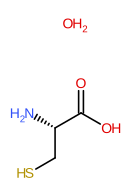
| Cysteine monohydrate | |
 | |
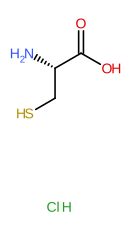
| Cysteine hydrochloride | |
 |
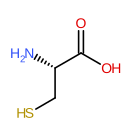
| Molecular structure drawn from PubChem coordinates |
| Physical properties [] | |
|---|---|
| Molecular mass | 121.16 g/mol [1] |
| Appearance | Colorless crystals [1] |
| Melting point | 240 dec °C [1] |
| Decomposition | When heated to decomposition it emits very toxic fumes of /sulfur oxides and nitrogen oxides/. [1] |
| Solubility | 277000 mg/L (at 25 °C) [1] |
| Predicted LogP | -2.5 [1] |
| Structural Identifiers [] | |
|---|---|
| Molecular formula | C3H7NO2S |
| IUPAC name | (2R)-2-amino-3-sulfanylpropanoic acid |
| SMILES | C([C@@H](C(=O)O)N)S |
| InChI | InChI=1S/C3H7NO2S/c4-2(1-7)3(5)6/h2,7H,1,4H2,(H,5,6)/t2-/m0/s1 |
| InChIKey | XUJNEKJLAYXESH-REOHCLBHSA-N |
| CAS number | 52-90-4 |
| UNII | K848JZ4886 |
| PubChem CID | 5862 |
| Toxicity [] | |
|---|---|
| LD50 | Rat: - oral: 1890 mg/kg - ip: 1620 mg/kg - sc: 1550 mg/kg [1] |
Cysteine (also known as L-cysteine, Cystein, Thioserine, (R)-2-Amino-3-mercaptopropanoic acid, Half-cystine, L-Cystein, β-Mercaptoalanine, Cysteinum, L-Cys or cisteina) is a substance of the amino acid class.
Chemistry
Salts []
Stereochemistry []
Cysteine is a single defined stereoisomer.
Druglikeness
Lipinski's rule of five
Cysteine matches Lipinski's rule of five.Pharmacology
Mechanism of action []
Cysteine can usually be synthesized by the human body under normal physiological conditions if a sufficient quantity of methionine is available. Cysteine is typically synthesized in the human body when there is sufficient methionine available. Cysteine exhibits antioxidant properties and participates in redox reactions. Cysteine's antioxidant properties are typically expressed in the tripeptide glutathione, which occurs in humans as well as other organisms. Glutathione (GSH) typically requires biosynthesis from its constituent amino acids, cysteine, glycine, and glutamic acid, due to its limited systemic availability. Glutamic acid and glycine are readily available in the diets of most industrialized countries, but the availability of cysteine can be the limiting substrate. In human metabolism, cysteine is also involved in the generation of sulfide present in iron-sulfur clusters and nitrogenase by acting as a precursor. In a 1994 report released by five top cigarette companies, cysteine is one of the 599 additives to cigarettes. Its use or purpose, however, is unknown, like most cigarette additives. Its inclusion in cigarettes could offer two benefits: Acting as an expectorant, since smoking increases mucus production in the lungs; and increasing the beneficial antioxidant glutathione (which is diminished in smokers). [1]
See also []
External links []
References []
National Center for Biotechnology Information. PubChem Compound Summary for CID 5862, Cysteine. Accessed November 20, 2026. https://pubchem.ncbi.nlm.nih.gov/compound/5862
U.S. Food and Drug Administration; National Center for Advancing Translational Sciences. Cysteine. UNII: K848JZ4886. Global Substance Registration System. Accessed November 20, 2026. https://gsrs.ncats.nih.gov/ginas/app/beta/substances/K848JZ4886
Data sources []
| Source | Status | Updated (UTC) |
|---|---|---|
| dosing | missing (no dosing statistics) | 2026-11-20 08:00:16 |
| drugspro | missing (no DrugsPRO reagent data) | 2026-11-20 08:00:12 |
| erowid | missing (no Erowid substance of that name) | 2026-11-20 08:00:12 |
| gsrs | ok | 2026-11-20 08:00:15 |
| hmdb | missing (hmdb.ca refused automated access to HMDB0000574) | 2026-11-20 08:00:12 |
| kegg | ok | 2026-11-20 08:00:14 |
| pubchem | ok | 2026-11-20 08:00:12 |
| missing (no r/tripreports posts mention it) | 2026-11-20 08:00:12 | |
| sider | missing (not in SIDER) | 2026-11-20 08:00:12 |
| structure | ok | 2026-11-20 08:00:12 |
| wikipedia | missing (no Wikipedia article with a drug infobox) | 2026-11-20 08:00:13 |