Daridorexant
| Daridorexant | |
|---|---|
 |
| Salts [] | |
|---|---|
| Daridorexant hydrochloride | |
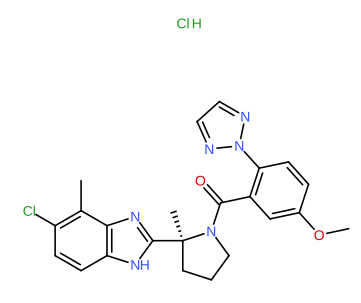 |
| Molecular structure drawn from PubChem coordinates |
| Rotamer [] | |
|---|---|
| Conformer structure via 3Dmol.js |
| Physical properties [] | |
|---|---|
| Molecular mass | 450.90 g/mol [1] |
| Predicted LogP | 4.1 [1] |
| Structural Identifiers [] | |
|---|---|
| Molecular formula | C23H23ClN6O2 |
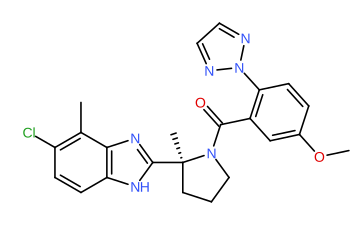
| IUPAC name | [(2S)-2-(5-chloro-4-methyl-1H-benzimidazol-2-yl)-2-methylpyrrolidin-1-yl]-[5-methoxy-2-(triazol-2-yl)phenyl]methanone |
| SMILES | CC1=C(C=CC2=C1N=C(N2)[C@@]3(CCCN3C(=O)C4=C(C=CC(=C4)OC)N5N=CC=N5)C)Cl |
| InChI | InChI=1S/C23H23ClN6O2/c1-14-17(24)6-7-18-20(14)28-22(27-18)23(2)9-4-12-29(23)21(31)16-13-15(32-3)5-8-19(16)30-25-10-11-26-30/h5-8,10-11,13H,4,9,12H2,1-3H3,(H,27,28)/t23-/m0/s1 |
| InChIKey | NBGABHGMJVIVBW-QHCPKHFHSA-N |
| CAS number | 1505484-82-1 |
| UNII | LMQ24G57E9 |
| PubChem CID | 91801202 |
| Pharmacokinetics[] | |
|---|---|
| Onset | T<sub>max</sub>: 1–2 hours (delayed by 1.3 hours with food) |
| Elimination half-life | 8 hours (6–10 hours)[3] |
| Duration of action | ~8 hours (50 mg) |
| Metabolism | Extensive (mainly CYP3A4 (89%)) |
| Excretion | Feces: ~57%, Urine: ~28% |
| Routes of administration | By mouth |
Daridorexant (also known as Nemorexant, Act-541468, Quviviq, Dea no. 2410, daridorexantum, Act 541468;act-541468, Nemorexant?, Act541468, Nemorexant;?Daridorexant or nemorexant (former name)) is a substance of the benzylamine class.
Chemistry
Salts []
Stereochemistry []
Daridorexant is a single defined stereoisomer.
Druglikeness
Lipinski's rule of five
Daridorexant matches Lipinski's rule of five.Pharmacology
ATC Classification
- nervous system (N)
- psycholeptics (N05)
- hypnotics and sedatives (N05C)
- orexin receptor antagonists (N05CJ)
- daridorexant (N05CJ03)
Mechanism of action []
The sleep and wake cycle is regulated by complex interactions between sleep-promoting systems, including inhibitory GABA activity, and wake-promoting systems, including orexins, acetylcholine and monoaminergic systems. Orexin, also called hypocretin, is a wake-promoting neuropeptide produced by a small group of neurons in the lateral hypothalamus. Orexin stabilizes wakefulness by activating orexin neurons with the highest activity during active wakefulness and minimal activity during sleep. Orexin neurons project to other wake-promoting neurons that also express orexin receptors: these include the histaminergic neurons of the tuberomammillary nucleus, noradrenergic neurons of the locus coeruleus, serotoninergic neurons of the dorsal raphe, dopaminergic neurons of the ventral tegmental area, and cholinergic neurons of the basal forebrain and the pedunculopontine and laterodorsal tegmental nuclei. These wake-promoting neurons are part of the ascending reticular activating system that operates under a feedback loop in the sleep and wake cycle. There are two identified types of orexin (OXA and OXB) that bind to orexin type 1 and 2 receptors (OX1R and OX2R), which are G-protein coupled receptors. OXA binds more preferentially to OX1R, while OX2R shows a dual affinity for OXA and OXB. The defined role of each orexin receptor is still unclear; however, there is some evidence suggesting that OX2R regulates sleep and wake, while OX1R have some role in sleep maintenance. Daridorexant blocks the binding of wake-promoting neuropeptides OXA and OXB to OX1R and OX2R, thereby suppressing wake drive. Daridorexant selectively targets orexin neurons and inhibits downstream neuronal pathways that promote wakefulness; however, it does not affect neuronal pathways that cause side effects commonly seen in positive allosteric GABA-A receptor modulators. [1]
Interactions []
Subjective effects []
| emily / Daridorexant [] | |
|---|---|
Routes:
| |
| Pilz / Daridorexant [] | |
|---|---|
Routes:
| |
Legal status []
See also []
External links []
References []
National Center for Biotechnology Information. PubChem Compound Summary for CID 91801202, Daridorexant. Accessed November 20, 2026. https://pubchem.ncbi.nlm.nih.gov/compound/91801202
U.S. Food and Drug Administration; National Center for Advancing Translational Sciences. Daridorexant. UNII: LMQ24G57E9. Global Substance Registration System. Accessed November 20, 2026. https://gsrs.ncats.nih.gov/ginas/app/beta/substances/LMQ24G57E9
Muehlan C, Vaillant C, Zenklusen I, Kraehenbuehl S, Dingemanse J. Clinical pharmacology, efficacy, and safety of orexin receptor antagonists for the treatment of insomnia disorders. Expert Opinion on Drug Metabolism & Toxicology. November 2020; 16(11):1063–1078. PMID 32901578. https://doi.org/10.1080/17425255.2020.1817380
Summary Basis of Decision for Quviviq. Health Canada. 4 August 2023. https://dhpp.hpfb-dgpsa.ca/review-documents/resource/SBD1691500592141
Details for: Quviviq. Health Canada. 8 September 2023. https://dhpp.hpfb-dgpsa.ca/dhpp/resource/102615
Daridorexant Medicinal forms. British National Formulary. https://bnf.nice.org.uk/drugs/daridorexant/medicinal-forms/
Quviviq- daridorexant tablet, film coated. DailyMed. 23 March 2022. https://dailymed.nlm.nih.gov/dailymed/drugInfo.cfm?setid=3a2d1503-b816-40c9-9fac-7e03c5a3bcef
Data sources []
| Source | Status | Updated (UTC) |
|---|---|---|
| dosing | missing (no dosing statistics) | 2026-11-20 03:05:18 |
| drugspro | missing (no DrugsPRO reagent data) | 2026-11-20 03:05:14 |
| erowid | missing (no Erowid substance of that name) | 2026-11-20 03:05:14 |
| gsrs | ok | 2026-11-20 03:05:15 |
| hmdb | missing (no HMDB id) | 2026-11-20 03:05:14 |
| kegg | ok | 2026-11-20 03:05:18 |
| pubchem | ok | 2026-11-20 03:05:14 |
| missing (no r/tripreports posts mention it) | 2026-11-20 03:05:14 | |
| sider | missing (not in SIDER) | 2026-11-20 03:05:14 |
| structure | ok | 2026-11-20 03:05:14 |
| wikipedia | ok | 2026-11-20 03:05:15 |