Dextromethamphetamine
| Dextromethamphetamine | |
|---|---|
 |
| Salts [] | |
|---|---|
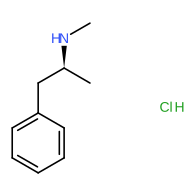
| Dextromethamphetamine hydrochloride | |
 | |
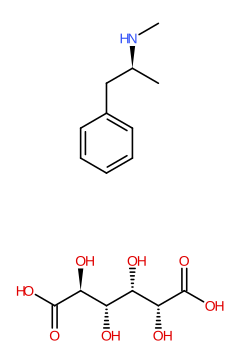
| Dextromethamphetamine saccharate | |
 | |
| Dextromethamphetamine tartrate | |
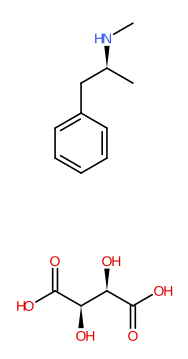 |
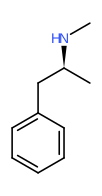
| Molecular structure drawn from PubChem coordinates |
| Rotamer [] | |
|---|---|
| Conformer structure via 3Dmol.js |
| Physical properties [] | |
|---|---|
| Molecular mass | 149.23 g/mol [1] |
| Appearance | Clear, colorless liquid [1] |
| Odor | Characteristic odor resembling geranium leaves [1] |
| Taste | Bitter-tasting [1] |
| Melting point | 170-2 °C [1] |
| Boiling point | 212 °C [1] |
| Decomposition | When heated to decomposition it emits toxic vapors of Nitric oxides. [1] |
| Solubility | In water, 0.5 g/mL [1] |
| Predicted LogP | 2.1 [1] |
| Structural Identifiers [] | |
|---|---|
| Molecular formula | C10H15N |
| IUPAC name | (2S)-N-methyl-1-phenylpropan-2-amine |
| SMILES | C[C@@H](CC1=CC=CC=C1)NC |
| InChI | InChI=1S/C10H15N/c1-9(11-2)8-10-6-4-3-5-7-10/h3-7,9,11H,8H2,1-2H3/t9-/m0/s1 |
| InChIKey | MYWUZJCMWCOHBA-VIFPVBQESA-N |
| CAS number | 537-46-2 |
| UNII | 44RAL3456C |
| PubChem CID | 10836 |
| Pharmacokinetics[] | |
|---|---|
| Onset | Oral: 3 hours (peak), Intranasal: <15 minutes, Inhalation: <18 minutes, Intravenous: <15 minutes |
| Elimination half-life | 9–12 hours (range 5–30 hours); irrespective of route |
| Duration of action | 8–12 hours[3] |
| Metabolism | CYP2D6 and FMO3[4] |
| Excretion | Primarily kidney |
| Routes of administration | By mouth, intravenous, intramuscular, subcutaneous, inhalation, insufflation, rectal, vaginal |
| Addiction liability | Very high |
| Toxicity [] | |
|---|---|
| LD50 | Mouse: - intraperitoneal: 70 mg/kg [1] |
| Dosing[] |
|---|
| Insufflated [] | |
|---|---|
| Light | ≤ 15 mg(34x - 41.5%) |
| Common | 15 - 20 mg(13x - 15.9%) |
| Strong | 20 - 27.3 mg(14x - 17.1%) |
| Heavy | 27.3 - 31.8 mg(12x - 14.6%) |
| Extreme | 31.8 mg +(9x - 11.0%) |
| Intravenous [] | |
|---|---|
| Light | ≤ 56.2 mg(30x - 47.6%) |
| Common | 56.2 - 130 mg(2x - 3.2%) |
| Strong | 130 - 180 mg(22x - 34.9%) |
| Heavy | 180 - 200 mg(6x - 9.5%) |
| Extreme | 200 mg +(3x - 4.8%) |
| Oral [] | |
|---|---|
| Light | ≤ 20 mg(5x - 83.3%) |
| Common | 20 mg |
| Strong | 20 mg |
| Heavy | 20 - 22 mg |
| Extreme | 22 mg +(1x - 16.7%) |
| Intrarectal [] | |
|---|---|
| Light | ≤ 51.2 mg(4x - 57.1%) |
| Common | 51.2 mg |
| Strong | 40 - 200 mg(1x - 14.3%) |
| Heavy | 200 - 300 mg(2x - 28.6%) |
| Extreme | 300 mg + |
| Vaporized [] | |
|---|---|
| Light | ≤ 11.1 mg(12x - 57.1%) |
| Common | 11.1 mg |
| Strong | 10 - 25 mg(4x - 19.0%) |
| Heavy | 25 - 50 mg(4x - 19.0%) |
| Extreme | 50 mg +(1x - 4.8%) |
Statistically derived dosages via DBI-IGS (archived by anodyne.wiki) We do not take any responsibility for medical complications or loss of life sustained by following these dosages blindly. |
Dextromethamphetamine (also known as Metamfetamine, d-Deoxyephedrine, Metamphetamine, d-Desoxyephedrine, d-Methylamphetamine, d-N-Methylamphetamine, Norodin, (S)-Methamphetamine, d-Phenylisopropylmethylamine or N-Methylamphetamine) is a antidepressant, depressant and stimulant substance of the amphetamine class.
Chemistry
Salts []
Stereochemistry []
Dextromethamphetamine is a single defined stereoisomer (optical activity ( + )).
Druglikeness
Lipinski's rule of five
Dextromethamphetamine matches Lipinski's rule of five.Pharmacology
ATC Classification
- nervous system (N)
- psychoanaleptics (N06)
- psychostimulants, agents used for adhd and nootropics (N06B)
- centrally acting sympathomimetics (N06BA)
- metamfetamine (N06BA03)
MeSH Classification
- central nervous system stimulants (M0001063)
- sympathomimetics (M0020947)
- dopamine agents (M0023499)
- adrenergic agents (M0027961)
- adrenergic uptake inhibitors (M0028095)
- dopamine uptake inhibitors (M0028098)
Mechanism of action []
Methamphetamine enters the brain and triggers a cascading release of norepinephrine, dopamine and serotonin. To a lesser extent methamphetamine acts as a dopaminergic and adrenergic reuptake inhibitor and in high concentrations as a monamine oxidase inhibitor (MAOI). The mechanism of action involved in producing the beneficial behavioral changes seen in hyperkinetic children receiving methamphetamine is unknown. [1]
Prodrugs of dextromethamphetamine: Benzphetamine.
Interactions []
Subjective effects []
| 0xea / Dextromethamphetamine [] | |
|---|---|
Routes:
| |
Legal status []
- Australia: Dextromethamphetamine is a Schedule 8.
- Brazil: Dextromethamphetamine is a F2.[5]
- Canada: Dextromethamphetamine is a Schedule I.
- Germany: Dextromethamphetamine is a Anlage II under the "Betäubungsmittelgesetz (BtMG)".
- New Zealand: Dextromethamphetamine is a Class A.
- United Kingdom: Dextromethamphetamine is a Class A under the "Misuse of Drugs Act 1971".
- United States: Dextromethamphetamine is a Schedule II under the "Controlled Substances Act".[6]
- European Union: Dextromethamphetamine is Prescription only.
- United Nations: Dextromethamphetamine is a Psychotropic Schedule II.
- Other: Dextromethamphetamine is a SE: Förteckning II.[7]
External links []
- Dextromethamphetamine (Wikipedia)
- Dextromethamphetamine (PubChem)
- Dextromethamphetamine (Wikidata)
- Dextromethamphetamine (DrugBank)
- Dextromethamphetamine (ChEMBL)
- Dextromethamphetamine (ChEBI)
- Dextromethamphetamine (Common Chemistry)
- Dextromethamphetamine (HMDB)
- Dextromethamphetamine (KEGG)
- Dextromethamphetamine (EPA DSSTox)
- Dextromethamphetamine (Effect Index)
- Dextromethamphetamine (UNII)
References []
National Center for Biotechnology Information. PubChem Compound Summary for CID 10836, Dextromethamphetamine. Accessed November 20, 2026. https://pubchem.ncbi.nlm.nih.gov/compound/10836
U.S. Food and Drug Administration; National Center for Advancing Translational Sciences. Dextromethamphetamine. UNII: 44RAL3456C. Global Substance Registration System. Accessed November 20, 2026. https://gsrs.ncats.nih.gov/ginas/app/beta/substances/44RAL3456C
Courtney KE, Ray LA. Methamphetamine: an update on epidemiology, pharmacology, clinical phenomenology, and treatment literature. Drug Alcohol Depend. October 2014; 143():11–21. PMID 25176528.
Sellers EM, Tyndale RF. Mimicking gene defects to treat drug dependence. Ann. N. Y. Acad. Sci. 2000; 909(1):233–246. PMID 10911933. https://doi.org/10.1111/j.1749-6632.2000.tb06685.x
RDC Nº 804 – Listas de Substâncias Entorpecentes, Psicotrópicas, Precursoras e Outras sob Controle Especial. Diário Oficial da União. 24 July 2023. https://www.in.gov.br/en/web/dou/-/resolucao-rdc-n-804-de-24-de-julho-de-2023-498447451
Ingersoll J. Amphetamine, Methamphetamine, and Optical Isomers. Federal Register. 7 July 1971. https://archives.federalregister.gov/issue_slice/1971/7/7/12730-12734.pdf
Desoxyn®, Tablett 5 mg. E-hälsomyndigheten. https://vara.ehalsomyndigheten.se/vara-web/visaProdukt.xhtml?id=20130603019155
Data sources []
| Source | Status | Updated (UTC) |
|---|---|---|
| dosing | ok | 2026-11-20 04:01:05 |
| drugspro | missing (no DrugsPRO reagent data) | 2026-11-20 04:01:01 |
| erowid | missing (no Erowid substance of that name) | 2026-11-20 04:01:01 |
| gsrs | ok | 2026-11-20 04:01:04 |
| hmdb | missing (hmdb.ca refused automated access to HMDB0015517) | 2026-11-20 04:01:01 |
| kegg | ok | 2026-11-20 04:01:04 |
| pubchem | ok | 2026-11-20 04:01:01 |
| missing (no r/tripreports posts mention it) | 2026-11-20 04:01:01 | |
| sider | missing (not in SIDER) | 2026-11-20 04:01:01 |
| structure | ok | 2026-11-20 04:01:01 |
| wikipedia | ok | 2026-11-20 04:01:02 |