Glucose
| Glucose | |
|---|---|
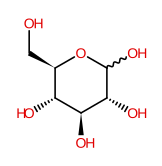 |
| Molecular structure drawn from PubChem coordinates |
| Physical properties [] | |
|---|---|
| Molecular mass | 180.16 g/mol [1] |
| Appearance | Colorless crystals or white granular powder [1] |
| Odor | Odorless [1] |
| Taste | Sweet [1] |
| Density | 1.2 at 68 °F (est.) (USCG, 1999) - Denser than water; will sink [1] |
| Melting point | less than 32 °F (USCG, 1999) [1] |
| Boiling point | greater than 212 °F at 760 mmHg (USCG, 1999) [1] |
| Decomposition | When heated to decomposition it emits acrid smoke and irritating fumes. [1] |
| Solubility | Soluble [1] |
| Predicted LogP | -2.6 [1] |
| Structural Identifiers [] | |
|---|---|
| Molecular formula | C6H12O6 |
| IUPAC name | (3R,4S,5S,6R)-6-(hydroxymethyl)oxane-2,3,4,5-tetrol |
| SMILES | C([C@@H]1[C@H]([C@@H]([C@H](C(O1)O)O)O)O)O |
| InChI | InChI=1S/C6H12O6/c7-1-2-3(8)4(9)5(10)6(11)12-2/h2-11H,1H2/t2-,3-,4+,5-,6?/m1/s1 |
| InChIKey | WQZGKKKJIJFFOK-GASJEMHNSA-N |
| CAS number | 50-99-7 |
| PubChem CID | 5793 |
| Toxicity [] | |
|---|---|
| LD50 | Mouse: - intravenous: 9 g/kg Rat: - oral: 25,800 mg/kg [1] |
Glucose (also known as D-Glucopyranose, Glucopyranose, Grape sugar, Blood sugar, Traubenzucker, D-Glc, Glucosteril, Cartose, anhydrous glucose or Maxim Energy Gel).
Chemistry
Stereochemistry []
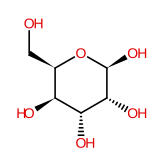
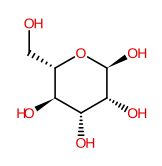
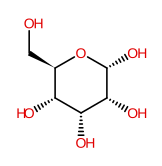
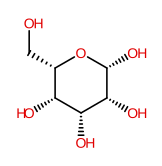
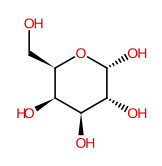
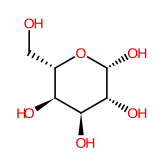
Glucose is a racemic mixture of the enantiomers.
| Stereoisomerism |
|---|
| Stereoisomers from PubChem |
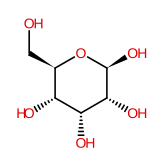
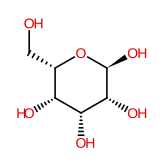
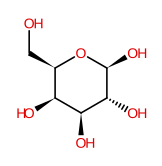
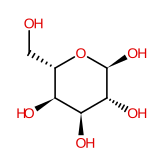
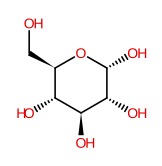
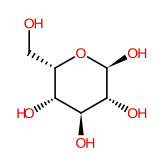
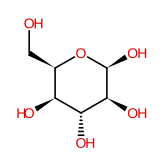
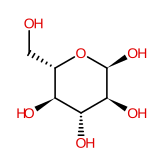
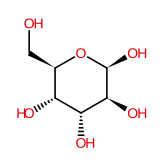
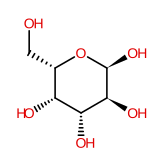
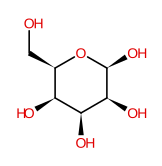
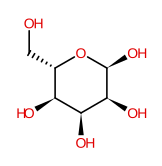
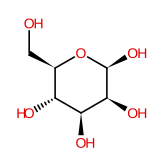
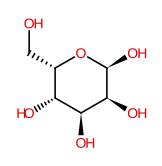
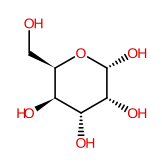
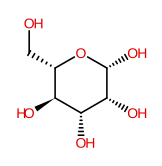
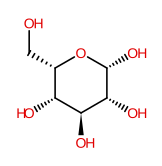
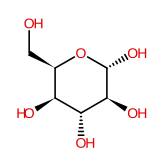
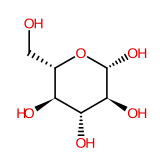
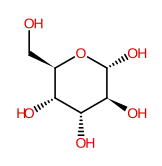
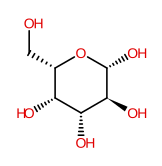
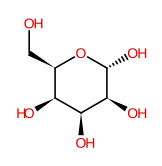
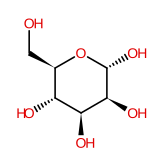
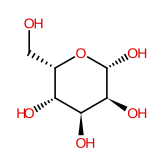
Druglikeness
Lipinski's rule of five
Glucose matches Lipinski's rule of five.Pharmacology
ATC Classification
- blood and blood forming organs (B)
- blood substitutes and perfusion solutions (B05)
- irrigating solutions (B05C)
- other irrigating solutions (B05CX)
- (B05CX01)
- glucose (B05CX01)
- various (V)
- diagnostic agents (V04)
- other diagnostic agents (V04C)
- tests for diabetes (V04CA)
- glucose (V04CA02)
- general nutrients (V06)
- other nutrients (V06D)
- carbohydrates (V06DC)
- glucose (V06DC01)
MeSH Classification
- sweetening agents (M0020928)
Mechanism of action []
Glucose supplies most of the energy to all tissues by generating energy molecules ATP and NADH during a series of metabolism reactions called glycolysis. Glycolysis can be divided into two main phases where the preparatory phase is initiated by the phosphorylation of glucose by hexokinase to form glucose 6-phosphate. The addition of the high-energy phosphate group activates glucose for the subsequent breakdown in later steps of glycolysis and is the rate-limiting step. Products end up as substrates for following reactions, to ultimately convert C6 glucose molecule into two C3 sugar molecules. These products enter the energy-releasing phase where the total of 4ATP and 2NADH molecules are generated per one glucose molecule. The total aerobic metabolism of glucose can produce up to 36 ATP molecules. These energy-producing reactions of glucose are limited to D-glucose as L-glucose cannot be phosphorylated by hexokinase. Glucose can act as precursors to generate other biomolecules such as vitamin C. It plays a role as a signaling molecule to control glucose and energy homeostasis. Glucose can regulate gene transcription, enzyme activity, hormone secretion, and the activity of glucoregulatory neurons. The types, number, and kinetics of glucose transporters expressed depends on the tissues and fine-tunes glucose uptake, metabolism, and signal generation to preserve cellular and whole body metabolic integrity. [1]
Medical side effects []
38 side effects listed on drug labels in SIDER 4.1 (glucose).
- Abscess
- Acidosis
- Asthenia
- Nervous system disorder
- Coma
- Confusional state
- Feeling abnormal
- Dehydration
- Dizziness
- Oedema
- Extravasation
- Body temperature increased
- Headache
- Cardiac failure congestive
- Haemolysis
- Hypernatraemia
- Hypertension
- Hypokalaemia
- Irritability
- Necrosis
- Pain
- Phlebitis
- Pulmonary embolism
- Salivary hypersecretion
- Convulsion
- Shock
- Tachycardia
- Thirst
- Thrombophlebitis
- Loss of consciousness
- Venous thrombosis
- Agitation
- Tenderness
- Lacrimation increased
- Fluid retention
- Fluid overload
- Respiratory failure
- Somnolence
Indications
- Cardiac failure congestive
- Hepatic cirrhosis
- Hyperglycaemia
- Hyperinsulinism
- Hypernatraemia
- Hypoglycaemia
- Hypoglycaemic episode
- Insulin hypoglycemia
- Oedema
- Renal impairment
- Shock insulin
- Varicose vein
- Wound
External links []
References []
National Center for Biotechnology Information. PubChem Compound Summary for CID 5793, Glucose. Accessed November 21, 2026. https://pubchem.ncbi.nlm.nih.gov/compound/5793
Data sources []
| Source | Status | Updated (UTC) |
|---|---|---|
| dosing | missing (no dosing statistics) | 2026-11-20 03:04:42 |
| drugspro | missing (no DrugsPRO reagent data) | 2026-11-20 03:05:18 |
| erowid | missing (no Erowid substance of that name) | 2026-11-20 03:04:38 |
| gsrs | missing (no UNII) | 2026-11-20 03:04:38 |
| hmdb | missing (hmdb.ca refused automated access to HMDB0304632) | 2026-11-20 03:04:38 |
| kegg | ok | 2026-11-20 03:04:42 |
| pubchem | ok | 2026-11-20 03:04:20 |
| missing (no r/tripreports posts mention it) | 2026-11-20 03:04:38 | |
| sider | ok | 2026-11-20 03:04:39 |
| structure | ok | 2026-11-20 03:04:38 |
| wikipedia | missing (no Wikipedia article with a drug infobox) | 2026-11-20 03:04:38 |