Dichlorodiethyl sulfide
| Mustard gas | |
|---|---|
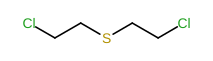 |
| Molecular structure drawn from PubChem coordinates |
| Physical properties [] | |
|---|---|
| Molecular mass | 159.08 g/mol [1] |
| Appearance | Colorless, oily liquid when pure [1] |
| Odor | Weak, sweet, agreeable odor [1] |
| Density | 1.274 at 68 °F (EPA, 1998) - Denser than water; will sink [1] |
| Melting point | 55 to 57 °F (EPA, 1998) [1] |
| Boiling point | 419 to 423 °F at 760 mmHg (EPA, 1998) [1] |
| Decomposition | In pure aqueous media, most sulfur mustard is hydrolyzed to thiodiglycol and hydrochloric acid. [1] |
| Solubility | In water, 609 mg/L at 25 °C [1] |
| Predicted LogP | 2.1 [1] |
| Structural Identifiers [] | |
|---|---|
| Molecular formula | C4H8Cl2S |
| IUPAC name | 1-chloro-2-(2-chloroethylsulfanyl)ethane |
| SMILES | C(CCl)SCCCl |
| InChI | InChI=1S/C4H8Cl2S/c5-1-3-7-4-2-6/h1-4H2 |
| InChIKey | QKSKPIVNLNLAAV-UHFFFAOYSA-N |
| CAS number | 505-60-2 |
| UNII | T8KEC9FH9P |
| PubChem CID | 10461 |
| Toxicity [] | |
|---|---|
| LD50 | Rat: - percutaneous: 9 mg/kg [1] |
| LC50 | Monkey: - inhalation: 80 mg/cu Rabbit: - inhalation: 280 mg/cu Rat: - inhalation: 100 mg/cu [1] |
Dichlorodiethyl sulfide (also known as Yperite, Senfgas, Iprit, Lost, Bis(2-chloroethyl) sulfide, Schwefel-lost, Yellow cross liquid, Mustard, sulfur, Distilled mustard or S-Lost) is a substance of the thioether class.
Chemistry
Stereochemistry []
Dichlorodiethyl sulfide is achiral.
Druglikeness
Lipinski's rule of five
Dichlorodiethyl sulfide matches Lipinski's rule of five.Pharmacology
MeSH Classification
Mechanism of action []
Low-dose exposure of alkylating mustard gas causes long-term respiratory complications characterized by bronchitis and lung fibrosis. In this study, we utilized a mouse model for lung exposure of the nitrogen mustard melphalan, in order to define early and late events in the pathogenesis such as expression of pro-inflammatory cytokines, recruitment of inflammatory cells to airways and late-phase fibrosis. /The authors/ investigated the roles of different T lymphocyte subsets on the inflammatory response by using knockout mice lacking either the genes expressing T cell receptor (TCR)-alpha beta or TCR-gamma delta, and compared the responsiveness with that of wild type mice and double knockout mice completely deficient in T cells. Exposure to melphalan induced an early burst of the pro-inflammatory cytokines interleukin (IL)-1beta, IL-6 and IL-23 in airways, followed by extensive infiltration of neutrophils in the lung tissue and airways within 24hr. The acute phase was followed by a sustained lymphocytic response that persisted for at least 14 days with resulting lung fibrosis. Engagement of T lymphocytes, particularly the gamma delta T cell subset, was crucial both for the acute cytokine and neutrophil response and for the late-phase lung fibrosis as indicated by the lack of response in gamma delta T cell deficient mice. /The/ data demonstrate that T lymphocytes play a prominent role in the pathogenesis of long-term lung injuries caused by strong alkylating agents. [1]
See also []
External links []
- Dichlorodiethyl sulfide (PubChem)
- Dichlorodiethyl sulfide (Wikidata)
- Dichlorodiethyl sulfide (ChEMBL)
- Dichlorodiethyl sulfide (ChEBI)
- Dichlorodiethyl sulfide (Common Chemistry)
- Dichlorodiethyl sulfide (HMDB)
- Dichlorodiethyl sulfide (KEGG)
- Dichlorodiethyl sulfide (EPA DSSTox)
- Dichlorodiethyl sulfide (Effect Index)
- Dichlorodiethyl sulfide (UNII)
References []
National Center for Biotechnology Information. PubChem Compound Summary for CID 10461, Dichlorodiethyl sulfide. Accessed November 22, 2026. https://pubchem.ncbi.nlm.nih.gov/compound/10461
U.S. Food and Drug Administration; National Center for Advancing Translational Sciences. Dichlorodiethyl sulfide. UNII: T8KEC9FH9P. Global Substance Registration System. Accessed November 22, 2026. https://gsrs.ncats.nih.gov/ginas/app/beta/substances/T8KEC9FH9P
Data sources []
| Source | Status | Updated (UTC) |
|---|---|---|
| dosing | missing (no dosing statistics) | 2026-11-20 18:53:53 |
| drugspro | missing (no DrugsPRO reagent data) | 2026-11-20 18:53:49 |
| erowid | missing (no Erowid substance of that name) | 2026-11-20 18:53:49 |
| gsrs | ok | 2026-11-20 18:53:50 |
| hmdb | missing (hmdb.ca refused automated access to HMDB0254958) | 2026-11-20 18:53:49 |
| kegg | missing (no KEGG DRUG entry) | 2026-11-20 18:53:54 |
| pubchem | ok | 2026-11-20 18:53:49 |
| missing (no r/tripreports posts mention it) | 2026-11-20 18:53:49 | |
| sider | missing (not in SIDER) | 2026-11-20 18:53:49 |
| structure | ok | 2026-11-20 18:53:49 |
| wikipedia | missing (no Wikipedia article with a drug infobox) | 2026-11-20 18:53:50 |