Dichlorodiphenyltrichloroethane
| DDT | |
|---|---|
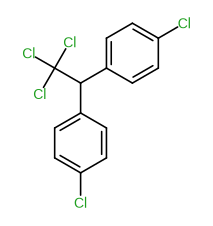 |
| Molecular structure drawn from PubChem coordinates |
| Physical properties [] | |
|---|---|
| Molecular mass | 354.50 g/mol [1] |
| Appearance | Biaxial elongated tablets, needles from 95% alcohol [1] |
| Odor | Odorless or with slight aromatic odor [1] |
| Density | 1.56 at 59 °F (USCG, 1999) - Denser than water; will sink [1] |
| Melting point | 227 to 228 °F (NTP, 1992) [1] |
| Boiling point | 500 °F at 760 mmHg (NTP, 1992) [1] |
| Decomposition | Decomp at 110 °C; dehydrochlorinates in alkali or org bases when in org solvents [1] |
| Solubility | less than 1 mg/mL at 70 °F (NTP, 1992) [1] |
| Predicted LogP | 6.9 [1] |
| Structural Identifiers [] | |
|---|---|
| Molecular formula | C14H9Cl5 |
| IUPAC name | 1-chloro-4-[2,2,2-trichloro-1-(4-chlorophenyl)ethyl]benzene |
| SMILES | C1=CC(=CC=C1C(C2=CC=C(C=C2)Cl)C(Cl)(Cl)Cl)Cl |
| InChI | InChI=1S/C14H9Cl5/c15-11-5-1-9(2-6-11)13(14(17,18)19)10-3-7-12(16)8-4-10/h1-8,13H |
| InChIKey | YVGGHNCTFXOJCH-UHFFFAOYSA-N |
| CAS number | 50-29-3 |
| UNII | CIW5S16655 |
| PubChem CID | 3036 |
| Toxicity [] | |
|---|---|
| LD50 | Dog: - oral: 500-750 Female: - rat percutaneous: 2510 mg/kg Mouse: - oral: 150-300 Rat: - Oral: 87 mg/kg [1] |
Dichlorodiphenyltrichloroethane (also known as Clofenotane, p,p'-DDT, Chlorophenothane, Dicophane, 4,4'-ddt, Chlorphenothan, Pentachlorin, Chlorphenotoxum, Parachlorocidum or Agritan) is a substance of the alkylbenzene class.
Chemistry
Stereochemistry []
Dichlorodiphenyltrichloroethane is achiral.
Druglikeness
Lipinski's rule of five
Dichlorodiphenyltrichloroethane matches Lipinski's rule of five (violations: 1).Pharmacology
ATC Classification
- antiparasitic products, insecticides and repellents (P)
- ectoparasiticides, incl. scabicides, insecticides and repellents (P03)
- ectoparasiticides, incl. scabicides (P03A)
- chlorine containing products (P03AB)
- clofenotane (P03AB01)
Mechanism of action []
The temporal and dose-dependent hepatic estrogenicity of o,p'-DDT was investigated using complementary DNA microarrays in immature ovariectomized Sprague-Dawley rats with complementary histopathology and tissue-level analysis. Animals were gavaged with 300 mg/kg o,p'-DDT either once or once daily for 3 consecutive days. Liver samples were examined 2, 4, 8, 12, 18, or 24 h after a single dose or following three daily doses. For dose-response studies, a single dose of 3, 10, 30, 100, or 300 mg/kg body weight o,p'-DTT was administered for 3 consecutive days. Genes associated with drug metabolism (Cyp2b2 and Cyp3a2), the nuclear receptors constitutive androstane receptor (CAR) and pregnane X receptor (PXR), cell proliferation (Ccnd1, Ccnb1, Ccnb2, and Stmn1), and oxidative stress (Gclm and Hmox1) were significantly induced. Cyp2b2 exhibited dose-dependent regulation and was significantly induced across all time points, while cell proliferation- and oxidative stress-related genes exhibited transient induction. The induction of Cyp2b2 and Cyp3a2 mRNA levels suggest PXR/CAR activation, consistent with expression of genes associated with oxidative stress. Few genes known to be estrogen receptor (ER) regulated were differentially expressed when compared to the hepatic gene expression profile elicited by ethynyl estradiol in immature ovariectomized C57BL/6 mice using the same study design and analysis methods. These data indicate that o,p'-DDT elicits PXR/CAR-, not ER-, mediated gene expression in the rat liver. Based on the species-specific differences in CAR regulation, the extrapolation of rodent DDT hepatocarcinogenicity to humans warrants further investigation. [1]
See also []
External links []
- Dichlorodiphenyltrichloroethane (PubChem)
- Dichlorodiphenyltrichloroethane (Wikidata)
- Dichlorodiphenyltrichloroethane (DrugBank)
- Dichlorodiphenyltrichloroethane (ChEMBL)
- Dichlorodiphenyltrichloroethane (ChEBI)
- Dichlorodiphenyltrichloroethane (Common Chemistry)
- Dichlorodiphenyltrichloroethane (HMDB)
- Dichlorodiphenyltrichloroethane (KEGG)
- Dichlorodiphenyltrichloroethane (EPA DSSTox)
- Dichlorodiphenyltrichloroethane (Effect Index)
- Dichlorodiphenyltrichloroethane (UNII)
References []
National Center for Biotechnology Information. PubChem Compound Summary for CID 3036, Dichlorodiphenyltrichloroethane. Accessed November 24, 2026. https://pubchem.ncbi.nlm.nih.gov/compound/3036
U.S. Food and Drug Administration; National Center for Advancing Translational Sciences. Dichlorodiphenyltrichloroethane. UNII: CIW5S16655. Global Substance Registration System. Accessed November 24, 2026. https://gsrs.ncats.nih.gov/ginas/app/beta/substances/CIW5S16655
Data sources []
| Source | Status | Updated (UTC) |
|---|---|---|
| dosing | missing (no dosing statistics) | 2026-11-20 21:00:23 |
| drugspro | missing (no DrugsPRO reagent data) | 2026-11-20 21:00:19 |
| erowid | missing (no Erowid substance of that name) | 2026-11-20 21:00:19 |
| gsrs | ok | 2026-11-20 21:00:19 |
| hmdb | missing (hmdb.ca refused automated access to HMDB0032127) | 2026-11-20 21:00:19 |
| kegg | ok | 2026-11-20 21:00:21 |
| pubchem | ok | 2026-11-20 21:00:19 |
| missing (no r/tripreports posts mention it) | 2026-11-20 21:00:19 | |
| sider | missing (not in SIDER) | 2026-11-20 21:00:19 |
| structure | ok | 2026-11-20 21:00:19 |
| wikipedia | missing (no Wikipedia article with a drug infobox) | 2026-11-20 21:00:20 |