Dihydrocodeine
| Dihydrocodeine | |
|---|---|
 |
| Salts [] | |
|---|---|
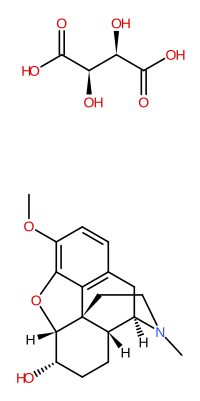
| Dihydrocodeine bitartrate | |
 | |
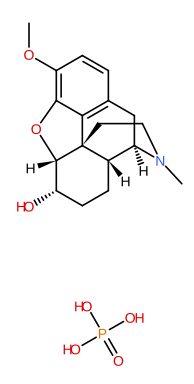
| Dihydrocodeine phosphate | |
 | |
| Dihydrocodeine hydrochloride | |
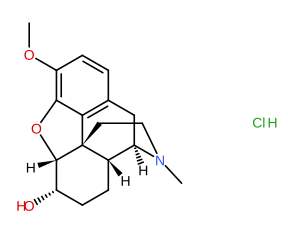 |
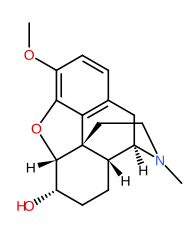
| Molecular structure drawn from PubChem coordinates |
| Physical properties [] | |
|---|---|
| Molecular mass | 301.40 g/mol [1] |
| Melting point | 112.5 °C [1] |
| Predicted LogP | 2.2 [1] |
| Structural Identifiers [] | |
|---|---|
| Molecular formula | C18H23NO3 |
| IUPAC name | (4R,4aR,7S,7aR,12bS)-9-methoxy-3-methyl-2,4,4a,5,6,7,7a,13-octahydro-1H-4,12-methanobenzofuro[3,2-e]isoquinolin-7-ol |
| SMILES | CN1CC[C@]23[C@@H]4[C@H]1CC5=C2C(=C(C=C5)OC)O[C@H]3[C@H](CC4)O |
| InChI | InChI=1S/C18H23NO3/c1-19-8-7-18-11-4-5-13(20)17(18)22-16-14(21-2)6-3-10(15(16)18)9-12(11)19/h3,6,11-13,17,20H,4-5,7-9H2,1-2H3/t11-,12+,13-,17-,18-/m0/s1 |
| InChIKey | RBOXVHNMENFORY-DNJOTXNNSA-N |
| CAS number | 125-28-0 |
| UNII | N9I9HDB855 |
| PubChem CID | 5284543 |
| Pharmacokinetics[] | |
|---|---|
| Elimination half-life | 4 hours |
| Routes of administration | Oral, subcutaneous, intramuscular, rectal, sublingual, buccal |
| Dependence liability | High |
| Addiction liability | High |
| Dosing[] |
|---|
| Oral [] | |
|---|---|
| Threshold | 8 |
| Light | ≤ 8 |
| Common | 8 - 30 |
| Strong | 30 - 60 |
| Heavy | 60 - 105 |
Statistically derived dosages via DBI-IGS (archived by anodyne.wiki) We do not take any responsibility for medical complications or loss of life sustained by following these dosages blindly. |
Dihydrocodeine (also known as Rapacodin, Novicondin, Codhydrine, Dehacodin, Hydrocodeine, 8,14-Dihydroneopine, Dihidrocodeina, Dihydroneopine, Cohydrin or α-Hydrocodol) is a opioid substance of the 2-benzylpiperidine and morphinan class.
Chemistry
Salts []
Dihydrocodeine is typically found in the form of its bitartrate, phosphate and hydrochloride salts.
Stereochemistry []
Dihydrocodeine is a single defined stereoisomer.
Druglikeness
Lipinski's rule of five
Dihydrocodeine matches Lipinski's rule of five.Reagents
There are currently 2 reagent-interactions on DrugsPRO
| Reagent | Color change | Description |
|---|---|---|
| Marquis | violet | |
| Mandelin | grey / > green |
Pharmacology
ATC Classification
- nervous system (N)
- analgesics (N02)
- opioids (N02A)
- natural opium alkaloids (N02AA)
- dihydrocodeine (N02AA08)
MeSH Classification
- analgesics, opioid (M0001068)
Mechanism of action []
Dihydrocodeine is metabolized to dihydromorphine -- a highly active metabolite with a high affinity for mu opioid receptors. [3] [1]
Interactions []
Medical side effects []
44 side effects listed on drug labels in SIDER 4.1 (dihydrocodeine).
- Abdominal pain
- Gastrointestinal pain
- Constipation
- Nausea
- Vomiting
- Dry mouth
- Somnolence
- Angioedema
- Confusional state
- Feeling abnormal
- Diarrhoea
- Dizziness
- Dyspnoea
- Dermatitis
- Rash
- Hallucination
- Headache
- Hyperhidrosis
- Hypotension
- Ileus paralytic
- Paraesthesia
- Pruritus
- Convulsion
- Withdrawal syndrome
- Urticaria
- Vertigo
- Urinary retention
- Mood swings
- Affect lability
- Biliary colic
- Dysphoria
- Respiratory depression
- Pulmonary function test decreased
- Hepatic enzyme increased
- Mental disorder
- Gastrointestinal disorder
- Immune system disorder
- Mediastinal disorder
- Nervous system disorder
- Urethral disorder
- Urinary tract disorder
- Angiopathy
- Skin disorder
- Hepatobiliary disease
Indications
- Chronic pain
- Neoplasm malignant
- Pain
- Postoperative pain
Subjective effects []
Legal status []
- Australia: Dihydrocodeine is a Schedule 3.
- Brazil: Dihydrocodeine is a A2.[3]
- Canada: Dihydrocodeine is a Schedule I.
- Germany: Dihydrocodeine is Prescription only/Anlage III.
- New Zealand: Dihydrocodeine is a Class C2.[4]
- United Kingdom: Dihydrocodeine is a Class B under the "Misuse of Drugs Act 1971".
- United States: Dihydrocodeine is a Schedule II (Schedule III in drug combination) under the "Controlled Substances Act".
External links []
References []
National Center for Biotechnology Information. PubChem Compound Summary for CID 5284543, Dihydrocodeine. Accessed November 20, 2026. https://pubchem.ncbi.nlm.nih.gov/compound/5284543
U.S. Food and Drug Administration; National Center for Advancing Translational Sciences. Dihydrocodeine. UNII: N9I9HDB855. Global Substance Registration System. Accessed November 20, 2026. https://gsrs.ncats.nih.gov/ginas/app/beta/substances/N9I9HDB855
RDC Nº 784 – Listas de Substâncias Entorpecentes, Psicotrópicas, Precursoras e Outras sob Controle Especial. Diário Oficial da União. 2023-03-31. https://www.in.gov.br/en/web/dou/-/resolucao-rdc-n-784-de-31-de-marco-de-2023-474904992
Dihydrocodeine Datasheet. Medsafe. https://www.medsafe.govt.nz/profs/datasheet/d/DHCContinustab.pdf
Data sources []
| Source | Status | Updated (UTC) |
|---|---|---|
| dosing | ok | 2026-11-20 05:19:44 |
| drugspro | ok | 2026-11-20 05:19:40 |
| erowid | missing (no Erowid substance of that name) | 2026-11-20 05:19:40 |
| gsrs | ok | 2026-11-20 05:19:43 |
| hmdb | missing (no HMDB id) | 2026-11-20 05:19:40 |
| kegg | ok | 2026-11-20 05:19:42 |
| pubchem | ok | 2026-11-20 05:19:39 |
| missing (no r/tripreports posts mention it) | 2026-11-20 05:19:40 | |
| sider | ok | 2026-11-20 05:19:40 |
| structure | ok | 2026-11-20 05:19:40 |
| wikipedia | ok | 2026-11-20 05:19:40 |