Disulfiram
| Disulfiram | |
|---|---|
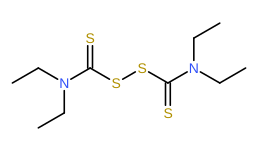 |
| Molecular structure drawn from PubChem coordinates |
| Physical properties [] | |
|---|---|
| Molecular mass | 296.50 g/mol [1] |
| Appearance | WHITE TO OFF-WHITE CRYSTALLINE POWDER [1] |
| Odor | Slight odor. [1] |
| Taste | SLIGHTLY BITTER TASTE [1] |
| Density | 1.27 at 68 °F (NTP, 1992) - Denser than water; will sink [1] |
| Melting point | 158 °F (NTP, 1992) [1] |
| Boiling point | 243 °F at 17 mmHg (NTP, 1992) [1] |
| Solubility | less than 0.1 mg/mL at 70 °F (NTP, 1992) [1] |
| Predicted LogP | 3.9 [1] |
| Structural Identifiers [] | |
|---|---|
| Molecular formula | C10H20N2S4 |
| IUPAC name | diethylcarbamothioylsulfanyl N,N-diethylcarbamodithioate |
| SMILES | CCN(CC)C(=S)SSC(=S)N(CC)CC |
| InChI | InChI=1S/C10H20N2S4/c1-5-11(6-2)9(13)15-16-10(14)12(7-3)8-4/h5-8H2,1-4H3 |
| InChIKey | AUZONCFQVSMFAP-UHFFFAOYSA-N |
| CAS number | 97-77-8 |
| UNII | TR3MLJ1UAI |
| PubChem CID | 3117 |
| Pharmacokinetics[] | |
|---|---|
| Elimination half-life | 7.3 +/-1.5 hours[3][4] |
| Metabolism | In Liver to diethylthiocarbamate |
| Routes of administration | By mouth, subdermal implant |
| Toxicity [] | |
|---|---|
| LD50 | Mouse: - intraperitoneal: 75 mg/kg - oral: 1980 mg/kg Rabbit: - oral: 2050 mg/kg Rat: - oral: 500 mg/kg - oral: 8.6g/kg [1] |
Disulfiram (also known as Tetraethylthiuram disulfide, Antabuse, Bis(diethylthiocarbamoyl) disulfide, Esperal, Teturam, Alcophobin, Antabus, Anticol, Exhorran or Abstinyl).
Chemistry
Stereochemistry []
Disulfiram is achiral.
Druglikeness
Lipinski's rule of five
Disulfiram matches Lipinski's rule of five.Pharmacology
ATC Classification
- nervous system (N)
- other nervous system drugs (N07)
- drugs used in addictive disorders (N07B)
- drugs used in alcohol dependence (N07BB)
- (N07BB01)
- disulfiram (N07BB01)
- antiparasitic products, insecticides and repellents (P)
- ectoparasiticides, incl. scabicides, insecticides and repellents (P03)
- ectoparasiticides, incl. scabicides (P03A)
- sulfur containing products (P03AA)
- disulfiram (P03AA04)
MeSH Classification
Mechanism of action []
Disulfiram blocks the oxidation of alcohol at the acetaldehyde stage during alcohol metabolism following disulfiram intake causing an accumulation of acetaldehyde in the blood producing highly unpleasant symptoms. Disulfiram blocks the oxidation of alcohol through its irreversible inactivation of aldehyde dehydrogenase, which acts in the second step of ethanol utilization. In addition, disulfiram competitively binds and inhibits the peripheral benzodiazepine receptor, which may indicate some value in the treatment of the symptoms of alcohol withdrawal, however this activity has not been extensively studied. [1]
Interactions []
Medical side effects []
32 side effects listed on drug labels in SIDER 4.1 (disulfiram).
- Asthenia
- Fatigue
- Dermatitis atopic
- Dizziness
- Somnolence
- Lassitude
- Fatigability
- Breath odour
- Headache
- Hepatitis
- Jaundice
- Neuritis
- Neuropathy peripheral
- Neuropathy
- Hypoaesthesia
- Sensory loss
- Optic neuritis
- Pain
- Polyneuropathy
- Psychotic disorder
- Stress
- Hepatic failure
- Hepatic necrosis
- Eye pain
- Dermatitis acneiform
- Tenderness
- Abdominal discomfort
- Erectile dysfunction
- Rash
- Hepatitis fulminant
- Peripheral sensorimotor neuropathy
- Paraesthesia
Indications
- Alcoholism
- Flushing
- Lipids increased
- Nausea
- Palpitations
- Throbbing headache
- Vomiting
Experience reports
Legal status []
- Australia: Disulfiram is a S6 / S4.
- Brazil: Disulfiram is a C1.[5]
- United Kingdom: Disulfiram is Prescription only.
- United States: Disulfiram is Prescription only.
External links []
References []
National Center for Biotechnology Information. PubChem Compound Summary for CID 3117, Disulfiram. Accessed November 20, 2026. https://pubchem.ncbi.nlm.nih.gov/compound/3117
U.S. Food and Drug Administration; National Center for Advancing Translational Sciences. Disulfiram. UNII: TR3MLJ1UAI. Global Substance Registration System. Accessed November 20, 2026. https://gsrs.ncats.nih.gov/ginas/app/beta/substances/TR3MLJ1UAI
Disulfiram. PubChem. https://pubchem.ncbi.nlm.nih.gov/compound/Disulfiram
Lanz J, Biniaz-Harris N, Kuvaldina M, Jain S, Lewis K, Fallon BA. Disulfiram: Mechanisms, Applications, and Challenges. Antibiotics. March 2023; 12(3):1234. PMID 36978391. https://doi.org/10.3390/antibiotics12030524
RDC Nº 784 - Listas de Substâncias Entorpecentes, Psicotrópicas, Precursoras e Outras sob Controle Especial. Diário Oficial da União. 2023-03-31. https://www.in.gov.br/en/web/dou/-/resolucao-rdc-n-784-de-31-de-marco-de-2023-474904992
Data sources []
| Source | Status | Updated (UTC) |
|---|---|---|
| dosing | missing (no dosing statistics) | 2026-11-20 20:01:53 |
| drugspro | missing (no DrugsPRO reagent data) | 2026-11-20 20:01:49 |
| erowid | ok | 2026-11-20 20:01:51 |
| gsrs | ok | 2026-11-20 20:01:49 |
| hmdb | missing (hmdb.ca refused automated access to HMDB0014960) | 2026-11-20 20:01:49 |
| kegg | ok | 2026-11-20 20:01:51 |
| pubchem | ok | 2026-11-20 20:01:48 |
| missing (no r/tripreports posts mention it) | 2026-11-20 20:01:49 | |
| sider | ok | 2026-11-20 20:01:49 |
| structure | ok | 2026-11-20 20:01:49 |
| wikipedia | ok | 2026-11-20 20:01:49 |