Efavirenz
| Efavirenz | |
|---|---|
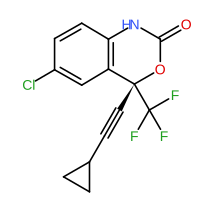 |
| Molecular structure drawn from PubChem coordinates |
| Rotamer [] | |
|---|---|
| Conformer structure via 3Dmol.js |
| Physical properties [] | |
|---|---|
| Molecular mass | 315.67 g/mol [1] |
| Appearance | Crystals from toluene:heptane [1] |
| Melting point | 139-141 °C [1] |
| Solubility | Practically insoluble in water (less than 10 mg/L) [1] |
| Predicted LogP | 4 [1] |
| Structural Identifiers [] | |
|---|---|
| Molecular formula | C14H9ClF3NO2 |
| IUPAC name | (4S)-6-chloro-4-(2-cyclopropylethynyl)-4-(trifluoromethyl)-1H-3,1-benzoxazin-2-one |
| SMILES | C1CC1C#C[C@]2(C3=C(C=CC(=C3)Cl)NC(=O)O2)C(F)(F)F |
| InChI | InChI=1S/C14H9ClF3NO2/c15-9-3-4-11-10(7-9)13(14(16,17)18,21-12(20)19-11)6-5-8-1-2-8/h3-4,7-8H,1-2H2,(H,19,20)/t13-/m0/s1 |
| InChIKey | XPOQHMRABVBWPR-ZDUSSCGKSA-N |
| CAS number | 154598-52-4 |
| UNII | JE6H2O27P8 |
| PubChem CID | 64139 |
| Pharmacokinetics[] | |
|---|---|
| Onset | 3–5 hours |
| Elimination half-life | Single-dose: 52–76 h, Multi-dose: 40–55 h |
| Metabolism | Liver (CYP2A6 and CYP2B6-mediated) |
| Excretion | Kidney (14–34%) and feces (16–61%) |
| Routes of administration | By mouth (capsules, tablets) |
Efavirenz (also known as Sustiva, Stocrin, Dmp-266, (-)-Efavirenz, Viraday, Efavirenz teva, Efavirenzum, L-743726, L-743,726 or efavirenz, (S)-) is a antiretroviral and psychedelic substance of the aniline class.
Chemistry
Stereochemistry []
Efavirenz is a single defined stereoisomer (optical activity ( - )).
Druglikeness
Lipinski's rule of five
Efavirenz matches Lipinski's rule of five.Pharmacology
ATC Classification
- antiinfectives for systemic use (J)
- antivirals for systemic use (J05)
- direct acting antivirals (J05A)
- non-nucleoside reverse transcriptase inhibitors (J05AG)
- (J05AG03)
- efavirenz (J05AG03)
MeSH Classification
- reverse transcriptase inhibitors (M0028255)
- cytochrome p-450 cyp2c9 inhibitors (M0590379)
- cytochrome p-450 cyp2c19 inhibitors (M0590380)
- cytochrome p-450 cyp2b6 inducers (M0590393)
- cytochrome p-450 cyp3a inducers (M0590399)
Mechanism of action []
Similar to zidovudine, efavirenz inhibits the activity of viral RNA-directed DNA polymerase (i.e., reverse transcriptase). Antiviral activity of efavirenz is dependent on intracellular conversion to the active triphosphorylated form. The rate of efavirenz phosphorylation varies, depending on cell type. It is believed that inhibition of reverse transcriptase interferes with the generation of DNA copies of viral RNA, which, in turn, are necessary for synthesis of new virions. Intracellular enzymes subsequently eliminate the HIV particle that previously had been uncoated, and left unprotected, during entry into the host cell. Thus, reverse transcriptase inhibitors are virustatic and do not eliminate HIV from the body. Even though human DNA polymerase is less susceptible to the pharmacologic effects of triphosphorylated efavirenz, this action may nevertheless account for some of the drug's toxicity. [1]
Interactions []
Medical side effects []
238 side effects listed on drug labels in SIDER 4.1 (efavirenz).
- Diarrhoea
- Body temperature increased
- Cough
- Cough increased
- Dizziness
- Lightheadedness
- Shock
- Syncope
- Loss of consciousness
- Discomfort
- Malaise
- Vomiting
- Erythema
- Dermatitis
- Rash
- Eruption
- Rash recurrent
- Pain
- Headache
- Nausea
- Pruritus
- Disturbance in attention
- Cerebration impaired
- Asthenia
- Fatigue
- Abdominal pain
- Gastrointestinal pain
- Depression
- Depression aggravated
- Dyspepsia
- Insomnia
- Dermatitis exfoliative
- Toxic epidermal necrolysis
- Necrolysis epidermal
- Necrosis
- Anxiety
- Decreased appetite
- Flatulence
- Haematuria
- Nervousness
- Tension
- Abnormal dreams
- Amnesia
- Confusional state
- Feeling abnormal
- Hallucination
- Vertigo
- Affect lability
- Mood swings
- Thinking abnormal
- Mental disability
- Euphoric mood
- Hepatitis acute
- Somnolence
- Drowsiness
- Suicidal ideation
- Aggression
- Suicide attempt
- Vision blurred
- Arthralgia
- Musculoskeletal discomfort
- Myalgia
- Ataxia
- Constipation
- Delusion
- Dyspnoea
- Erythema multiforme
- Stevens-Johnson syndrome
- Flushing
- Gynaecomastia
- Hepatitis
- Hypercholesterolaemia
- Hypersensitivity
- Hypertriglyceridaemia
- Blood triglycerides increased
- Hypoaesthesia
- Malabsorption
- Myopathy
- Nail disorder
- Neurosis
- Palpitations
- Pancreatitis
- Paraesthesia
- Psychotic disorder
- Paranoia
- Rhabdomyolysis
- Convulsion
- Completed suicide
- Tinnitus
- Tremor
- Hepatic failure
- Agitation
- Skin discolouration
- Photosensitivity reaction
- Mania
- Manic psychosis
- Neuropathy peripheral
- Neuritis
- Coordination abnormal
- Fat redistribution
- Paranoid reaction
- Visual impairment
- Lactic acidosis
- Alopecia
- Anaemia
- Anencephaly
- Angioedema
- Anophthalmos
- Apnoea
- Arrhythmia
- Asthma
- Autoimmune disorder
- Back pain
- Blister
- Dermatitis bullous
- Vesiculobullous rash
- Breast disorder
- Cachexia
- Neoplasm malignant
- Chest pain
- Cleft palate
- Connective tissue disorder
- Delirium
- Depersonalisation
- Diplopia
- Dysgeusia
- Eczema
- Endocrine disorder
- Enzyme induction
- Erythema nodosum
- Eye disorder
- Fanconi syndrome
- Renal tubular disorder
- Fasting
- Flank pain
- Folliculitis
- Multiple fractures
- Fracture
- Gastrointestinal disorder
- Glaucoma
- Glycosuria
- Basedow's disease
- Cardiac disorder
- Cardiac failure congestive
- Hepatomegaly
- Hyperglycaemia
- Hypertension
- Breast enlargement
- Hypokalaemia
- Immune system disorder
- Inflammation
- Insulin resistance
- Iritis
- Jaundice
- Nephrolithiasis
- Renal failure acute
- Renal tubular necrosis
- Lipodystrophy acquired
- Lipidosis
- Lipoma
- Mediastinal disorder
- Nasopharyngitis
- Tubulointerstitial nephritis
- Nervous system disorder
- Neuralgia
- Obesity
- Opportunistic infection
- Osteomalacia
- Osteonecrosis
- Pancytopenia
- Paresis
- Pneumonia
- Polyuria
- Urine output increased
- Pregnancy
- Proteinuria
- Protein urine present
- Renal failure
- Renal impairment
- Rhinitis
- Sinusitis
- Skin disorder
- Unspecified disorder of skin and subcutaneous tissue
- Speech disorder
- Hyperhidrosis
- Sweating increased
- Tachycardia
- Thrombocytopenia
- Thrombophlebitis
- Ulcer
- Upper respiratory tract infection
- Urethral disorder
- Urinary tract disorder
- Urticaria
- Angiopathy
- Skin papilloma
- Dry mouth
- Stupor
- Depressed level of consciousness
- Apathy
- Flat affect
- Rash pustular
- Oedema peripheral
- Hypophosphataemia
- Migraine
- Alcohol intolerance
- Amylase increased
- Serum amylase increased
- Blood creatinine increased
- Muscular weakness
- Bone pain
- Nephrogenic diabetes insipidus
- Polyarthritis
- Malnutrition
- Skin hyperpigmentation
- Ill-defined disorder
- Teratogenicity
- Psychiatric symptom
- Neurological symptom
- Muscle contractions involuntary
- Hepatotoxicity
- Hepatic enzyme increased
- Skin exfoliation
- Hepatobiliary disease
- Hepatitis C antibody positive
- Blood bilirubin increased
- Abdominal distension
- Influenza like illness
- Rash maculo-papular
- Rash generalised
- Lipohypertrophy
- Menopausal symptoms
- Hot flush
- Hyperlactacidaemia
- Infestation
- Parosmia
- Blood cholesterol increased
- Hepatic steatosis
Indications
- Carcinogenicity
- Cross resistance
- Drug interaction
- Hepatitis B
- Human immunodeficiency virus type
- Immunodeficiency
- Infection
- Liver disorder
- Mental disorder
- Rash
Legal status []
- Australia: Efavirenz is a Schedule 4.
- Canada: Efavirenz is Prescription only.[3]
- United Kingdom: Efavirenz is Prescription only.
- United States: Efavirenz is Prescription only.
- European Union: Efavirenz is Prescription only.
- Other: Efavirenz is a Rx-only.
See also []
External links []
References []
National Center for Biotechnology Information. PubChem Compound Summary for CID 64139, Efavirenz. Accessed November 21, 2026. https://pubchem.ncbi.nlm.nih.gov/compound/64139
U.S. Food and Drug Administration; National Center for Advancing Translational Sciences. Efavirenz. UNII: JE6H2O27P8. Global Substance Registration System. Accessed November 21, 2026. https://gsrs.ncats.nih.gov/ginas/app/beta/substances/JE6H2O27P8
Product monograph brand safety updates. Health Canada. 7 July 2016. https://www.canada.ca/en/health-canada/services/drugs-health-products/drug-products/drug-product-database/label-safety-assessment-update/product-monograph-brand-safety-updates.html
Data sources []
| Source | Status | Updated (UTC) |
|---|---|---|
| dosing | missing (no dosing statistics) | 2026-11-20 17:02:11 |
| drugspro | missing (no DrugsPRO reagent data) | 2026-11-20 17:02:07 |
| erowid | missing (no Erowid substance of that name) | 2026-11-20 17:02:07 |
| gsrs | ok | 2026-11-20 17:02:07 |
| hmdb | missing (hmdb.ca refused automated access to HMDB0014763) | 2026-11-20 17:02:07 |
| kegg | ok | 2026-11-20 17:02:09 |
| pubchem | ok | 2026-11-20 17:02:06 |
| missing (no r/tripreports posts mention it) | 2026-11-20 17:02:07 | |
| sider | ok | 2026-11-20 17:02:07 |
| structure | ok | 2026-11-20 17:02:07 |
| wikipedia | ok | 2026-11-20 17:02:07 |