Formoterol
| Formoterol | |
|---|---|
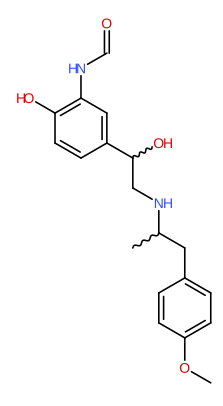 |
| Molecular structure drawn from PubChem coordinates |
| Physical properties [] | |
|---|---|
| Molecular mass | 344.40 g/mol [1] |
| Solubility | Slightly (as fumarate salt) [1] |
| Predicted LogP | 1.8 [1] |
| Structural Identifiers [] | |
|---|---|
| Molecular formula | C19H24N2O4 |
| IUPAC name | N-[2-hydroxy-5-[1-hydroxy-2-[1-(4-methoxyphenyl)propan-2-ylamino]ethyl]phenyl]formamide |
| SMILES | CC(CC1=CC=C(C=C1)OC)NCC(C2=CC(=C(C=C2)O)NC=O)O |
| InChI | InChI=1S/C19H24N2O4/c1-13(9-14-3-6-16(25-2)7-4-14)20-11-19(24)15-5-8-18(23)17(10-15)21-12-22/h3-8,10,12-13,19-20,23-24H,9,11H2,1-2H3,(H,21,22) |
| InChIKey | BPZSYCZIITTYBL-UHFFFAOYSA-N |
| CAS number | 73573-87-2 |
| PubChem CID | 3410 |
| Pharmacokinetics[] | |
|---|---|
| Elimination half-life | 10 h |
| Metabolism | Liver demethylation and glucuronidation (CYP2D6, CYP2C19, CYP2C9 and CYP2A6 involved) |
| Excretion | Kidney and fecal |
| Routes of administration | Inhalation (capsules for oral inhalation, DPI, MDI) |
| Toxicity [] | |
|---|---|
| LD50 | Mouse: - ip: 210 mg/kg - iv: 71 mg/kg - oral: 6700 mg/kg - subcutaneous: 640 mg/kg [1] |
Formoterol (also known as Oxis, Formoterolum, (+-)-Formoterol, R03ac13, Eformoterol, Oxis (TN), Oxeze/Oxis, Formoterol Impurity 109, Gtpl3465 or Msk1310) is a beta agonist substance of the amphetamine class.
Chemistry
Stereochemistry []
Formoterol is a racemic mixture of the diastereomers.
Druglikeness
Lipinski's rule of five
Formoterol matches Lipinski's rule of five.Pharmacology
ATC Classification
- respiratory system (R)
- drugs for obstructive airway diseases (R03)
- adrenergics, inhalants (R03A)
- selective beta-2-adrenoreceptor agonists (R03AC)
- formoterol (R03AC13)
- adrenergics for systemic use (R03C)
- selective beta-2-adrenoreceptor agonists (R03CC)
- formoterol (R03CC15)
MeSH Classification
Mechanism of action []
Formoterol is a relatively selective long-acting agonist of beta<sub>2</sub>-adrenergic receptors, although it does carry some degree of activity at beta<sub>1</sub> and beta<sub>3</sub> receptors. Beta<sub>2</sub> receptors are found predominantly in bronchial smooth muscle (with a relatively minor amount found in cardiac tissue) whereas beta<sub>1</sub> receptors are the predominant adrenergic receptors found in the heart - for this reason, selectivity for beta<sub>2</sub> receptors is desirable in the treatment of pulmonary diseases such as COPD and asthma. Formoterol has demonstrated an approximately 200-fold greater activity at beta<sub>2</sub> receptors over beta<sub>1</sub> receptors. On a molecular level, activation of beta receptors by agonists like formoterol stimulates intracellular adenylyl cyclase, an enzyme responsible for the conversion of ATP to cyclic AMP (cAMP). The increased levels of cAMP in bronchial smooth muscle tissue result in relaxation of these muscles and subsequent dilation of the airways, as well as inhibition of the release of hypersensitivity mediators (e.g. histamine, leukotrienes) from culprit cells, especially mast cells. [1]
Interactions []
Medical side effects []
173 side effects listed on drug labels in SIDER 4.1 (formoterol).
- Headache
- Viral infection
- Pain
- Upper respiratory tract infection
- Diarrhoea
- Back pain
- Palpitations
- Pharyngeal disorder
- Bronchitis
- Acute bronchitis
- Sinusitis
- Pharyngitis
- Chest pain
- Dyspnoea
- Influenza
- Tremor
- Tremor muscle
- Muscle spasms
- Cramp muscle
- Lower respiratory tract infection
- Body temperature increased
- Lung disorder
- Oedema peripheral
- Sputum increased
- Increased bronchial secretion
- Tonsillitis
- Anxiety
- Insomnia
- Dysphonia
- Dry mouth
- Nervousness
- Tension
- Sleep disorder
- Tachycardia
- Agitation
- Myalgia
- Musculoskeletal discomfort
- Arthralgia
- Bronchospasm paradoxical
- Throat irritation
- Dizziness
- Anaphylactic shock
- Angioedema
- Arrhythmia
- Asthma
- Exacerbation of asthma
- Atrial fibrillation
- Bronchospasm
- Cough
- Dermatitis
- Rash
- Cardiac disorder
- Hypersensitivity
- Hypertension
- Hypokalaemia
- Hypotension
- Immune system disorder
- Mediastinal disorder
- Pruritus
- Supraventricular tachycardia
- Urticaria
- Tachyarrhythmia
- Ventricular extrasystoles
- Electrocardiogram QT prolonged
- Malnutrition
- Skin disorder
- Oedema mouth
- Extrasystoles
- Blood pressure increased
- Angina pectoris
- Dysgeusia
- Hyperglycaemia
- Nausea
- Abdominal pain
- Gastrointestinal pain
- Abscess
- Arteriosclerosis
- Arthritis
- Rheumatoid arthritis
- Asthenia
- Fatigue
- Atrial flutter
- Atrioventricular block
- Block heart
- Mental disorder
- Bone disorder
- Candida infection
- Oral candidiasis
- Nervous system disorder
- Cerebral infarction
- Infection
- Conjunctivitis
- Connective tissue disorder
- Constipation
- Cystitis
- Bladder pain
- Cystitis noninfective
- Dehydration
- Dermatitis contact
- Dyspepsia
- Oedema
- Gastritis
- Gastroenteritis
- Gastrointestinal disorder
- Glaucoma
- Glycosuria
- Gout
- Cardiac failure congestive
- Haematuria
- Hernia
- Herpes simplex
- Herpes zoster
- Hyperkalaemia
- Hyperlipidaemia
- Hypoglycaemia
- Inflammation
- Nephrolithiasis
- Leukocytosis
- Melaena
- Myocardial infarction
- Acute coronary syndrome
- Nasal congestion
- Nasopharyngitis
- Neoplasm
- Nocturia
- Pelvic pain
- Tooth abscess
- Pyuria
- Respiratory tract infection
- Rhinitis
- Pharyngitis streptococcal
- Urinary tract infection
- Urethral disorder
- Urinary tract disorder
- Vomiting
- Injury
- Hypokinesia
- Acute sinusitis
- Tracheobronchitis
- Musculoskeletal stiffness
- Nuchal rigidity
- Hypercalciuria
- Toxicity to various agents
- Glucose tolerance decreased
- Retroperitoneal haemorrhage
- Skin hypertrophy
- Injection site pain
- Paraesthesia oral
- Skin discolouration
- Dry skin
- Viral diarrhoea
- Tendinous contracture
- Eyelid oedema
- Respiratory arrest
- Metabolic acidosis
- Malaise
- Discomfort
- Feeling abnormal
- Ill-defined disorder
- Urine abnormality
- Urine analysis abnormal
- Conjunctival irritation
- Rectal haemorrhage
- Viral upper respiratory tract infection
- Electrocardiogram T wave inversion
- Paralysis
- Lung neoplasm malignant
- Chronic obstructive pulmonary disease
- Excoriation
- Breast neoplasm
- Rhinitis allergic
- Somnolence
- Visual impairment
Indications
- Asthma
- Asthma exercise induced
- Bronchitis chronic
- Bronchoconstriction
- Bronchospasm
- Chronic obstructive pulmonary disease
- Emphysema
- Exercise-induced bronchospasm
- Obstructive airways disorder
- Reversible airways obstruction
Subjective effects []
| 0xea / Formoterol [] | |
|---|---|
Routes:
| |
Legal status []
- Australia: Formoterol is a Schedule 4.
- New Zealand: Formoterol is Prescription only.
- United Kingdom: Formoterol is Prescription only.
- United States: Formoterol is Prescription only.
- European Union: Formoterol is Prescription only.[2]
- Other: Formoterol is a Rx-only.
See also []
External links []
References []
National Center for Biotechnology Information. PubChem Compound Summary for CID 3410, Formoterol. Accessed November 20, 2026. https://pubchem.ncbi.nlm.nih.gov/compound/3410
List of nationally authorised medicinal products. ema.europa.eu. https://www.ema.europa.eu/documents/psusa/formoterol-list-nationally-authorised-medicinal-products-psusa/00001469/202005_en.pdf
Data sources []
| Source | Status | Updated (UTC) |
|---|---|---|
| dosing | missing (no dosing statistics) | 2026-11-20 09:01:53 |
| drugspro | missing (no DrugsPRO reagent data) | 2026-11-20 09:01:49 |
| erowid | missing (no Erowid substance of that name) | 2026-11-20 09:01:49 |
| gsrs | missing (no UNII) | 2026-11-20 09:01:49 |
| hmdb | missing (hmdb.ca refused automated access to HMDB0015118) | 2026-11-20 09:01:49 |
| kegg | ok | 2026-11-20 09:01:51 |
| pubchem | ok | 2026-11-20 09:01:48 |
| missing (no r/tripreports posts mention it) | 2026-11-20 09:01:49 | |
| sider | ok | 2026-11-20 09:01:49 |
| structure | ok | 2026-11-20 09:01:49 |
| wikipedia | ok | 2026-11-20 09:01:49 |