Glutamic acid
| Glu | |
|---|---|
 |
| Salts [] | |
|---|---|
| Glutamic acid hydrochloride | |
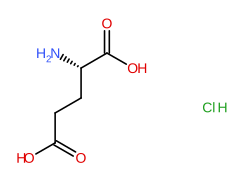 |
| Molecular structure drawn from PubChem coordinates |
| Physical properties [] | |
|---|---|
| Molecular mass | 147.13 g/mol [1] |
| Appearance | Orthorhombic plates from dilute alcohol [1] |
| Odor | Odorless [1] |
| Taste | Umami sour taste [1] |
| Density | 1.538 g/cu cm at 20 °C [1] |
| Melting point | 224 dec °C [1] |
| Boiling point | Sublimes at 175 °C [1] |
| Solubility | 8570 mg/L (at 25 °C) [1] |
| Predicted LogP | -3.7 [1] |
| Structural Identifiers [] | |
|---|---|
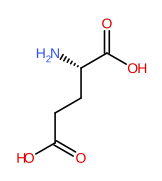
| Molecular formula | C5H9NO4 |
| IUPAC name | (2S)-2-aminopentanedioic acid |
| SMILES | C(CC(=O)O)[C@@H](C(=O)O)N |
| InChI | InChI=1S/C5H9NO4/c6-3(5(9)10)1-2-4(7)8/h3H,1-2,6H2,(H,7,8)(H,9,10)/t3-/m0/s1 |
| InChIKey | WHUUTDBJXJRKMK-VKHMYHEASA-N |
| CAS number | 56-86-0 |
| UNII | 3KX376GY7L |
| PubChem CID | 33032 |
Glutamic acid (also known as L-glutamate, Glutamidex, (S)-2-Aminopentanedioic acid, Glutaton, L-Glutaminic acid, Glutaminol, Aciglut, glutacid, Glutamicol or (S)-Glutamic acid) is a substance of the gabapentinoid and amino acid class.
Chemistry
Salts []
Stereochemistry []
Glutamic acid is a single defined stereoisomer.
Druglikeness
Lipinski's rule of five
Glutamic acid matches Lipinski's rule of five.Pharmacology
Mechanism of action []
Glutamate activates both ionotropic and metabotropic glutamate receptors. The ionotropic ones being non-NMDA (AMPA and kainate) and NMDA receptors. Free glutamic acid cannot cross the blood-brain barrier in appreciable quantities; instead it is converted into L-glutamine, which the brain uses for fuel and protein synthesis. It is conjectured that glutamate is involved in cognitive functions like learning and memory in the brain, though excessive amounts may cause neuronal damage associated in diseases like amyotrophic lateral sclerosis, lathyrism, and Alzheimer's disease. Also, the drug phencyclidine (more commonly known as PCP) antagonizes glutamate at the NMDA receptor, causing behavior reminiscent of schizophrenia. Glutamate in action is extremely difficult to study due to its transient nature. [1]
External links []
References []
National Center for Biotechnology Information. PubChem Compound Summary for CID 33032, Glutamic acid. Accessed November 20, 2026. https://pubchem.ncbi.nlm.nih.gov/compound/33032
U.S. Food and Drug Administration; National Center for Advancing Translational Sciences. Glutamic acid. UNII: 3KX376GY7L. Global Substance Registration System. Accessed November 20, 2026. https://gsrs.ncats.nih.gov/ginas/app/beta/substances/3KX376GY7L
Data sources []
| Source | Status | Updated (UTC) |
|---|---|---|
| dosing | missing (no dosing statistics) | 2026-11-20 07:06:17 |
| drugspro | missing (no DrugsPRO reagent data) | 2026-11-20 07:06:13 |
| erowid | missing (no Erowid substance of that name) | 2026-11-20 07:06:13 |
| gsrs | ok | 2026-11-20 07:06:14 |
| hmdb | missing (hmdb.ca refused automated access to HMDB0000148) | 2026-11-20 07:06:13 |
| kegg | ok | 2026-11-20 07:06:16 |
| pubchem | ok | 2026-11-20 07:06:13 |
| missing (no r/tripreports posts mention it) | 2026-11-20 07:06:13 | |
| sider | missing (not in SIDER) | 2026-11-20 07:06:13 |
| structure | ok | 2026-11-20 07:06:13 |
| wikipedia | missing (no Wikipedia article with a drug infobox) | 2026-11-20 07:06:14 |