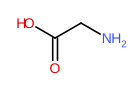
Glycine
| Gly | |
|---|---|
 |
| Salts [] | |
|---|---|
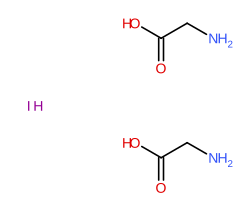
| Glycine hemihydriodide | |
 | |
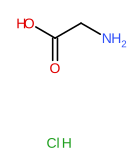
| Glycine hydrochloride | |
 |
| Molecular structure drawn from PubChem coordinates |
| Physical properties [] | |
|---|---|
| Molecular mass | 75.07 g/mol [1] |
| Appearance | White crystals [1] |
| Odor | Odorless [1] |
| Taste | Sweet [1] |
| Density | 1.1607 (NTP, 1992) - Denser than water; will sink [1] |
| Melting point | 451 °F (NTP, 1992) [1] |
| Decomposition | STARTS TO DECOMP AT 233 °C [1] |
| Solubility | greater than or equal to 100 mg/mL at 64 °F (NTP, 1992) [1] |
| Predicted LogP | -3.2 [1] |
| Structural Identifiers [] | |
|---|---|
| Molecular formula | C2H5NO2 |
| IUPAC name | 2-aminoacetic acid |
| SMILES | C(C(=O)O)N |
| InChI | InChI=1S/C2H5NO2/c3-1-2(4)5/h1,3H2,(H,4,5) |
| InChIKey | DHMQDGOQFOQNFH-UHFFFAOYSA-N |
| CAS number | 56-40-6 |
| UNII | TE7660XO1C |
| PubChem CID | 750 |
Glycine (also known as aminoacetic acid, Glycocoll, Aminoethanoic acid, Glycolixir, Glycosthene, Aciport, Glicoamin, Padil, Hampshire glycine or Amitone).
Chemistry
Salts []
Stereochemistry []
Glycine is achiral.
Druglikeness
Lipinski's rule of five
Glycine matches Lipinski's rule of five.Pharmacology
ATC Classification
- blood and blood forming organs (B)
- blood substitutes and perfusion solutions (B05)
- irrigating solutions (B05C)
- other irrigating solutions (B05CX)
- glycine (B05CX03)
MeSH Classification
- glycine agents (M0027996)
Mechanism of action []
In the CNS, there exist strychnine-sensitive glycine binding sites as well as strychnine-insensitive glycine binding sites. The strychnine-insensitive glycine-binding site is located on the NMDA receptor complex. The strychnine-sensitive glycine receptor complex is comprised of a chloride channel and is a member of the ligand-gated ion channel superfamily. The putative antispastic activity of supplemental glycine could be mediated by glycine's binding to strychnine-sensitive binding sites in the spinal cord. This would result in increased chloride conductance and consequent enhancement of inhibitory neurotransmission. The ability of glycine to potentiate NMDA receptor-mediated neurotransmission raised the possibility of its use in the management of neuroleptic-resistant negative symptoms in schizophrenia. Animal studies indicate that supplemental glycine protects against endotoxin-induced lethality, hypoxia-reperfusion injury after liver transplantation, and D-galactosamine-mediated liver injury. Neutrophils are thought to participate in these pathologic processes via invasion of tissue and releasing such reactive oxygen species as superoxide. In vitro studies have shown that neutrophils contain a glycine-gated chloride channel that can attenuate increases in intracellular calcium and diminsh neutrophil oxidant production. This research is ealy-stage, but suggests that supplementary glycine may turn out to be useful in processes where neutrophil infiltration contributes to toxicity, such as ARDS. [1]
Medical side effects []
37 side effects listed on drug labels in SIDER 4.1 (glycine).
- Fluid overload
- Acidosis
- Angina pectoris
- Back pain
- Cardiovascular disorder
- Coma
- Dehydration
- Diarrhoea
- Toxicity to various agents
- Polyuria
- Oedema
- Hypersensitivity
- Hyponatraemia
- Hypotension
- Lung disorder
- Nausea
- Pain
- Rhinitis
- Salivary hypersecretion
- Convulsion
- Tachycardia
- Thirst
- Thrombophlebitis
- Urticaria
- Vertigo
- Vomiting
- Urinary retention
- Encephalopathy
- Chills
- Blindness transient
- Dizziness
- Hyperammonaemia
- Pulmonary congestion
- Respiratory tract congestion
- Electrolyte imbalance
- Vision blurred
- Visual impairment
External links []
References []
National Center for Biotechnology Information. PubChem Compound Summary for CID 750, Glycine. Accessed November 21, 2026. https://pubchem.ncbi.nlm.nih.gov/compound/750
U.S. Food and Drug Administration; National Center for Advancing Translational Sciences. Glycine. UNII: TE7660XO1C. Global Substance Registration System. Accessed November 21, 2026. https://gsrs.ncats.nih.gov/ginas/app/beta/substances/TE7660XO1C
Data sources []
| Source | Status | Updated (UTC) |
|---|---|---|
| dosing | missing (no dosing statistics) | 2026-11-20 08:00:04 |
| drugspro | missing (no DrugsPRO reagent data) | 2026-11-20 08:00:00 |
| erowid | missing (no Erowid substance of that name) | 2026-11-20 08:00:00 |
| gsrs | ok | 2026-11-20 08:00:02 |
| hmdb | missing (hmdb.ca refused automated access to HMDB0000123) | 2026-11-20 08:00:00 |
| kegg | ok | 2026-11-20 08:00:02 |
| pubchem | ok | 2026-11-20 08:00:00 |
| missing (no r/tripreports posts mention it) | 2026-11-20 08:00:00 | |
| sider | ok | 2026-11-20 08:00:00 |
| structure | ok | 2026-11-20 08:00:00 |
| wikipedia | missing (no Wikipedia article with a drug infobox) | 2026-11-20 08:00:01 |