Haloperidol
| Haloperidol | |
|---|---|
 |
| Salts [] | |
|---|---|
| Haloperidol hydrochloride | |
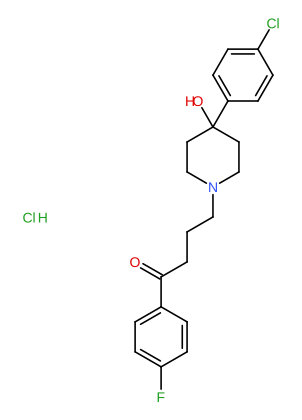 |
| Molecular structure drawn from PubChem coordinates |
| Physical properties [] | |
|---|---|
| Molecular mass | 375.90 g/mol [1] |
| Appearance | Crystals [1] |
| Melting point | 148 [1] |
| Solubility | 14 mg/L (at 25 °C) [1] |
| Predicted LogP | 3.2 [1] |
| Structural Identifiers [] | |
|---|---|
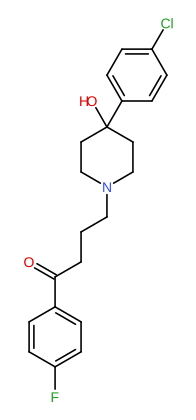
| Molecular formula | C21H23ClFNO2 |
| IUPAC name | 4-[4-(4-chlorophenyl)-4-hydroxypiperidin-1-yl]-1-(4-fluorophenyl)butan-1-one |
| SMILES | C1CN(CCC1(C2=CC=C(C=C2)Cl)O)CCCC(=O)C3=CC=C(C=C3)F |
| InChI | InChI=1S/C21H23ClFNO2/c22-18-7-5-17(6-8-18)21(26)11-14-24(15-12-21)13-1-2-20(25)16-3-9-19(23)10-4-16/h3-10,26H,1-2,11-15H2 |
| InChIKey | LNEPOXFFQSENCJ-UHFFFAOYSA-N |
| CAS number | 52-86-8 |
| UNII | J6292F8L3D |
| PubChem CID | 3559 |
| Pharmacokinetics[] | |
|---|---|
| Elimination half-life | 14–26 hours (IV), 20.7 hours (IM), 14–37 hours (oral) |
| Metabolism | Liver-mediated |
| Excretion | Biliary (hence in feces) and in urine[3] |
| Routes of administration | By mouth, intramuscular, intravenous, depot (as decanoate ester) |
| Toxicity [] | |
|---|---|
| LD50 | Mouse: - ip: 60 mg/kg Rat: - oral: 165 mg/kg - Oral: 128 mg/kg [1] |
Haloperidol (also known as Serenace, Aloperidin, Serenelfi, Eukystol, Linton, Serenase, Aloperidolo, Galoperidol, Brotopon or Halopoidol) is a substance of the phenylpropylamine class.
Chemistry
Salts []
Stereochemistry []
Haloperidol is achiral.
Druglikeness
Lipinski's rule of five
Haloperidol matches Lipinski's rule of five.Pharmacology
ATC Classification
- nervous system (N)
- psycholeptics (N05)
- antipsychotics (N05A)
- butyrophenone derivatives (N05AD)
- (N05AD01)
- haloperidol (N05AD01)
MeSH Classification
- antiemetics (M0001391)
- antipsychotic agents (M0021770)
- dopamine antagonists (M0027734)
- anti-dyskinesia agents (M0028056)
Mechanism of action []
While haloperidol has demonstrated pharmacologic activity at a number of receptors in the brain, it exerts its antipsychotic effect through its strong antagonism of the dopamine receptor (mainly D2), particularly within the mesolimbic and mesocortical systems of the brain. Schizophrenia is theorized to be caused by a hyperdopaminergic state within the limbic system of the brain. Dopamine-antagonizing medications such as haloperidol, therefore, are thought to improve psychotic symptoms by halting this over-production of dopamine. The optimal clinical efficacy of antipsychotics is associated with the blockade of approximately 60 % - 80 % of D2 receptors in the brain. While the exact mechanism is not entirely understood, haloperidol is known to inhibit the effects of dopamine and increase its turnover. Traditional antipsychotics, such as haloperidol, bind more tightly than dopamine itself to the dopamine D2 receptor, with dissociation constants that are lower than that for dopamine. It is believed that haloperidol competitively blocks post-synaptic dopamine (D2) receptors in the brain, eliminating dopamine neurotransmission and leading to the relief of delusions and hallucinations that are commonly associated with psychosis. It acts primarily on the D2-receptors and has some effect on 5-HT2 and α1-receptors, with negligible effects on dopamine D1-receptors. The drug also exerts some blockade of α-adrenergic receptors of the autonomic system. Antagonistic activity regulated through dopamine D2 receptors in the chemoreceptive trigger zone (CTZ) of the brain renders its antiemetic activity. Of the three D2-like receptors, only the D2 receptor is blocked by antipsychotic drugs in direct relation to their clinical antipsychotic abilities. Clinical brain-imaging findings show that haloperidol remains tightly bound to D2 dopamine receptors in humans undergoing 2 positron emission tomography (PET) scans with a 24h pause in between scans. A common adverse effect of this drug is the development of extrapyramidal symptoms (EPS), due to this tight binding of haloperidol to the dopamine D2 receptor. Due to the risk of unpleasant and sometimes lifelong extrapyramidal symptoms, newer antipsychotic medications than haloperidol have been discovered and formulated. Rapid dissociation of drugs from dopamine D2 receptors is a plausible explanation for the improved EPS profile of atypical antipsychotics such as [DB00734]. This is also consistent with the theory of a lower affinity for D2 receptors for these drugs. As mentioned above, haloperidol binds tightly to the dopamine receptor, potentiating the risk of extrapyramidal symptoms, and therefore should only been used when necessary. [1]
Interactions []
Medical side effects []
158 side effects listed on drug labels in SIDER 4.1 (haloperidol).
- Mental disorder
- Breast disorder
- Endocrine disorder
- Gastrointestinal disorder
- Cardiac disorder
- Immune system disorder
- Mediastinal disorder
- Nervous system disorder
- Pregnancy
- Urethral disorder
- Urinary tract disorder
- Malnutrition
- Argininosuccinate synthetase deficiency
- Skin disorder
- Hyperammonaemia
- Hepatobiliary disease
- Agranulocytosis
- Anaphylactic shock
- Bronchospasm
- Cholestasis
- Confusional state
- Feeling abnormal
- Sudden death
- Sudden death, cause unknown
- Depression
- Dermatitis exfoliative
- Dyspnoea
- Oedema
- Dermatitis
- Rash
- Body temperature increased
- Gynaecomastia
- Headache
- Hepatitis
- Hyperglycaemia
- Hyperhidrosis
- Sweating increased
- Hypersensitivity
- Hypoglycaemia
- Hyponatraemia
- Body temperature decreased
- Hypothermia
- Inappropriate antidiuretic hormone secretion
- Jaundice
- Laryngeal oedema
- Laryngospasm
- Leukopenia
- Nausea
- Drug withdrawal syndrome neonatal
- Neutropenia
- Pancytopenia
- Priapism
- Pruritus
- Psychotic disorder
- Convulsion
- Thrombocytopenia
- Torsade de pointes
- Urticaria
- Ventricular fibrillation
- Ventricular tachycardia
- Vomiting
- Weight decreased
- Urinary retention
- Agitation
- Hyperkinesia
- Liver function test abnormal
- Electrocardiogram QT prolonged
- Acute hepatic failure
- Photosensitivity reaction
- Photosensitivity
- Extrasystoles
- Face oedema
- Insomnia
- Leukocytoclastic vasculitis
- Alopecia
- Amenorrhoea
- Anaemia
- Decreased appetite
- Anxiety
- Catatonia
- Connective tissue disorder
- Constipation
- Libido decreased
- Disturbance in sexual arousal
- Libido increased
- Dysphagia
- Diarrhoea
- Dizziness
- Somnolence
- Dyskinesia
- Orofacial dyskinesia
- Movements involuntary
- Dysmenorrhoea
- Dyspepsia
- Extrapyramidal disorder
- Extrapyramidal symptoms
- Eye disorder
- Hallucination
- Cardiac arrest
- Heat stroke
- Hyperprolactinaemia
- Hypertension
- Hypotension
- Orthostatic hypotension
- Lethargy
- Leukocytosis
- Breast pain
- Menorrhagia
- Menstrual disorder
- Hypertonia
- Muscle rigidity
- Neuroleptic malignant syndrome
- Nystagmus
- Abnormal behaviour
- Retinal disorder
- Salivary hypersecretion
- Muscle spasms
- Tachycardia
- Torticollis
- Tremor
- Trismus
- Angiopathy
- Vertigo
- Weight increased
- Dry mouth
- Ventricular arrhythmia
- Akinesia
- Oculogyric crisis
- Breast engorgement
- Hypokinesia
- Cataract
- Hepatic function abnormal
- Cogwheel rigidity
- Injection site reaction
- Opisthotonus
- Menstruation irregular
- Muscle twitching
- Bradykinesia
- Motor dysfunction
- Muscle contractions involuntary
- Euphoric mood
- Galactorrhoea
- Throat tightness
- Protrusion tongue
- Erectile dysfunction
- Parkinsonism
- Vision blurred
- Akathisia
- Hyperpyrexia
- Masked facies
- Grand mal convulsion
- Visual impairment
- Sexual dysfunction
- Gait disturbance
- Tardive dyskinesia
- Breast discomfort
- Musculoskeletal stiffness
- Loss of libido
Indications
- Abnormal behaviour
- Conduct disorder
- Frustration
- Hyperkinesia
- Increased activity
- Mood swings
- Psychotic disorder
- Schizoaffective disorder
- Schizophrenia
- Tourette's disorder
Subjective effects []
| bonzi / Haloperidol [] | |
|---|---|
Legal status []
See also []
External links []
References []
National Center for Biotechnology Information. PubChem Compound Summary for CID 3559, Haloperidol. Accessed November 20, 2026. https://pubchem.ncbi.nlm.nih.gov/compound/3559
U.S. Food and Drug Administration; National Center for Advancing Translational Sciences. Haloperidol. UNII: J6292F8L3D. Global Substance Registration System. Accessed November 20, 2026. https://gsrs.ncats.nih.gov/ginas/app/beta/substances/J6292F8L3D
Product Information Serenace. TGA eBusiness Services. 29 September 2011. https://www.ebs.tga.gov.au/ebs/picmi/picmirepository.nsf/pdf?OpenAgent&id=CP-2011-PI-03532-3
RDC Nº 784 - Listas de Substâncias Entorpecentes, Psicotrópicas, Precursoras e Outras sob Controle Especial. Diário Oficial da União. 31 March 2023. https://www.in.gov.br/en/web/dou/-/resolucao-rdc-n-784-de-31-de-marco-de-2023-474904992
Haloperidol Datasheet. Medsafe NZ. https://www.medsafe.govt.nz/profs/datasheet/s/Serenacetaboralsolninj.pdf
Data sources []
| Source | Status | Updated (UTC) |
|---|---|---|
| dosing | missing (no dosing statistics) | 2026-11-20 06:12:12 |
| drugspro | missing (no DrugsPRO reagent data) | 2026-11-20 06:12:08 |
| erowid | missing (no Erowid substance of that name) | 2026-11-20 06:12:08 |
| gsrs | ok | 2026-11-20 06:12:09 |
| hmdb | missing (hmdb.ca refused automated access to HMDB0014645) | 2026-11-20 06:12:08 |
| kegg | ok | 2026-11-20 06:12:10 |
| pubchem | ok | 2026-11-20 06:12:08 |
| missing (no r/tripreports posts mention it) | 2026-11-20 06:12:08 | |
| sider | ok | 2026-11-20 06:12:08 |
| structure | ok | 2026-11-20 06:12:08 |
| wikipedia | ok | 2026-11-20 06:12:08 |