Heparin
| UFH | |
|---|---|
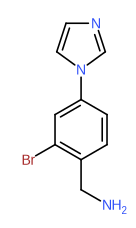 |
| Molecular structure drawn from PubChem coordinates |
| Rotamer [] | |
|---|---|
| Conformer structure via 3Dmol.js |
| Physical properties [] | |
|---|---|
| Molecular mass | 252.11 g/mol [1] |
| Predicted LogP | 1.2 [1] |
| Structural Identifiers [] | |
|---|---|
| Molecular formula | C10H10BrN3 |
| IUPAC name | (2-bromo-4-imidazol-1-ylphenyl)methanamine |
| SMILES | C1=CC(=C(C=C1N2C=CN=C2)Br)CN |
| InChI | InChI=1S/C10H10BrN3/c11-10-5-9(2-1-8(10)6-12)14-4-3-13-7-14/h1-5,7H,6,12H2 |
| InChIKey | SUCTXLUAHUVMQP-UHFFFAOYSA-N |
| PubChem CID | 107275093 |
| Pharmacokinetics[] | |
|---|---|
| Elimination half-life | 1.5 hours |
| Metabolism | Liver |
| Excretion | Urine[2] |
| Routes of administration | Intravenous, subcutaneous |
Heparin (also known as (2-Bromo-4-imidazol-1-ylphenyl)methanamine) is a anticoagulant substance of the benzylamine class.
Chemistry
Stereochemistry []
Heparin is achiral.
Druglikeness
Lipinski's rule of five
Heparin matches Lipinski's rule of five.Pharmacology
Interactions []
Medical side effects []
49 side effects listed on drug labels in SIDER 4.1 (heparin).
- Alopecia
- Asthma
- Body temperature increased
- Headache
- Haematoma
- Haemorrhage
- Haemoglobin
- Hyperlipidaemia
- Hypersensitivity
- Nausea
- Necrosis
- Osteoporosis
- Pain
- Priapism
- Pruritus
- Rhinitis
- Shock
- Ulcer
- Erythema
- Urticaria
- Vomiting
- Chills
- Adrenocortical insufficiency acute
- Adrenal haemorrhage
- Retroperitoneal haemorrhage
- Skin necrosis
- Skin exfoliation
- Haemorrhage urinary tract
- Anaphylactic shock
- Anaphylactoid reaction
- Lacrimation increased
- Infection
- Cyanosis
- Oedema
- Extravasation
- Gangrene
- Cardiac failure congestive
- Hypernatraemia
- Myocardial infarction
- Acute coronary syndrome
- Phlebitis
- Cerebrovascular accident
- Thrombocytopenia
- Thrombosis
- Coagulation time prolonged
- Heparin-induced thrombocytopenia
- Injection site irritation
- Fluid retention
- Fluid overload
Indications
- Arterial thrombosis
- Atrial fibrillation
- Clotting
- Coagulopathy
- Deep vein thrombosis postoperative
- Disseminated intravascular coagulation
- Embolism arterial
- Pulmonary embolism
- Venous thrombosis
Legal status []
- Australia: Heparin is a Schedule 4.
- United States: Heparin is Prescription only.
- Other: Heparin is a Rx-only.
See also []
References []
National Center for Biotechnology Information. PubChem Compound Summary for CID 107275093, Heparin. Accessed November 23, 2026. https://pubchem.ncbi.nlm.nih.gov/compound/107275093
Heparin. 10 February 2012. http://online.lexi.com
Data sources []
| Source | Status | Updated (UTC) |
|---|---|---|
| dosing | missing (no dosing statistics) | 2026-11-20 10:52:14 |
| drugspro | missing (no DrugsPRO reagent data) | 2026-11-20 10:52:09 |
| erowid | missing (no Erowid substance of that name) | 2026-11-20 10:52:09 |
| gsrs | missing (no UNII) | 2026-11-20 10:52:09 |
| hmdb | missing (no HMDB id) | 2026-11-20 10:52:09 |
| kegg | ok | 2026-11-20 10:52:11 |
| pubchem | ok | 2026-11-20 10:52:09 |
| missing (no r/tripreports posts mention it) | 2026-11-20 10:52:09 | |
| sider | ok | 2026-11-20 10:52:10 |
| structure | ok | 2026-11-20 10:52:09 |
| wikipedia | ok | 2026-11-20 10:52:10 |