Hyoscyamine
| Hyoscyamine | |
|---|---|
 |
| Salts [] | |
|---|---|
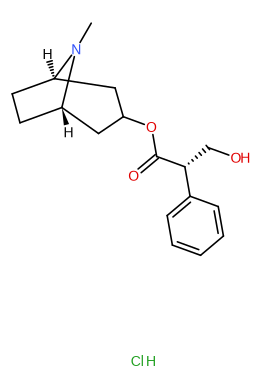
| Hyoscyamine hydrochloride | |
 | |
| Hyoscyamine disulfate | |
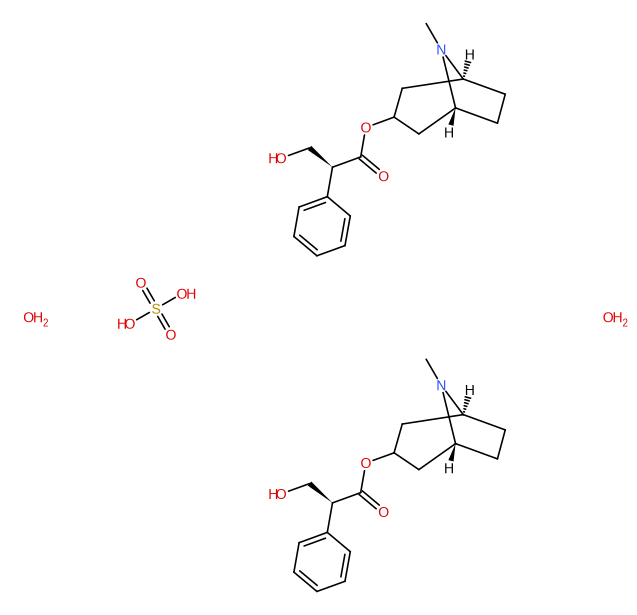 | |
| Hyoscyamine hemisulfate | |
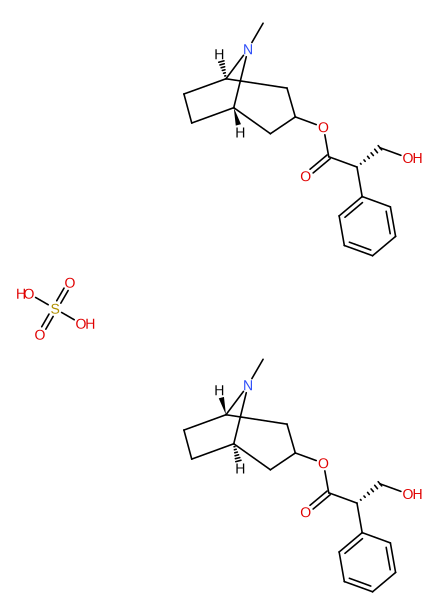 |
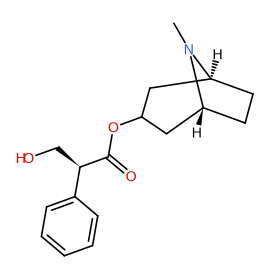
| Molecular structure drawn from PubChem coordinates |
| Rotamer [] | |
|---|---|
| Conformer structure via 3Dmol.js |
| Physical properties [] | |
|---|---|
| Molecular mass | 289.40 g/mol [1] |
| Melting point | 108.5 °C [1] |
| Solubility | 3560 mg/L (at 20 °C) [1] |
| Predicted LogP | 1.8 [1] |
| Structural Identifiers [] | |
|---|---|
| Molecular formula | C17H23NO3 |
| IUPAC name | [(1R,5S)-8-methyl-8-azabicyclo[3.2.1]octan-3-yl] (2S)-3-hydroxy-2-phenylpropanoate |
| SMILES | CN1[C@@H]2CC[C@H]1CC(C2)OC(=O)[C@H](CO)C3=CC=CC=C3 |
| InChI | InChI=1S/C17H23NO3/c1-18-13-7-8-14(18)10-15(9-13)21-17(20)16(11-19)12-5-3-2-4-6-12/h2-6,13-16,19H,7-11H2,1H3/t13-,14+,15?,16-/m1/s1 |
| InChIKey | RKUNBYITZUJHSG-VFSICIBPSA-N |
| CAS number | 101-31-5 |
| UNII | PX44XO846X |
| PubChem CID | 154417 |
| Pharmacokinetics[] | |
|---|---|
| Elimination half-life | 3–5 hours |
| Metabolism | Liver |
| Excretion | Kidney |
| Routes of administration | By mouth, sublingual, subcutaneous, intramuscular, intravenous |
Hyoscyamine (also known as L-Hyoscyamine, Daturine, (-)-Hyoscyamine, Duboisine, (-)-Atropine, L-Tropine tropate, (S)-(-)-Hyoscyamine, Cystospaz, l-Atropine or (S)-Atropine).
Chemistry
Salts []
Stereochemistry []
Hyoscyamine is a single defined stereoisomer (optical activity ( - )).
Druglikeness
Lipinski's rule of five
Hyoscyamine matches Lipinski's rule of five.Pharmacology
Mechanism of action []
Hyoscyamine competitively and non-selectively antagonises muscarinic receptors in the smooth muscle, cardiac muscle, sino-atrial node, atrioventricular node, exocrine nodes, gastrointestinal tract, and respiratory tract. Antagonism of muscarinic M1, M4, and M5 receptors in the central nervous system lead to cognitive impairment; antagonism of M2 in the sinoatrial and atrioventricular nodes leads to increases in heart rate and atrial contractility; and antagonism of M3 in smooth muscle results in reduced peristalsis, bladder contraction, salivary secretions, gastric secretions, bronchial secretions, sweating, increased bronchodilation, mydriasis, and cycloplegia. [1]
Interactions []
Experience reports
Legal status []
- Australia: Hyoscyamine is a Schedule 4.
- United States: Hyoscyamine is a Rx only.
External links []
References []
National Center for Biotechnology Information. PubChem Compound Summary for CID 154417, Hyoscyamine. Accessed November 24, 2026. https://pubchem.ncbi.nlm.nih.gov/compound/154417
U.S. Food and Drug Administration; National Center for Advancing Translational Sciences. Hyoscyamine. UNII: PX44XO846X. Global Substance Registration System. Accessed November 24, 2026. https://gsrs.ncats.nih.gov/ginas/app/beta/substances/PX44XO846X
Data sources []
| Source | Status | Updated (UTC) |
|---|---|---|
| dosing | missing (no dosing statistics) | 2026-11-20 11:10:03 |
| drugspro | missing (no DrugsPRO reagent data) | 2026-11-20 11:09:59 |
| erowid | ok | 2026-11-20 11:10:01 |
| gsrs | ok | 2026-11-20 11:10:03 |
| hmdb | missing (no HMDB id) | 2026-11-20 11:09:59 |
| kegg | ok | 2026-11-20 11:10:01 |
| pubchem | ok | 2026-11-20 11:09:59 |
| missing (no r/tripreports posts mention it) | 2026-11-20 11:09:59 | |
| sider | missing (not in SIDER) | 2026-11-20 11:09:59 |
| structure | ok | 2026-11-20 11:09:59 |
| wikipedia | ok | 2026-11-20 11:10:00 |