Ibogaine
| Ibogaine | |
|---|---|
 |
| Salts [] | |
|---|---|
| Ibogaine hydrochloride | |
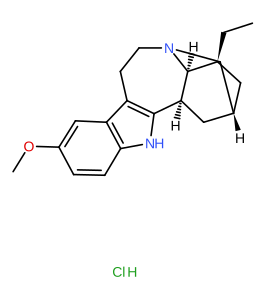 |
| Molecular structure drawn from PubChem coordinates |
| Physical properties [] | |
|---|---|
| Molecular mass | 310.40 g/mol [1] |
| Melting point | 148 °C [1] |
| Solubility | Soluble in chloroform [1] |
| Predicted LogP | 3.9 [1] |
| Structural Identifiers [] | |
|---|---|
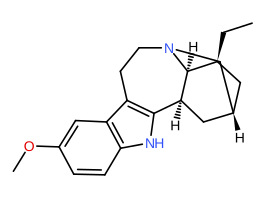
| Molecular formula | C20H26N2O |
| IUPAC name | (1R,15R,17S,18S)-17-ethyl-7-methoxy-3,13-diazapentacyclo[13.3.1.02,10.04,9.013,18]nonadeca-2(10),4(9),5,7-tetraene |
| SMILES | CC[C@H]1C[C@@H]2C[C@@H]3[C@H]1N(C2)CCC4=C3NC5=C4C=C(C=C5)OC |
| InChI | InChI=1S/C20H26N2O/c1-3-13-8-12-9-17-19-15(6-7-22(11-12)20(13)17)16-10-14(23-2)4-5-18(16)21-19/h4-5,10,12-13,17,20-21H,3,6-9,11H2,1-2H3/t12-,13+,17+,20+/m1/s1 |
| InChIKey | HSIBGVUMFOSJPD-CFDPKNGZSA-N |
| CAS number | 83-74-9 |
| UNII | 3S814I130U |
| PubChem CID | 197060 |
| Pharmacokinetics[] | |
|---|---|
| Onset | 1–3 hours |
| Elimination half-life | Ibogaine: 7 hours, Noribogaine: 24–50 hours |
| Duration of action | 18–36 hours (but up–96 hours or more in total) |
| Routes of administration | Oral[3] |
| Toxicity [] | |
|---|---|
| LD50 | Mouse: - intragastric: 263 mg/kg [1] |
Ibogaine (also known as Endabuse, (-)-Ibogaine, Nih 10567, 12 Methoxyibogamine, Nih10567, 201-498-4, 12-Methoxyibogamine, Ibogain, (5β)-12-methoxyibogamine or Tabernanthe iboga) is a psychedelic substance of the hexahydroazepinoindole and tryptamine class.
Chemistry
Salts []
Stereochemistry []
Ibogaine is a single defined stereoisomer.
Druglikeness
Lipinski's rule of five
Ibogaine matches Lipinski's rule of five.Reagents
There are currently 3 reagent-interactions on DrugsPRO
| Reagent | Color change | Description |
|---|---|---|
| Marquis | purplish > brown > orange | |
| Ehrlich | purplish | |
| Hofmann | yellow / green |
Pharmacology
MeSH Classification
Mechanism of action []
... In this study, /researchers/ first characterized the actions of ibogaine on ethanol self-administration in rodents. Ibogaine decreased ethanol intake by rats in two-bottle choice and operant self-administration paradigms. Ibogaine also reduced operant self-administration of ethanol in a relapse model. Next, /the researchers/ identified a molecular mechanism that mediates the desirable activities of ibogaine on ethanol intake. Microinjection of ibogaine into the ventral tegmental area (VTA), but not the substantia nigra, reduced self-administration of ethanol, and systemic administration of ibogaine increased the expression of glial cell line-derived neurotrophic factor (GDNF) in a midbrain region that includes the VTA. In dopaminergic neuron-like SHSY5Y cells, ibogaine treatment upregulated the GDNF pathway as indicated by increases in phosphorylation of the GDNF receptor, Ret, and the downstream kinase, ERK1 (extracellular signal-regulated kinase 1). Finally, the ibogaine-mediated decrease in ethanol self-administration was mimicked by intra-VTA microinjection of GDNF and was reduced by intra-VTA delivery of anti-GDNF neutralizing antibodies. Together, these results suggest that GDNF in the VTA mediates the action of ibogaine on ethanol consumption. These findings highlight the importance of GDNF as a new target for drug development for alcoholism that may mimic the effect of ibogaine against alcohol consumption but avoid the negative side effects. [1]
Experience reports
Erowid
There are currently 30 experience reports involving ibogaine on Erowid: []- "Welcome Back to My Life" by tobala
- "No Boundaries" by TPTB
- "Spectacular, Sacramental Meeting" by Bjorn C.
- "Into The Flood" by Xorkoth
- "Defragmentation and Factory Restore" by Morninggloryseed
- "Detox in Three Stages" by Transmigraine
- "Found the 'On' Switch in My Soul" by allotrope
- "Powerful But Gentle" by C.S.
- "Healing and Insights" by Charon
- "Not for Everyone" by PennyScout
- "Not a Miracle Cure Nor Completely Useless" by SnoitseuqPi
- "Defragmentation And Factory Restore1" by Morninggloryseed
- "Nothing but Goodness" by Rory
- "One of the Best Defrags" by folias
- "Clean from Opium Tea" by Survivor
- "Low Dose Giving High Effect" by Londoner
- "A Psycho-Spiritual Experience" by KBF
- "Saved from Addiction" by Lightofiboga
- "To Heaven and Back" by Jasen
- "Breaking Open the Head" by Matthew
- "Shown Death and a Muse (2 People's Visions)" by Mars
- "Primordial Wisdom Teacher" by Daniel Pinchbeck
- "I Was Surprised at the Strength" by Joan Clark
- "Hoping to Be Cured From Depression" by ResetMyself
- "In One Go" by Sam
- "My Beautiful Trip" by Lora_
- "Biophysical Alcohol Relapse Prevention" by Splungeman Stoge
- "The Road To Mexico" by npal
- "Solidity in the Absolute" by fox and rabbit
- "A Guided Ibogaine Experience" by D.L., NV
- "The Shamanic Aphrodisiac & Chemsex Drug [Yohimbe]" by DMTrott (11 upvotes)
- "My experience doing Ibogaine in Mexico to break a heavy Kratom addiction" by throwlegalaway12358 (9 upvotes)
- "Are you planning to take a psychedelic? (New) opportunities to participate in psychedelic research and make your (tripping) experience count for science!" by ImperialPRG (6 upvotes)
- "Direct Mystical Transmission via ayahuasca vine + DMT + mushrooms" by Samwise2512 (5 upvotes)
- "There are 45 psychedelic and dissociative trip reports in the Drug Users Bible: Download a free copy from here. Whether psychedelics are used for recreation, you need to look after yourself. Stay safe." by DMTrott (3 upvotes)
- "Friend's Bufo/5-MeO-DMT breakthrough experience at Iboga-Farm, Netherlands" by Samwise2512 (3 upvotes)
Legal status []
External links []
References []
National Center for Biotechnology Information. PubChem Compound Summary for CID 197060, Ibogaine. Accessed November 21, 2026. https://pubchem.ncbi.nlm.nih.gov/compound/197060
U.S. Food and Drug Administration; National Center for Advancing Translational Sciences. Ibogaine. UNII: 3S814I130U. Global Substance Registration System. Accessed November 21, 2026. https://gsrs.ncats.nih.gov/ginas/app/beta/substances/3S814I130U
Ballentine G, Friedman SF, Bzdok D. Trips and neurotransmitters: Discovering principled patterns across 6850 hallucinogenic experiences. Science Advances. March 2022; 8(11). PMID 35294242. https://doi.org/10.1126/sciadv.abl6989
Notice - Prescription Drug List (PDL): Multiple additions. Health Canada. 12 May 2017. http://www.hc-sc.gc.ca/dhp-mps/prodpharma/pdl-ord/pdl-ldo-noa-ad-2017-05-16-eng.php
Galea S, Lorusso M, Newcombe D, Walters C, Williman J, Wheeler A. Ibogaine—be informed before you promote or prescribe. Journal of Primary Health Care. March 2011; 3(1):86–87. PMID 21359272. https://www.rnzcgp.org.nz/assets/documents/Publications/JPHC/March-2011/JPHCMarch11CompleteIssue.pdf#page=86
Data sources []
| Source | Status | Updated (UTC) |
|---|---|---|
| dosing | missing (no dosing statistics) | 2026-11-20 03:07:01 |
| drugspro | ok | 2026-11-20 03:06:57 |
| erowid | ok | 2026-11-20 03:07:05 |
| gsrs | ok | 2026-11-20 03:06:57 |
| hmdb | missing (no HMDB id) | 2026-11-20 03:06:57 |
| kegg | missing (no KEGG DRUG entry) | 2026-11-20 03:07:00 |
| pubchem | ok | 2026-11-20 03:06:56 |
| ok | 2026-11-20 03:06:57 | |
| sider | missing (not in SIDER) | 2026-11-20 03:06:57 |
| structure | ok | 2026-11-20 03:06:57 |
| wikipedia | ok | 2026-11-20 03:06:57 |