Isoniazid
| Isoniazid | |
|---|---|
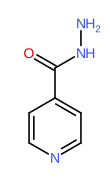 |
| Molecular structure drawn from PubChem coordinates |
| Physical properties [] | |
|---|---|
| Molecular mass | 137.14 g/mol [1] |
| Appearance | COLORLESS OR WHITE CRYSTALS, OR A WHITE, CRYSTALLINE POWDER [1] |
| Melting point | 340.5 °F (NTP, 1992) [1] |
| Decomposition | When heated to decomposition it emits toxic fumes of /nitrogen oxides/. [1] |
| Solubility | greater than or equal to 100 mg/mL at 77 °F (NTP, 1992) [1] |
| Predicted LogP | -0.7 [1] |
| Structural Identifiers [] | |
|---|---|
| Molecular formula | C6H7N3O |
| IUPAC name | pyridine-4-carbohydrazide |
| SMILES | C1=CN=CC=C1C(=O)NN |
| InChI | InChI=1S/C6H7N3O/c7-9-6(10)5-1-3-8-4-2-5/h1-4H,7H2,(H,9,10) |
| InChIKey | QRXWMOHMRWLFEY-UHFFFAOYSA-N |
| CAS number | 54-85-3 |
| UNII | V83O1VOZ8L |
| PubChem CID | 3767 |
| Pharmacokinetics[] | |
|---|---|
| Elimination half-life | 0.5–1.6h (fast acetylators), 2-5h (slow acetylators) |
| Metabolism | liver; CYP450: 2C19, 3A4 inhibitor |
| Excretion | urine (primarily), feces |
| Routes of administration | By mouth, intramuscular, intravenous |
| Toxicity [] | |
|---|---|
| LD50 | Mouse: - ip: 100 mg/kg Rat: - oral: 650 mg/kg [1] |
Isoniazid (also known as Isonicotinic acid hydrazide, Isonicotinohydrazide, Isoniazide, Rimifon, Cotinazin, Dinacrin, Hydrazid, Nydrazid, Iscotin or Mybasan) is a antibiotic substance.
Chemistry
Stereochemistry []
Isoniazid is achiral.
Druglikeness
Lipinski's rule of five
Isoniazid matches Lipinski's rule of five.Pharmacology
ATC Classification
- antiinfectives for systemic use (J)
- antimycobacterials (J04)
- drugs for treatment of tuberculosis (J04A)
- hydrazides (J04AC)
- (J04AC01)
- isoniazid (J04AC01)
MeSH Classification
Mechanism of action []
Isoniazid is a prodrug and must be activated by bacterial catalase. Specficially, activation is associated with reduction of the mycobacterial ferric KatG catalase-peroxidase by hydrazine and reaction with oxygen to form an oxyferrous enzyme complex. Once activated, isoniazid inhibits the synthesis of mycoloic acids, an essential component of the bacterial cell wall. At therapeutic levels isoniazid is bacteriocidal against actively growing intracellular and extracellular <i>Mycobacterium tuberculosis</i> organisms. Specifically isoniazid inhibits InhA, the enoyl reductase from <i>Mycobacterium tuberculosis</i>, by forming a covalent adduct with the NAD cofactor. It is the INH-NAD adduct that acts as a slow, tight-binding competitive inhibitor of InhA. [1]
Medical side effects []
45 side effects listed on drug labels in SIDER 4.1 (isoniazid).
- Agranulocytosis
- Aplastic anaemia
- Decreased appetite
- Asthenia
- Fatigue
- Eosinophilia
- Body temperature increased
- Gynaecomastia
- Hepatitis
- Hepatitis symptom
- Hyperbilirubinaemia
- Hyperglycaemia
- Hypersensitivity
- Jaundice
- Systemic lupus erythematosus
- Malaise
- Nausea
- Neuritis
- Neuropathy peripheral
- Optic neuritis
- Nicotinic acid deficiency
- Psychotic disorder
- Convulsion
- Thrombocytopenia
- Vasculitis
- Vomiting
- Hepatic function abnormal
- Toxic encephalopathy
- Hepatocellular injury
- Liver injury
- Metabolic acidosis
- Dyspepsia
- Discomfort
- Feeling abnormal
- Ill-defined disorder
- Emotional distress
- Memory impairment
- Neurotoxicity
- Paraesthesia
- Diabetes mellitus
- Rash
- Atrophy
- Lymphadenopathy
- Gastrointestinal disorder
- Vitamin B6 deficiency
Indications
- Active tuberculosis
- Carcinoma
- Chronic peptic ulcer
- Diabetes mellitus
- Extrapulmonary tuberculosis
- Hodgkin's disease
- Immunodeficiency
- Induration
- Infection
- Leukaemia
- Low income
- Malabsorption
- Malnutrition
- Renal failure chronic
- Silicosis
- Skin test reaction
- Tuberculosis
- Ulcer
- Weight decreased
Legal status []
- Canada: Isoniazid is Prescription only.[3]
- United States: Isoniazid is Prescription only.
See also []
External links []
References []
National Center for Biotechnology Information. PubChem Compound Summary for CID 3767, Isoniazid. Accessed November 22, 2026. https://pubchem.ncbi.nlm.nih.gov/compound/3767
U.S. Food and Drug Administration; National Center for Advancing Translational Sciences. Isoniazid. UNII: V83O1VOZ8L. Global Substance Registration System. Accessed November 22, 2026. https://gsrs.ncats.nih.gov/ginas/app/beta/substances/V83O1VOZ8L
Drug and medical device highlights 2018: Helping you maintain and improve your health. Health Canada. 14 October 2020. https://www.canada.ca/en/health-canada/services/publications/drugs-health-products/drug-medical-device-highlights-2018.html
Data sources []
| Source | Status | Updated (UTC) |
|---|---|---|
| dosing | missing (no dosing statistics) | 2026-11-20 16:02:27 |
| drugspro | missing (no DrugsPRO reagent data) | 2026-11-20 16:02:23 |
| erowid | missing (no Erowid substance of that name) | 2026-11-20 16:02:23 |
| gsrs | ok | 2026-11-20 16:02:24 |
| hmdb | missing (hmdb.ca refused automated access to HMDB0015086) | 2026-11-20 16:02:23 |
| kegg | ok | 2026-11-20 16:02:26 |
| pubchem | ok | 2026-11-20 16:02:23 |
| missing (no r/tripreports posts mention it) | 2026-11-20 16:02:23 | |
| sider | ok | 2026-11-20 16:02:24 |
| structure | ok | 2026-11-20 16:02:23 |
| wikipedia | ok | 2026-11-20 16:02:24 |