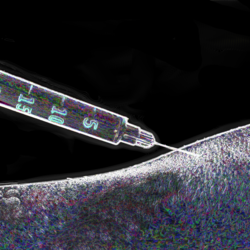
Lidocaine
| Lidocaine | |
|---|---|
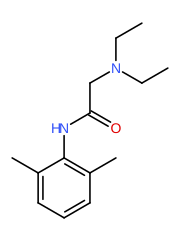 |
| Salts [] | |
|---|---|
| Lidocaine bicarbonate | |
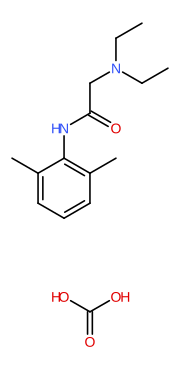 | |
| Lidocaine dicarbonate | |
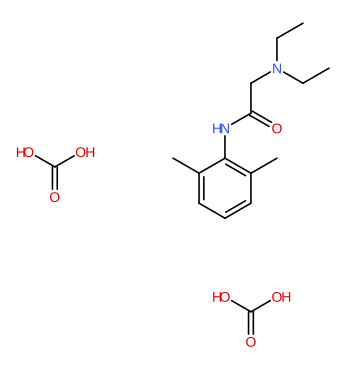 | |
| Lidocaine hydrochloride | |
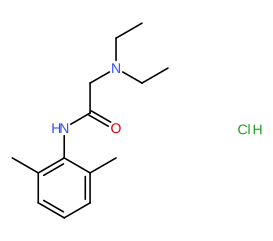 | |
| Lidocaine maleate | |
 | |
| Lidocaine tosylate | |
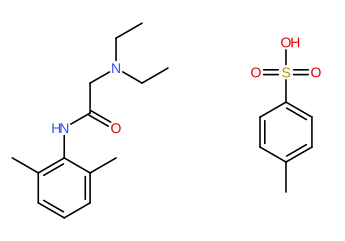 | |
| Lidocaine iminodiacetic acid | |
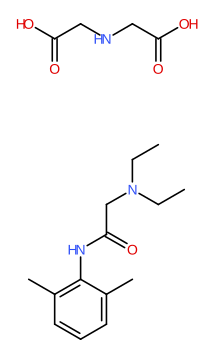 | |
| Lidocaine sulfate | |
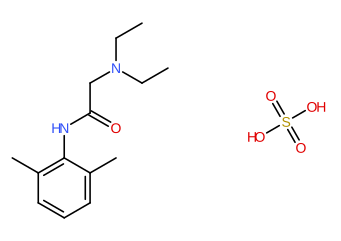 |
| Molecular structure drawn from PubChem coordinates |
| Physical properties [] | |
|---|---|
| Molecular mass | 234.34 g/mol [1] |
| Appearance | Needles from benzene or alcohol [1] |
| Odor | Characteristic odor [1] |
| Melting point | 68.5 °C [1] |
| Boiling point | 159-160 °C at 2.00E+00 mm Hg [1] |
| Decomposition | When heated to decomposition it emits toxic fumes of /nitrogen oxides/. [1] |
| Solubility | 4100 mg/L (at 30 °C) [1] |
| Predicted LogP | 2.3 [1] |
| Structural Identifiers [] | |
|---|---|
| Molecular formula | C14H22N2O |
| IUPAC name | 2-(diethylamino)-N-(2,6-dimethylphenyl)acetamide |
| SMILES | CCN(CC)CC(=O)NC1=C(C=CC=C1C)C |
| InChI | InChI=1S/C14H22N2O/c1-5-16(6-2)10-13(17)15-14-11(3)8-7-9-12(14)4/h7-9H,5-6,10H2,1-4H3,(H,15,17) |
| InChIKey | NNJVILVZKWQKPM-UHFFFAOYSA-N |
| CAS number | 137-58-6 |
| UNII | 98PI200987 |
| PubChem CID | 3676 |
| Pharmacokinetics[] | |
|---|---|
| Onset | Within 1.5 min (IV) |
| Elimination half-life | 1.5 h–2 h |
| Duration of action | 10 min–20 min (IV), 0.5 h–3 h (local) |
| Metabolism | Liver, 90% CYP3A4-mediated |
| Excretion | Kidney |
| Routes of administration | Intravenous, subcutaneous, topical, by mouth |
| Toxicity [] | |
|---|---|
| LD50 | Mouse: - oral: 292 mg/kg - ip: 105 mg/kg - iv: 19.5 mg/kg Non-Fasted Female Rats: - 346-773) mg/kg (oral: 459 Rat: - oral: 317 mg/kg [1] |
Lidocaine (also known as Xylocaine, Esracaine, Xylestesin, Duncaine, Lidoderm, Gravocain, Isicaina, Leostesin, Maricaine or Solcain) is a anaesthetic, depressant and sodium channel blocker substance of the aniline class.
Chemistry
Salts []
Stereochemistry []
Lidocaine is achiral.
Druglikeness
Lipinski's rule of five
Lidocaine matches Lipinski's rule of five.Reagents
There are currently 10 reagent-interactions on DrugsPRO
| Reagent | Color change | Description |
|---|---|---|
| Marquis | fizzes clear | |
| Mecke | yellow | |
| Mandelin | brown | |
| Liebermann | red | |
| Froehde | no color change | |
| Simon's | no blue color change | |
| Ehrlich | no color change | |
| Hofmann | no color change | |
| Scott | blue | |
| Morris | blue precipitate |
Pharmacology
ATC Classification
- cardiovascular system (C)
- cardiac therapy (C01)
- antiarrhythmics, class i and iii (C01B)
- antiarrhythmics, class ib (C01BB)
- lidocaine (C01BB01)
- (C01BB01; N01BB02)
- vasoprotectives (C05)
- agents for treatment of hemorrhoids and anal fissures for topical use (C05A)
- local anesthetics (C05AD)
- lidocaine (C05AD01)
- dermatologicals (D)
- antipruritics, incl. antihistamines, anesthetics, etc. (D04)
- antipruritics, incl. antihistamines, anesthetics, etc. (D04A)
- anesthetics for topical use (D04AB)
- lidocaine (D04AB01)
- nervous system (N)
- anesthetics (N01)
- anesthetics, local (N01B)
- amides (N01BB)
- (N01BB02)
- lidocaine (N01BB02)
- respiratory system (R)
- throat preparations (R02)
- throat preparations (R02A)
- anesthetics, local (R02AD)
- lidocaine (R02AD02)
- sensory organs (S)
- ophthalmologicals (S01)
- local anesthetics (S01H)
- local anesthetics (S01HA)
- lidocaine (S01HA07)
- otologicals (S02)
- other otologicals (S02D)
- analgesics and anesthetics (S02DA)
- lidocaine (S02DA01)
MeSH Classification
- anesthetics, local (M0001169)
- anti-arrhythmia agents (M0001326)
- voltage-gated sodium channel blockers (M0559316)
Mechanism of action []
Lidocaine is a local anesthetic of the amide type. It is used to provide local anesthesia by nerve blockade at various sites in the body. It does so by stabilizing the neuronal membrane by inhibiting the ionic fluxes required for the initiation and conduction of impulses, thereby effecting local anesthetic action. In particular, the lidocaine agent acts on sodium ion channels located on the internal surface of nerve cell membranes. At these channels, neutral uncharged lidocaine molecules diffuse through neural sheaths into the axoplasm where they are subsequently ionized by joining with hydrogen ions. The resultant lidocaine cations are then capable of reversibly binding the sodium channels from the inside, keeping them locked in an open state that prevents nerve depolarization. As a result, with sufficient blockage, the membrane of the postsynaptic neuron will ultimately not depolarize and will thus fail to transmit an action potential. This facilitates an anesthetic effect by not merely preventing pain signals from propagating to the brain but by aborting their generation in the first place. In addition to blocking conduction in nerve axons in the peripheral nervous system, lidocaine has important effects on the central nervous system and cardiovascular system. After absorption, lidocaine may cause stimulation of the CNS followed by depression and in the cardiovascular system, it acts primarily on the myocardium where it may produce decreases in electrical excitability, conduction rate, and force of contraction. [1]
Interactions []
Interaction mechanisms documented in KEGG DRUG (number of interacting drugs):
| CYP3A4 | induction / metabolism / inhibition | 407 (46 contraindicated) |
|---|---|---|
| CYP1A2 | metabolism / induction / inhibition | 75 (17 contraindicated) |
| SCN5A | shared target | 44 |
| SCN10A | shared target | 41 |
| SCN11A | shared target | 41 |
| SCN1A | shared target | 41 |
| SCN2A | shared target | 41 |
| SCN3A | shared target | 41 |
| SCN4A | shared target | 41 |
| SCN8A | shared target | 41 |
| SCN9A | shared target | 41 |
Medical side effects []
131 side effects listed on drug labels in SIDER 4.1 (lidocaine).
- Nausea
- Vomiting
- Nervous system disorder
- Cardiac arrest
- Cardiac disorder
- Acidosis
- Anaphylactic shock
- Anaphylactoid reaction
- Angioedema
- Aphonia
- Apnoea
- Arachnoiditis
- Asthenia
- Asthma
- Back pain
- Blister
- Dermatitis bullous
- Bronchospasm
- Chest pain
- Coma
- Confusional state
- Feeling abnormal
- Contusion
- Dysphagia
- Dermatitis
- Rash
- Dermatitis contact
- Diplopia
- Dizziness
- Lightheadedness
- Somnolence
- Dysarthria
- Slurred speech
- Osteoarthritis
- Dysgeusia
- Taste metallic
- Dyspnoea
- Oedema
- Electric shock
- Eye disorder
- Flushing
- Gastrointestinal disorder
- Gingivitis
- Headache
- Atrioventricular block
- Haemorrhage
- Haemoglobin
- Dysphonia
- Hyperaesthesia
- Hypersensitivity
- Hypertension
- Hypoaesthesia
- Numbness
- Hypotension
- Immune system disorder
- Laryngospasm
- Meningism
- Meningitis
- Methaemoglobinaemia
- Nervousness
- Tension
- Sensory loss
- Obstruction
- Paraesthesia
- Petechiae
- Pregnancy
- Psychotic disorder
- Hyperacusis
- Respiratory paralysis
- Rhinitis
- Convulsion
- Chills
- Shock
- Stomatitis
- Mouth irritation
- Tinnitus
- Tremor
- Loss of consciousness
- Erythema
- Redness
- Urinary incontinence
- Urticaria
- Angiopathy
- Ventricular fibrillation
- Ventricular tachycardia
- Urinary retention
- Burning sensation
- Agitation
- Cranial nerve paralysis
- Application site reaction
- Depressed level of consciousness
- Paraesthesia oral
- Skin irritation
- Nerve injury
- Respiratory arrest
- Leukoderma
- Anterior spinal artery syndrome
- Muscle twitching
- Teratogenicity
- Disorientation
- Anxiety
- Feeling hot
- Tenderness
- Neurological symptom
- Respiratory depression
- Pulmonary function test decreased
- Euphoric mood
- Sedation
- Skin exfoliation
- Oropharyngeal discomfort
- Oropharyngeal pain
- Peripheral nerve injury
- Papule
- Myocardial depression
- Vision blurred
- Cauda equina syndrome
- Bradycardia
- Neuropathy peripheral
- Spinal anaesthesia
- Hypoaesthesia oral
- Hypoesthesia tongue
- Application site irritation
- Paralysis
- Visual impairment
- Hyperhidrosis
- Local reaction
- Pain
- Vessel puncture site haemorrhage
- Conjunctival hyperaemia
- Endotracheal intubation complication
- Neurotoxicity
Indications
- Acute myocardial infarction
- Arrhythmia
- Circulatory depression
- Discomfort
- Excitability
- Insect bite NOS
- Oesophagitis
- Pain
- Sunburn
- Urethritis
- Ventricular arrhythmia
Subjective effects []
Legal status []
External links []
References []
National Center for Biotechnology Information. PubChem Compound Summary for CID 3676, Lidocaine. Accessed November 21, 2026. https://pubchem.ncbi.nlm.nih.gov/compound/3676
U.S. Food and Drug Administration; National Center for Advancing Translational Sciences. Lidocaine. UNII: 98PI200987. Global Substance Registration System. Accessed November 21, 2026. https://gsrs.ncats.nih.gov/ginas/app/beta/substances/98PI200987
Poisons Standard February 2021. Federal Register of Legislation. 1 January 2021. https://www.legislation.gov.au/Details/F2021C00098
Xylocard Product information. Health Canada. 9 October 2018. https://health-products.canada.ca/dpd-bdpp/info?lang=eng&code=4478
Lidocaine Product information. Health Canada. 18 June 2015. https://health-products.canada.ca/dpd-bdpp/info?lang=eng&code=83969
Lidocaine Hydrochloride Injection BP 1% w/v - Summary of Product Characteristics (SmPC). (emc). 29 June 2020. https://www.medicines.org.uk/emc/product/6277/smpc
Xylocaine MPF- lidocaine hydrochloride injection, solution Xylocaine- lidocaine hydrochloride injection, solution Xylocaine- lidocaine hydrochloride, epinephrine bitartrate injection, solution. DailyMed. https://dailymed.nlm.nih.gov/dailymed/drugInfo.cfm?setid=4dd52202-8eef-4136-92dd-ada573b7cf74
Ztlido- lidocaine patch. DailyMed. https://dailymed.nlm.nih.gov/dailymed/drugInfo.cfm?setid=a1b17507-4560-490d-a388-74e7fd7eaa5e
4% LIDOCAINE MAXIMUM STRENGTH PAIN RELIEF- lidocaine patch. DailyMed. https://dailymed.nlm.nih.gov/dailymed/drugInfo.cfm?setid=3e5a5165-a773-0501-e063-6294a90ae2f4
Data sources []
| Source | Status | Updated (UTC) |
|---|---|---|
| dosing | missing (no dosing statistics) | 2026-11-20 10:58:32 |
| drugspro | ok | 2026-11-20 10:58:28 |
| erowid | missing (no Erowid substance of that name) | 2026-11-20 10:58:28 |
| gsrs | ok | 2026-11-20 10:58:34 |
| hmdb | missing (hmdb.ca refused automated access to HMDB0014426) | 2026-11-20 10:58:28 |
| kegg | ok | 2026-11-20 10:58:35 |
| pubchem | ok | 2026-11-20 10:58:28 |
| missing (no r/tripreports posts mention it) | 2026-11-20 10:58:28 | |
| sider | ok | 2026-11-20 10:58:29 |
| structure | ok | 2026-11-20 10:58:28 |
| wikipedia | ok | 2026-11-20 10:58:29 |