Mefentanyl
| 3-MF | |
|---|---|
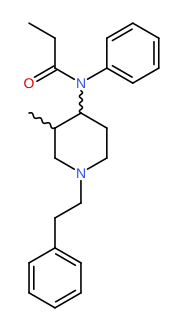 |
| Molecular structure drawn from PubChem coordinates |
| Physical properties [] | |
|---|---|
| Molecular mass | 350.50 g/mol [1] |
| Melting point | Crystals from isopropanol. MP: 272-8-273.6 °C /3-Methylfentanyl hydrochloride/ [1] |
| Predicted LogP | 4.5 [1] |
| Structural Identifiers [] | |
|---|---|
| Molecular formula | C23H30N2O |
| IUPAC name | N-[3-methyl-1-(2-phenylethyl)piperidin-4-yl]-N-phenylpropanamide |
| SMILES | CCC(=O)N(C1CCN(CC1C)CCC2=CC=CC=C2)C3=CC=CC=C3 |
| InChI | InChI=1S/C23H30N2O/c1-3-23(26)25(21-12-8-5-9-13-21)22-15-17-24(18-19(22)2)16-14-20-10-6-4-7-11-20/h4-13,19,22H,3,14-18H2,1-2H3 |
| InChIKey | MLQRZXNZHAOCHQ-UHFFFAOYSA-N |
| CAS number | 42045-86-3 |
| PubChem CID | 61996 |
Mefentanyl (3-Methylfentanyl) (also known as 3-Methylfentanil, DEA No. 9813, N-(3-Methyl-1-(2-phenylethyl)-4-piperidinyl)-N-phenylpropanamide, Propanamide, N-(3-methyl-1-(2-phenylethyl)-4-piperidinyl)-N-phenyl-, 3-methyl-fentanyl, N-(3-methyl-1-(2-phenylethyl)piperidin-4-yl)-N-phenylpropanamide, F-7209, Ids-nm-017, Ids-nm-017(sect.3) or China White) is a opioid substance of the phenethylpiperidine class.
Chemistry
Stereochemistry []
Mefentanyl is a racemic mixture of the diastereomers.
Druglikeness
Lipinski's rule of five
Mefentanyl matches Lipinski's rule of five.Pharmacology
MeSH Classification
- analgesics (M0001067)
Mechanism of action []
Opiate receptors are coupled with G-protein receptors and function as both positive and negative regulators of synaptic transmission via G-proteins that activate effector proteins. Binding of the opiate stimulates the exchange of GTP for GDP on the G-protein complex. As the effector system is adenylate cyclase and cAMP located at the inner surface of the plasma membrane, opioids decrease intracellular cAMP by inhibiting adenylate cyclase. Subsequently, the release of nociceptive neurotransmitters such as substance P, GABA, dopamine, acetylcholine and noradrenaline is inhibited. Opioids also inhibit the release of vasopressin, somatostatin, insulin and glucagon. Fentanyl's analgesic activity is, most likely, due to its conversion to morphine. Opioids close N-type voltage-operated calcium channels (OP2-receptor agonist) and open calcium-dependent inwardly rectifying potassium channels (OP3 and OP1 receptor agonist). This results in hyperpolarization and reduced neuronal excitability. [1]
Subjective effects []
Legal status []
- Australia: Mefentanyl is Unscheduled.
- Brazil: Mefentanyl is a F1.
- Canada: Mefentanyl is a Schedule I.
- New Zealand: Mefentanyl is Unscheduled.
- United Kingdom: Mefentanyl is a Class A under the "Misuse of Drugs Act 1971".
- Germany: Mefentanyl is a Anlage I under the "Betäubungsmittelgesetz (BtMG)".
- United States: Mefentanyl is a Schedule I under the "Controlled Substances Act".
- United Nations: Mefentanyl is Unscheduled.
See also []
External links []
References []
National Center for Biotechnology Information. PubChem Compound Summary for CID 61996, Mefentanyl. Accessed November 20, 2026. https://pubchem.ncbi.nlm.nih.gov/compound/61996
Data sources []
| Source | Status | Updated (UTC) |
|---|---|---|
| dosing | missing (no dosing statistics) | 2026-11-20 11:54:25 |
| drugspro | missing (no DrugsPRO reagent data) | 2026-11-20 11:54:21 |
| erowid | missing (no Erowid substance of that name) | 2026-11-20 11:54:21 |
| gsrs | missing (no UNII) | 2026-11-20 11:54:21 |
| hmdb | missing (hmdb.ca refused automated access to HMDB0243534) | 2026-11-20 11:54:21 |
| kegg | missing (no KEGG DRUG entry) | 2026-11-20 11:54:26 |
| pubchem | ok | 2026-11-20 11:54:20 |
| missing (no r/tripreports posts mention it) | 2026-11-20 11:54:21 | |
| sider | missing (not in SIDER) | 2026-11-20 11:54:21 |
| structure | ok | 2026-11-20 11:54:21 |
| wikipedia | ok | 2026-11-20 11:54:22 |