Methadone
| Methadone | |
|---|---|
 |
| Salts [] | |
|---|---|
| Methadone hydrobromide | |
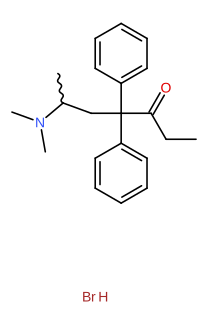 | |
| Methadone hydrochloride | |
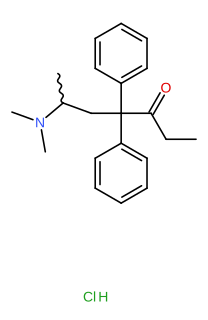 | |
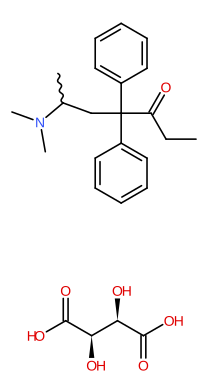
| Methadone tartrate | |
 | |
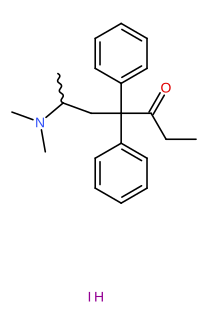
| Methadone hydriodide | |
 |
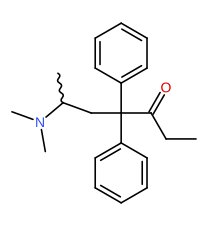
| Molecular structure drawn from PubChem coordinates |
| Physical properties [] | |
|---|---|
| Molecular mass | 309.40 g/mol [1] |
| Melting point | 235 °C [1] |
| Decomposition | When heated to decomposition it emits toxic fumes of /nitrogen oxides/. [1] |
| Solubility | Platelets from alcohol + ether; mp, 235 °C; bitter taste; UV maximum, 292 nm; solubility (g/100 mL) water, 12; alcohol, 8; isopropanol, 2.4; Practically insoluble in ether, glycerol; pH of a 1% aqueous solution is 4.5-5.6 /Methadone hydrochloride/ [1] |
| Predicted LogP | 3.9 [1] |
| Structural Identifiers [] | |
|---|---|
| Molecular formula | C21H27NO |
| IUPAC name | 6-(dimethylamino)-4,4-diphenylheptan-3-one |
| SMILES | CCC(=O)C(CC(C)N(C)C)(C1=CC=CC=C1)C2=CC=CC=C2 |
| InChI | InChI=1S/C21H27NO/c1-5-20(23)21(16-17(2)22(3)4,18-12-8-6-9-13-18)19-14-10-7-11-15-19/h6-15,17H,5,16H2,1-4H3 |
| InChIKey | USSIQXCVUWKGNF-UHFFFAOYSA-N |
| CAS number | 76-99-3 |
| UNII | UC6VBE7V1Z |
| PubChem CID | 4095 |
| Pharmacokinetics[] | |
|---|---|
| Onset | Rapid |
| Elimination half-life | 15–55 hours |
| Duration of action | Single dose: 4–8 h, Prolonged use:, • Withdrawal prevention: 1–2 days, • Pain relief: 8–12 hours |
| Metabolism | Liver (CYP3A4, CYP2B6 and CYP2D6-mediated)[3] |
| Excretion | Urine, faeces |
| Routes of administration | By mouth, intravenous, insufflation, sublingual, rectal |
| Addiction liability | High[4] |
| Toxicity [] | |
|---|---|
| LD50 | Rat: - oral: 86 mg/kg - ip: 18 mg/kg - sc: 30 mg/kg - iv: 11 mg/kg [1] |
| Dosing[] |
|---|
| Oral [] | |
|---|---|
| Threshold | 0.5 - 1 |
| Light | 1 - 5 |
| Common | 5 - 10 |
| Strong | 10 - 20 |
| Heavy | 20 - 29.10000000000001 |
Statistically derived dosages via DBI-IGS (archived by anodyne.wiki) We do not take any responsibility for medical complications or loss of life sustained by following these dosages blindly. |
Methadone (also known as dl-Methadone, Diaminon, Phenadone, Dolophin, Heptadone, Ketalgin, Methadon, Adanon, Amidone or Algovetin) is a depressant, hormone and opioid substance of the phenylpropylamine class.
Chemistry
Salts []
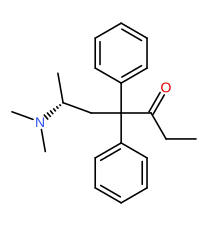
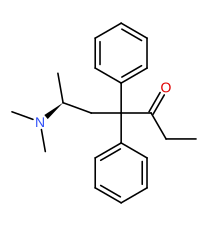
Stereochemistry []
Methadone is a racemic mixture of the enantiomers (optical activity ( + / - )).
| Stereoisomerism |
|---|
| Stereoisomers from PubChem |
Druglikeness
Lipinski's rule of five
Methadone matches Lipinski's rule of five.Reagents
There are currently 7 reagent-interactions on DrugsPRO
| Reagent | Color change | Description |
|---|---|---|
| Marquis | yellowish pink > violet | |
| Mecke | no color change | |
| Mandelin | green / green > blue | |
| Liebermann | yellowish / brownish | |
| Froehde | blue | |
| Simon's | no blue color change | |
| Scott | no color change |
Pharmacology
ATC Classification
- nervous system (N)
- other nervous system drugs (N07)
- drugs used in addictive disorders (N07B)
- drugs used in opioid dependence (N07BC)
- (N07BC02)
- methadone (N07BC02)
MeSH Classification
Mechanism of action []
Methadone is a synthetic opioid analgesic with full agonist activity at the µ-opioid receptor. While agonism of the µ-opioid receptor is the primary mechanism of action for the treatment of pain, methadone also acts as an agonist of κ- and σ-opioid receptors within the central and peripheral nervous systems. Interestingly, methadone differs from [morphine] (which is considered the gold standard reference opioid) in its antagonism of the N-methyl-D-aspartate (NMDA) receptor and its strong inhibition of serotonin and norepinephrine uptake, which likely also contributes to its antinociceptive activity. Methadone is administered as a 50:50 racemic mixture of (R)- and (S)-stereoisomers, with (R)-methadone demonstrating ~10-fold higher affinity and potency for the µ-opioid receptor than the (S) stereoisomer. The analgesic activity of the racemate is almost entirely due to the (R)-isomer, while the (S)-isomer lacks significant respiratory depressant activity but does have antitussive effects. While methadone shares similar effects and risks of other opioids such as [morphine], [hydromorphone], [oxycodone], and [fentanyl] it has a number of unique pharmacokinetic and pharmacodynamic properties that distinguish it from them and make it a useful agent for the treatment of opioid addiction. For example, methadone abstinence syndrome, although qualitatively similar to that of morphine, differs in that the onset is slower, the course is more prolonged, and the symptoms are less severe. [1]
Interactions []
Interaction mechanisms documented in KEGG DRUG (number of interacting drugs):
| CYP3A4 | metabolism / induction / inhibition | 285 (6 contraindicated) |
|---|---|---|
| CYP2C9 | inhibition / induction / metabolism | 37 (1 contraindicated) |
| CYP2C19 | metabolism / inhibition / induction | 34 (1 contraindicated) |
| ABCB1 | transporter inhibition / transporter induction | 33 |
| CYP2D6 | metabolism / inhibition / induction | 33 |
| CYP2B6 | metabolism / induction / inhibition | 30 |
| OPRM1 | shared target | 12 (1 contraindicated) |
| GRIN1 | shared target | 4 |
| GRIN2A | shared target | 4 |
| GRIN2B | shared target | 4 |
| GRIN2C | shared target | 4 |
| GRIN2D | shared target | 4 |
Medical side effects []
108 side effects listed on drug labels in SIDER 4.1 (methadone).
- Abdominal pain
- Gastrointestinal pain
- Bowel spasm
- Amenorrhoea
- Anaphylactic shock
- Decreased appetite
- Anxiety
- Arrhythmia
- Asthenia
- Confusional state
- Feeling abnormal
- Constipation
- Libido decreased
- Disturbance in sexual arousal
- Dermatitis contact
- Diarrhoea
- Dizziness
- Syncope
- Lightheadedness
- Somnolence
- Oedema
- Dermatitis
- Rash
- Body temperature increased
- Flushing
- Multiple fractures
- Fracture
- Glossitis
- Hallucination
- Head injury
- Headache
- Cardiac arrest
- Cardiac failure
- Chronic hepatitis
- Hypersensitivity
- Hypogonadism
- Hypokalaemia
- Hypotension
- Hypotensive
- Orthostatic hypotension
- Body temperature decreased
- Hypothermia
- Irritability
- Lung disorder
- Miosis
- Mydriasis
- Nausea
- Osteoporosis
- Palpitations
- Phlebitis
- Piloerection
- Cutis anserina
- Pruritus
- Pulmonary oedema
- Convulsion
- Shock
- Sneezing
- Muscle spasms
- Withdrawal syndrome
- Hyperhidrosis
- Sweating increased
- Swelling
- Loss of consciousness
- Tachycardia
- Thrombocytopenia
- Torsade de pointes
- Tremor
- Erythema
- Redness
- Urticaria
- Ventricular fibrillation
- Ventricular tachycardia
- Vertigo
- Vomiting
- Weight increased
- Weight decreased
- Dry mouth
- Yawning
- Urinary retention
- Chills
- Agitation
- Drug withdrawal syndrome
- Hypomagnesaemia
- Intracranial pressure increased
- Electrocardiogram QT prolonged
- Respiratory arrest
- Muscle twitching
- Disorientation
- Dysphoria
- Pain
- Respiratory depression
- Pulmonary function test decreased
- Euphoric mood
- Muscle mass
- Extrasystoles
- Lacrimation increased
- Bradycardia
- Electrocardiogram T wave inversion
- Visual impairment
- Drug interaction
- Feeling cold
- Blood testosterone decreased
- Cardiomyopathy
- Insomnia
- Haemorrhagic urticaria
- Nasopharyngitis
- Rhinorrhoea
- Cardiovascular insufficiency
Indications
- Acute pain
- Analgesic effect
- Convulsion
- Dependence on opiates
- Heroin addiction
- Opioid naive
- Pain
- Postoperative pain
- Respiratory depression
- Substance abuse
- Withdrawal syndrome
Subjective effects []
Experience reports
Erowid
There are currently 30 experience reports involving methadone on Erowid: []- "Detox in Three Stages" by Transmigraine
- "Opiate Reviews and Overviews" by Morphitron
- "My Battle with MMT (Methadone Maintenance)" by Chris
- "Finally Free" by Entropy
- "What Has Two Years of It Gotten Me?"
- "In Loyalty and Detox" by Junkielover
- "Will You Marry Me?" by Bethany
- "To Heaven and Back" by Jasen
- "Method Death" by Nog
- "Space Cadet Glow" by Eeyore
- "Completely Ecstatic" by rec_user
- "The Only Pleasure Has Been Relief From Physical Pain" by Rainey
- "Meditation & Pranayama for Opiate Detox" by CarsonZi
- "Dumping my Heroine" by mickeybee
- "Not My Cup of Tea" by Venus In Furs
- "Finally, No Pain" by Intractible
- "Methadone Hell" by Mimi T.
- "Methadone Maintenance Treatment" by marea
- "Saved My Life" by Misfit138
- "Maintenance" by Jeff F.
- "The Methadone Days" by Legi0n
- "Happy Apathy" by Seymour
- "Opioid Valhalla" by Putnik
- "Saved My Life" by Lisa
- "Study Help" by Nothing
- "Does Have its Euphoria" by Morphinenymph
- "Springing Steps" by TooBad
- "Life Saving" by Josh
- "The Juice Saved My Life" by Basikone
- "Into Rehab and Lessons" by Persistent
Legal status []
- Australia: Methadone is a Schedule 8.
- Brazil: Methadone is a A1.
- Canada: Methadone is a Schedule I.
- Germany: Methadone is a Anlage III under the "Betäubungsmittelgesetz (BtMG)".
- New Zealand: Methadone is a Class B3.[5]
- United Kingdom: Methadone is a Class A under the "Misuse of Drugs Act 1971".
- United States: Methadone is a Schedule II under the "Controlled Substances Act".
- European Union: Methadone is Prescription only.
- Other: Methadone is a SE: Förteckning II.[6]
External links []
References []
National Center for Biotechnology Information. PubChem Compound Summary for CID 4095, Methadone. Accessed November 21, 2026. https://pubchem.ncbi.nlm.nih.gov/compound/4095
U.S. Food and Drug Administration; National Center for Advancing Translational Sciences. Methadone. UNII: UC6VBE7V1Z. Global Substance Registration System. Accessed November 21, 2026. https://gsrs.ncats.nih.gov/ginas/app/beta/substances/UC6VBE7V1Z
Brown R, Kraus C, Fleming M, Reddy S. Methadone: applied pharmacology and use as adjunctive treatment in chronic pain. Postgraduate Medical Journal. November 2004; 80(949):654–659. PMID 15537850. http://pmj.bmj.com/content/80/949/654.full.pdf
Bonewit-West K, Hunt SA, Applegate E. Today's Medical Assistant: Clinical and Administrative Procedures. Elsevier Health Sciences. 2012. https://books.google.com/books?id=YalYPI1KqTQC&pg=PA571
Methatab Data Sheet. Medsafe. https://www.medsafe.govt.nz/profs/datasheet/m/Methatabs.pdf
Metadon DnE (Oral lösning 1 mg/ml) • Bipacksedel | FASS Patient. fass.se. https://fass.se/product/20070329000030/pl
Data sources []
| Source | Status | Updated (UTC) |
|---|---|---|
| dosing | ok | 2026-11-20 12:47:11 |
| drugspro | ok | 2026-11-20 12:47:07 |
| erowid | ok | 2026-11-20 12:47:09 |
| gsrs | ok | 2026-11-20 12:47:10 |
| hmdb | missing (hmdb.ca refused automated access to HMDB0014477) | 2026-11-20 12:47:07 |
| kegg | ok | 2026-11-20 12:47:09 |
| pubchem | ok | 2026-11-20 12:47:05 |
| missing (no r/tripreports posts mention it) | 2026-11-20 12:47:07 | |
| sider | ok | 2026-11-20 12:47:07 |
| structure | ok | 2026-11-20 12:47:07 |
| wikipedia | ok | 2026-11-20 12:47:07 |