
Metoclopramide
| Metoclopramide | |
|---|---|
 |
| Salts [] | |
|---|---|
| Metoclopramide hydrochloride | |
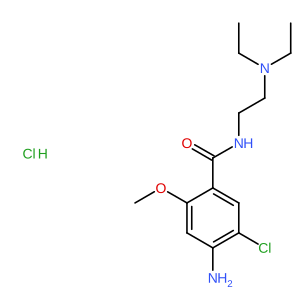 |
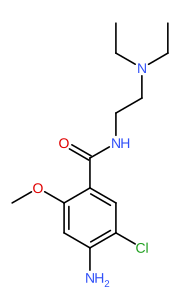
| Molecular structure drawn from PubChem coordinates |
| Physical properties [] | |
|---|---|
| Molecular mass | 299.79 g/mol [1] |
| Melting point | 171-173 [1] |
| Boiling point | 418.7 [1] |
| Decomposition | When heated to decomposition it emits very toxic fumes of /nitrogen oxides and hydrogen chloride/. [1] |
| Solubility | Crystal; decomposes at 145 °C. Solubility at 25 °C (g/100 mL): water 48; ethanol (95%) 9; absolute ethanol 6; benzene 0.10; chloroform 0.10. Stable in acidic solutions. Unstable in strongly alkaline solutions. /Metoclopramide Dihydrochloride monohydrate/ [1] |
| Predicted LogP | 2.6 [1] |
| Structural Identifiers [] | |
|---|---|
| Molecular formula | C14H22ClN3O2 |
| IUPAC name | 4-amino-5-chloro-N-[2-(diethylamino)ethyl]-2-methoxybenzamide |
| SMILES | CCN(CC)CCNC(=O)C1=CC(=C(C=C1OC)N)Cl |
| InChI | InChI=1S/C14H22ClN3O2/c1-4-18(5-2)7-6-17-14(19)10-8-11(15)12(16)9-13(10)20-3/h8-9H,4-7,16H2,1-3H3,(H,17,19) |
| InChIKey | TTWJBBZEZQICBI-UHFFFAOYSA-N |
| CAS number | 364-62-5 |
| UNII | L4YEB44I46 |
| PubChem CID | 4168 |
| Pharmacokinetics[] | |
|---|---|
| Elimination half-life | 5–6 hours |
| Metabolism | Liver |
| Excretion | Urine: 70–85%, Feces: 2% |
| Routes of administration | By mouth, intravenous, intramuscular, nasal spray |
| Toxicity [] | |
|---|---|
| LD50 | Rat: - oral: 750 mg/kg - ip: 114 mg/kg - sc: 340 mg/kg - iv: 50 mg/kg [1] |
Metoclopramide (also known as Methochlopramide, Metochlopramide, Reliveran, Metaclopramide, Elieten, Metoclopramida, Terperan, Metoclopramidum, 4-Amino-5-chloro-N-(2-(diethylamino)ethyl)-2-methoxybenzamide or 2-Methoxy-5-chloroprocainamide) is a antiemetics and cyp2d6 inhibitors substance of the benzylamine and benzamide class.
Chemistry
Salts []
Stereochemistry []
Metoclopramide is achiral.
Druglikeness
Lipinski's rule of five
Metoclopramide matches Lipinski's rule of five.Pharmacology
ATC Classification
- alimentary tract and metabolism (A)
- drugs for functional gastrointestinal disorders (A03)
- propulsives (A03F)
- propulsives (A03FA)
- (A03FA01)
- metoclopramide (A03FA01)
MeSH Classification
Mechanism of action []
Metoclopramide causes antiemetic effects by inhibiting dopamine D2 and serotonin 5-HT3 receptors in the chemoreceptor trigger zone (CTZ) located in the area postrema of the brain. Administration of this drug leads to prokinetic effects via inhibitory actions on presynaptic and postsynaptic D2 receptors, agonism of serotonin 5-HT4 receptors, and antagonism of muscarinic receptor inhibition. This action enhances the release of acetylcholine, causing increased lower esophageal sphincter (LES) and gastric tone, accelerating gastric emptying and transit through the gut. Metoclopramide antagonizes the dopamine D2 receptors. Dopamine exerts relaxant effect on the gastrointestinal tract through binding to muscular D2 receptors. [1]
Interactions []
Medical side effects []
110 side effects listed on drug labels in SIDER 4.1 (metoclopramide).
- Agranulocytosis
- Amenorrhoea
- Angioedema
- Asthma
- Atrioventricular block
- Block heart
- Bronchospasm
- Confusional state
- Feeling abnormal
- Diarrhoea
- Dizziness
- Somnolence
- Dyspnoea
- Dermatitis
- Rash
- Extrapyramidal disorder
- Asthenia
- Fatigue
- Lassitude
- Gynaecomastia
- Hallucination
- Headache
- Cardiac failure congestive
- Hyperprolactinaemia
- Hypersensitivity
- Hypertension
- Hypotension
- Incontinence
- Jaundice
- Laryngeal oedema
- Laryngospasm
- Leukopenia
- Methaemoglobinaemia
- Nausea
- Neuroleptic malignant syndrome
- Neutropenia
- Porphyrin metabolism disorder
- Convulsion
- Convulsive seizure
- Stridor
- Sulphaemoglobinaemia
- Supraventricular tachycardia
- Torticollis
- Tremor
- Trismus
- Pollakiuria
- Urticaria
- Agitation
- Oculogyric crisis
- Cogwheel rigidity
- Opisthotonus
- Depression suicidal
- Bradykinesia
- Tetanus
- Hepatotoxicity
- Galactorrhoea
- Grimacing
- Protrusion tongue
- Erectile dysfunction
- Fluid retention
- Akathisia
- Motor restlessness
- Masked facies
- Dyskinesia
- Bradycardia
- Dystonia
- Visual impairment
- Tardive dyskinesia
- Insomnia
- Anxiety
- Atrial fibrillation
- Delirium
- Depression
- Acute depression
- Oedema
- Body temperature increased
- Flushing
- Cardiac arrest
- Blood disorder
- Muscle rigidity
- Palpitations
- Priapism
- Muscle spasms
- Completed suicide
- Tachycardia
- Urinary incontinence
- Ventricular fibrillation
- Ventricular tachycardia
- Wheezing
- Akinesia
- Menstruation irregular
- Renal impairment
- Dysphoria
- Obsessive rumination
- Obsessive thoughts
- Altered state of consciousness
- Autonomic nervous system imbalance
- Autonomic dysfunction
- Mania
- Hyperpyrexia
- Rash maculo-papular
- Suicidal ideation
- Sinus arrest
- Nervousness
- Feeling jittery
- Sexual dysfunction
- Cardio-respiratory arrest
- Upper airway obstruction
- Respiratory failure
- Breast enlargement
Indications
- Anorexia
- Asthma
- Cardiac failure congestive
- Cyclic vomiting syndrome
- Delayed gastric emptying
- Diabetes mellitus
- Diabetic
- Diabetic gastroparesis
- Fullness abdominal
- Gastric atony
- Gastrointestinal disorder
- Gastrooesophageal reflux disease
- Heartburn
- Hypertension
- Hypertensive
- Hypotonia
- Infection
- Migraine
- Motion sickness
- Nausea
- Nausea postoperative
- Neoplasm malignant
- Oesophageal ulcer
- Post vagotomy diarrhea
- Postoperative vomiting
- Retention gastric
- Sickness
- Uremia
- Vermiculation
- Vomiting
Legal status []
- Australia: Metoclopramide is a Schedule 4.
- Canada: Metoclopramide is Prescription only.
- United Kingdom: Metoclopramide is Prescription only.
- United States: Metoclopramide is Prescription only.
External links []
- Metoclopramide (Wikipedia)
- Metoclopramide (PubChem)
- Metoclopramide (Wikidata)
- Metoclopramide (DrugBank)
- Metoclopramide (ChEMBL)
- Metoclopramide (ChEBI)
- Metoclopramide (Common Chemistry)
- Metoclopramide (HMDB)
- Metoclopramide (KEGG)
- Metoclopramide (EPA DSSTox)
- Metoclopramide (Effect Index)
- Metoclopramide (UNII)
- Metoclopramide (SIDER)
References []
National Center for Biotechnology Information. PubChem Compound Summary for CID 4168, Metoclopramide. Accessed November 21, 2026. https://pubchem.ncbi.nlm.nih.gov/compound/4168
U.S. Food and Drug Administration; National Center for Advancing Translational Sciences. Metoclopramide. UNII: L4YEB44I46. Global Substance Registration System. Accessed November 21, 2026. https://gsrs.ncats.nih.gov/ginas/app/beta/substances/L4YEB44I46
Data sources []
| Source | Status | Updated (UTC) |
|---|---|---|
| dosing | missing (no dosing statistics) | 2026-11-20 19:00:25 |
| drugspro | missing (no DrugsPRO reagent data) | 2026-11-20 19:00:21 |
| erowid | missing (no Erowid substance of that name) | 2026-11-20 19:00:21 |
| gsrs | ok | 2026-11-20 19:00:22 |
| hmdb | missing (hmdb.ca refused automated access to HMDB0015363) | 2026-11-20 19:00:21 |
| kegg | ok | 2026-11-20 19:00:24 |
| pubchem | ok | 2026-11-20 19:00:21 |
| missing (no r/tripreports posts mention it) | 2026-11-20 19:00:21 | |
| sider | ok | 2026-11-20 19:00:21 |
| structure | ok | 2026-11-20 19:00:21 |
| wikipedia | ok | 2026-11-20 19:00:21 |