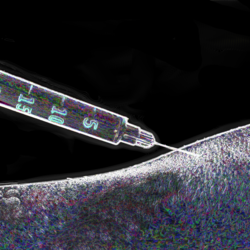
Midazolam
| Midazolam | |
|---|---|
 |
| Salts [] | |
|---|---|
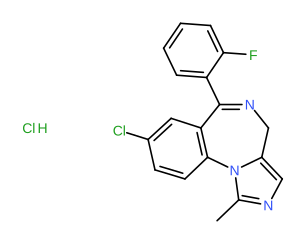
| Midazolam hydrochloride | |
 | |
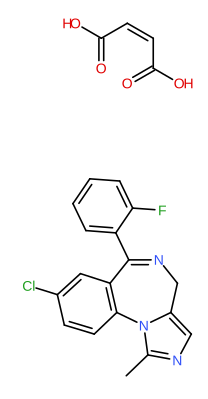
| Midazolam maleate | |
 |
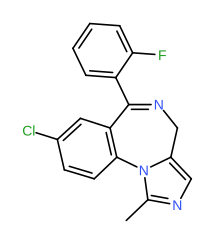
| Molecular structure drawn from PubChem coordinates |
| Physical properties [] | |
|---|---|
| Molecular mass | 325.80 g/mol [1] |
| Appearance | Colorless crystals from ether/methylene chloride/ hexane [1] |
| Melting point | 161-164 [1] |
| Boiling point | 496.9±55.0 [1] |
| Decomposition | When heated to decomposition it emits toxic fumes of /hydrogen fluoride, hydrogen chloride and nitrogen oxides/. [1] |
| Solubility | 54mg/L [1] |
| Predicted LogP | 2.5 [1] |
| Structural Identifiers [] | |
|---|---|
| Molecular formula | C18H13ClFN3 |
| IUPAC name | 8-chloro-6-(2-fluorophenyl)-1-methyl-4H-imidazo[1,5-a][1,4]benzodiazepine |
| SMILES | CC1=NC=C2N1C3=C(C=C(C=C3)Cl)C(=NC2)C4=CC=CC=C4F |
| InChI | InChI=1S/C18H13ClFN3/c1-11-21-9-13-10-22-18(14-4-2-3-5-16(14)20)15-8-12(19)6-7-17(15)23(11)13/h2-9H,10H2,1H3 |
| InChIKey | DDLIGBOFAVUZHB-UHFFFAOYSA-N |
| CAS number | 59467-70-8 |
| UNII | R60L0SM5BC |
| PubChem CID | 4192 |
| Pharmacokinetics[] | |
|---|---|
| Onset | Within 5 min (IV), 15 min (IM), 20 min (oral) |
| Elimination half-life | 1.5–2.5 hours |
| Duration of action | 1–6 hours |
| Metabolism | Liver: CYP3A3, CYP3A4, CYP3A5 |
| Excretion | Kidney |
| Routes of administration | By mouth, intramuscular, intravenous, buccal, intranasal |
| Addiction liability | Moderate[3] |
| Toxicity [] | |
|---|---|
| LD50 | Mouse: - iv: 50 mg/kg - oral: 1600 mg/kg Rat: - iv: 75 mg/kg - oral: 1600 mg/kg - Oral: 825 mg/kg [1] |
Midazolam (also known as Buccolam, Midazolamum, mezolam, Nayzilam, Midazolam civ, Usl261, Usl-261, 8-Chlor-6-(2-fluorphenyl)-1-methyl-4H-imidazo(1,5-a)(1,4)benzodiazepin, 8-Chloro-6-(o-fluorophenyl)-1-methyl-4H-imidazo(1,5-a)(1,4)benzodiazepine or 4H-Imidazo(1,5-a)(1,4)benzodiazepine, 8-chloro-6-(2-fluorophenyl)-1-methyl-) is a anaesthetic and depressant substance of the imidazobenzodiazepine class.
Chemistry
Salts []
Stereochemistry []
Midazolam is achiral.
Druglikeness
Lipinski's rule of five
Midazolam matches Lipinski's rule of five.Pharmacology
ATC Classification
- nervous system (N)
- psycholeptics (N05)
- hypnotics and sedatives (N05C)
- benzodiazepine derivatives (N05CD)
- (N05CD08)
- midazolam (N05CD08)
MeSH Classification
- adjuvants, anesthesia (M0001144)
- hypnotics and sedatives (M0010885)
- anti-anxiety agents (M0021771)
- anesthetics, intravenous (M0027999)
- gaba modulators (M0028093)
Mechanism of action []
The actions of benzodiazepines such as midazolam are mediated through the inhibitory neurotransmitter gamma-aminobutyric acid (GABA), which is one of the major inhibitory neurotransmitters in the central nervous system. Benzodiazepines increase the activity of GABA, thereby producing a sedating effect, relaxing skeletal muscles, and inducing sleep, anesthesia, and amnesia. Benzodiazepines bind to the benzodiazepine site on GABA-A receptors, which potentiates the effects of GABA by increasing the frequency of chloride channel opening. These receptors have been identified in different body tissues including the heart and skeletal muscle, although mainly appear to be present in the central nervous system. [1]
Interactions []
Interaction mechanisms documented in KEGG DRUG (number of interacting drugs):
| CYP3A4 | metabolism / inhibition / induction | 1558 (76 contraindicated) |
|---|---|---|
| GABRA1 | shared target | 186 |
| GABRA2 | shared target | 178 |
| GABRA3 | shared target | 178 |
| GABRA4 | shared target | 178 |
| GABRA5 | shared target | 178 |
| GABRA6 | shared target | 178 |
| GABRB1 | shared target | 178 |
| GABRB2 | shared target | 178 |
| GABRB3 | shared target | 178 |
| GABRD | shared target | 178 |
| GABRE | shared target | 178 |
| GABRG1 | shared target | 178 |
| GABRG2 | shared target | 178 |
| GABRG3 | shared target | 178 |
| GABRP | shared target | 178 |
| GABRQ | shared target | 178 |
Medical side effects []
165 side effects listed on drug labels in SIDER 4.1 (midazolam).
- Tenderness
- Injection site pain
- Somnolence
- Drowsiness
- Hiccups
- Pain
- Nausea
- Vomiting
- Agitation
- Excitement
- Hyperkinesia
- Hypoxia
- Hypoventilation
- Respiratory depression
- Pulmonary function test decreased
- Cough
- Headache
- Obstructive airways disorder
- Rhonchi
- Bradycardia
- Sedation
- Tranquillisation excessive
- Laryngospasm
- Pruritus
- Urticaria
- Welts
- Dermatitis
- Rash
- Ventricular extrasystoles
- Extrasystoles
- Induration
- Erythema
- Phlebitis
- Musculoskeletal stiffness
- Sneezing
- Nasopharyngitis
- Rhinorrhoea
- Aggression
- Aggressive reaction
- Argumentativeness
- Retrograde amnesia
- Anaphylactic shock
- Anaphylactoid reaction
- Anger
- Anxiety
- Apnoea
- Physical assault
- Injury
- Asthenia
- Fatigue
- Ataxia
- Athetosis
- Mental disorder
- Bronchospasm
- Confusional state
- Feeling abnormal
- Connective tissue disorder
- Constipation
- Delirium
- Delusion
- Depression
- Diplopia
- Dizziness
- Lightheadedness
- Felt faint
- Drooling
- Dysarthria
- Slurred speech
- Osteoarthritis
- Dyspnoea
- Eye disorder
- Multiple fractures
- Fracture
- Retching
- Gastrointestinal disorder
- Digestion impaired
- Hallucination
- Cardiac arrest
- Cardiac disorder
- Cardiac failure
- Haematoma
- Hostility
- Hypercapnia
- Carbon dioxide increased
- Hypersensitivity
- Hyperventilation
- Hypotension
- Hypotensive
- Immune system disorder
- Irritability
- Lethargy
- Mediastinal disorder
- Dyskinesia
- Movements involuntary
- Movement disorder
- Nervous system disorder
- Nervousness
- Tension
- Nightmare
- Nystagmus
- Paraesthesia
- Neuropathy peripheral
- Psychotic disorder
- Respiratory failure
- Salivary hypersecretion
- Shock
- Sleep disorder
- Stridor
- Withdrawal syndrome
- Swelling
- Tachycardia
- Thrombophlebitis
- Thrombosis
- Ventricular tachycardia
- Toothache
- Tremor
- Tremor muscle
- Syncope
- Presyncope
- Vertigo
- Wheezing
- Dry mouth
- Yawning
- Chills
- Mood swings
- Affect lability
- Drug withdrawal syndrome
- Muscular weakness
- Skin necrosis
- Skin exfoliation
- Respiratory arrest
- Skin disorder
- Hypopnoea
- Muscle twitching
- Tachypnoea
- Respiratory rate decreased
- Nodal rhythm
- Dyspepsia
- Disorientation
- Emotional disorder
- Dysphoria
- Anterograde amnesia
- Clonic convulsion
- Drug withdrawal convulsions
- Euphoric mood
- Miosis
- Therapeutic response decreased
- Dependence
- Vision blurred
- Difficulty focusing eyes
- Depressed mood
- Feeling hot
- Disinhibition
- Mean arterial pressure
- Mean arterial pressure decreased
- Application site pain
- Instillation site pain
- Visual impairment
- Cardio-respiratory arrest
- Upper airway obstruction
- Local reaction
- Clonus
- Depressed level of consciousness
- Injection site coldness
- Dysphonia
Indications
- Amnesia
- Apprehension
- Convulsion
- Convulsive seizure
- Distress
- Drowsiness
- Epilepsy
- Insomnia
- Laceration
- Memory impairment
- Short period
Subjective effects []
| 0xea / Midazolam [] | |
|---|---|
Routes:
| |
| nervewing / Midazolam [] | |
|---|---|
| Pilz / Midazolam [] | |
|---|---|
Routes:
| |
Experience reports
Legal status []
- Australia: Midazolam is a Schedule 4.
- Brazil: Midazolam is a B1.[4]
- Canada: Midazolam is a Schedule IV.[5][6]
- Germany: Midazolam is Prescription only/Anlage III.
- New Zealand: Midazolam is a Class C.
- United Kingdom: Midazolam is Prescription only.[7][8]
- United States: Midazolam is a Schedule IV under the "Controlled Substances Act".[9][10]
- European Union: Midazolam is Prescription only.[11]
- Other: Midazolam is a SE: Förteckning IV, In general: ℞ (Prescription only).[12]
External links []
References []
National Center for Biotechnology Information. PubChem Compound Summary for CID 4192, Midazolam. Accessed November 21, 2026. https://pubchem.ncbi.nlm.nih.gov/compound/4192
U.S. Food and Drug Administration; National Center for Advancing Translational Sciences. Midazolam. UNII: R60L0SM5BC. Global Substance Registration System. Accessed November 21, 2026. https://gsrs.ncats.nih.gov/ginas/app/beta/substances/R60L0SM5BC
Ries RK. Principles of Addiction Medicine. Lippincott Williams & Wilkins. 2009.
RDC Nº 784 - Listas de Substâncias Entorpecentes, Psicotrópicas, Precursoras e Outras sob Controle Especial. Diário Oficial da União. 31 March 2023. https://www.in.gov.br/en/web/dou/-/resolucao-rdc-n-784-de-31-de-marco-de-2023-474904992
Product information. Health Canada. 28 June 2004. https://health-products.canada.ca/dpd-bdpp/info?lang=eng&code=8457
Health product highlights 2021: Annexes of products approved in 2021. Health Canada. 3 August 2022. https://www.canada.ca/en/health-canada/services/publications/drugs-health-products/health-product-highlights-2021/appendices.html
Buccolam 10 mg oromucosal solution - Summary of Product Characteristics (SmPC). (emc). 7 June 2022. https://www.medicines.org.uk/emc/product/7460/smpc
Hypnovel 10mg in 2ml - Summary of Product Characteristics (SmPC). (emc). 16 February 2022. https://www.medicines.org.uk/emc/product/10948/smpc
Seizalam- midazolam hydrochloride injection, solution. DailyMed. https://dailymed.nlm.nih.gov/dailymed/drugInfo.cfm?setid=cb2381bf-984a-48a8-95c0-3017c34cc170
Nayzilam- midazolam spray. DailyMed. 19 January 2023. https://dailymed.nlm.nih.gov/dailymed/drugInfo.cfm?setid=2b29422e-54d5-4a49-8522-e9cf752368c3
Buccolam EPAR. European Medicines Agency. 5 September 2011. https://www.ema.europa.eu/en/medicines/human/EPAR/buccolam
BUCCOLAM, Munhålelösning 2,5 mg. FASS.se. 21 October 2024. https://fass.se/health/product/20101020000064/fass-text
Data sources []
| Source | Status | Updated (UTC) |
|---|---|---|
| dosing | missing (no dosing statistics) | 2026-11-20 10:21:12 |
| drugspro | missing (no DrugsPRO reagent data) | 2026-11-20 10:21:08 |
| erowid | missing (no Erowid substance of that name) | 2026-11-20 10:21:08 |
| gsrs | ok | 2026-11-20 10:21:10 |
| hmdb | missing (hmdb.ca refused automated access to HMDB0014821) | 2026-11-20 10:21:08 |
| kegg | ok | 2026-11-20 10:21:15 |
| pubchem | ok | 2026-11-20 10:21:08 |
| ok | 2026-11-20 10:21:08 | |
| sider | ok | 2026-11-20 10:21:09 |
| structure | ok | 2026-11-20 10:21:08 |
| wikipedia | ok | 2026-11-20 10:21:09 |