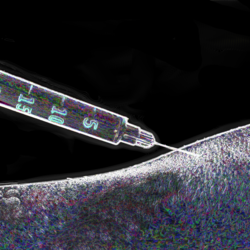
Nalbuphine
| Nalbuphine | |
|---|---|
 |
| Salts [] | |
|---|---|
| Nalbuphine hydrochloride | |
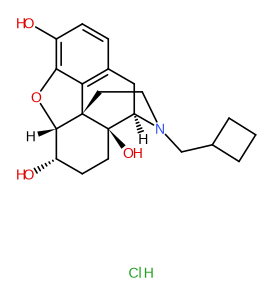 |
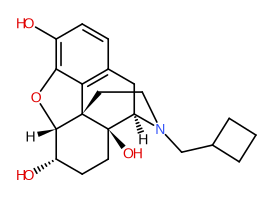
| Molecular structure drawn from PubChem coordinates |
| Physical properties [] | |
|---|---|
| Molecular mass | 357.40 g/mol [1] |
| Melting point | 230 °C as HCl salt [1] |
| Solubility | 35.5 mg/mL at 25 °C as HCl salt [1] |
| Predicted LogP | 0.2 [1] |
| Structural Identifiers [] | |
|---|---|
| Molecular formula | C21H27NO4 |
| IUPAC name | (4R,4aS,7S,7aR,12bS)-3-(cyclobutylmethyl)-1,2,4,5,6,7,7a,13-octahydro-4,12-methanobenzofuro[3,2-e]isoquinoline-4a,7,9-triol |
| SMILES | C1CC(C1)CN2CC[C@]34[C@@H]5[C@H](CC[C@]3([C@H]2CC6=C4C(=C(C=C6)O)O5)O)O |
| InChI | InChI=1S/C21H27NO4/c23-14-5-4-13-10-16-21(25)7-6-15(24)19-20(21,17(13)18(14)26-19)8-9-22(16)11-12-2-1-3-12/h4-5,12,15-16,19,23-25H,1-3,6-11H2/t15-,16+,19-,20-,21+/m0/s1 |
| InChIKey | NETZHAKZCGBWSS-CEDHKZHLSA-N |
| CAS number | 20594-83-6 |
| UNII | L2T84IQI2K |
| PubChem CID | 5311304 |
| Pharmacokinetics[] | |
|---|---|
| Onset | • Oral: <1 hour, • Rectal: <30 minutes, • Intravenous injection: 2–3 minutes, • Intramuscular injection: <15 minutes, • Subcutaneous injection: <15 minutes |
| Elimination half-life | ~5 hours (3–6 hours) |
| Duration of action | 3–6 hours |
| Metabolism | Liver (glucuronidation)[3] |
| Excretion | Urine, bile, feces; 93% within 6 hours[4] |
| Routes of administration | Intravenous, intramuscular, subcutaneous |
| Toxicity [] | |
|---|---|
| LD50 | Dog: - Oral: 1100 mg/kg [1] |
Nalbuphine (also known as Nalbufina, Nalbuphinum, Intapan, N-Cyclobutylmethyl-4,5α-epoxy-3,6α,14-morphinantriol, 17-(Cyclobutylmethyl)-4,5α-epoxymorphinan-3,6α,14-triol, Morphinan-3,6,14-triol, 17-(cyclobutylmethyl)-4,5-epoxy-, (5α,6α)-, 243-901-6, 17-cyclobutylmethyl-4,5α-epoxymorphinan-3,6α,14-triol, Nalbuphine (1.0mg/ml in Acetonitrile) or Intapan (TN)) is a opioid substance of the 2-benzylpiperidine class.
Chemistry
Salts []
Stereochemistry []
Nalbuphine is a single defined stereoisomer.
Druglikeness
Lipinski's rule of five
Nalbuphine matches Lipinski's rule of five.Pharmacology
ATC Classification
MeSH Classification
- analgesics, opioid (M0001068)
Mechanism of action []
The exact mechanism of action is unknown, but is believed to interact with an opiate receptor site in the CNS (probably in or associated with the limbic system). The opiate antagonistic effect may result from competitive inhibition at the opiate receptor, but may also be a result of other mechanisms. Nalbuphine is thought primarily to be a kappa agonist. It is also a partial mu antagonist analgesic, with some binding to the delta receptor and minimal agonist activity at the sigma receptor. [1]
Interactions []
Medical side effects []
67 side effects listed on drug labels in SIDER 4.1 (nalbuphine).
- Vomiting
- Vertigo
- Dry mouth
- Headache
- Abdominal pain
- Gastrointestinal pain
- Anxiety
- Asthenia
- Asthma
- Bronchospasm
- Confusional state
- Feeling abnormal
- Delusion
- Depersonalisation
- Depression
- Dizziness
- Syncope
- Dyspepsia
- Dyspnoea
- Oedema
- Dermatitis
- Rash
- Foetal death
- Body temperature increased
- Flushing
- Hallucination
- Cardiac arrest
- Hostility
- Hypersensitivity
- Hypertension
- Hypotension
- Laryngeal oedema
- Muscle spasms
- Nausea
- Nervousness
- Tension
- Hypoaesthesia
- Sensory loss
- Pruritus
- Pulmonary oedema
- Convulsion
- Shock
- Stridor
- Swelling
- Loss of consciousness
- Tachycardia
- Tremor
- Shakiness
- Urticaria
- Wheezing
- Pollakiuria
- Micturition urgency
- Agitation
- Injection site reaction
- Respiratory arrest
- Dysphoria
- Speech disorder
- Euphoric mood
- Dysgeusia
- Erythema
- Vision blurred
- Feeling hot
- Bradycardia
- Respiratory distress
- Hyperhidrosis
- Paraesthesia
- Somnolence
Indications
- Pain
Subjective effects []
| nervewing / Nalbuphine [] | |
|---|---|
Legal status []
See also []
External links []
References []
National Center for Biotechnology Information. PubChem Compound Summary for CID 5311304, Nalbuphine. Accessed November 25, 2026. https://pubchem.ncbi.nlm.nih.gov/compound/5311304
U.S. Food and Drug Administration; National Center for Advancing Translational Sciences. Nalbuphine. UNII: L2T84IQI2K. Global Substance Registration System. Accessed November 25, 2026. https://gsrs.ncats.nih.gov/ginas/app/beta/substances/L2T84IQI2K
Waldman SD. Pain Management E-Book. Elsevier Health Sciences. 9 June 2011. https://books.google.com/books?id=O6AojTbeXoEC&pg=PA910
Yoo YC, Chung HS, Kim IS, Jin WT, Kim MK. Determination of nalbuphine in drug abusers' urine. Journal of Analytical Toxicology. Mar–Apr 1995; 19(2):120–123. PMID 7769781. https://doi.org/10.1093/jat/19.2.120
RDC Nº 784 - Listas de Substâncias Entorpecentes, Psicotrópicas, Precursoras e Outras sob Controle Especial. Diário Oficial da União. 2023-03-31. https://www.in.gov.br/en/web/dou/-/resolucao-rdc-n-784-de-31-de-marco-de-2023-474904992
Nalbuphine Hydrochloride. DEA - Diversion Control Division. https://www.deadiversion.usdoj.gov/drug_chem_info/nalbuphine.pdf
Kentucky Penal Code: Title 902 Chapter 55 Regulation 015 - Controlled Substances. Kentucky Law. https://apps.legislature.ky.gov/law/kar/titles/902/055/015/
Data sources []
| Source | Status | Updated (UTC) |
|---|---|---|
| dosing | missing (no dosing statistics) | 2026-11-20 12:36:03 |
| drugspro | missing (no DrugsPRO reagent data) | 2026-11-20 12:35:59 |
| erowid | missing (no Erowid substance of that name) | 2026-11-20 12:35:59 |
| gsrs | ok | 2026-11-20 12:36:00 |
| hmdb | missing (hmdb.ca refused automated access to HMDB0014982) | 2026-11-20 12:35:59 |
| kegg | ok | 2026-11-20 12:36:00 |
| pubchem | ok | 2026-11-20 12:35:58 |
| missing (no r/tripreports posts mention it) | 2026-11-20 12:35:59 | |
| sider | ok | 2026-11-20 12:35:59 |
| structure | ok | 2026-11-20 12:35:59 |
| wikipedia | ok | 2026-11-20 12:35:59 |