Naratriptan
| Naratriptan | |
|---|---|
 |
| Salts [] | |
|---|---|
| Naratriptan hydrochloride | |
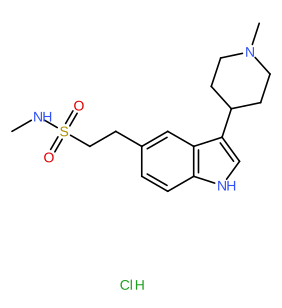 |
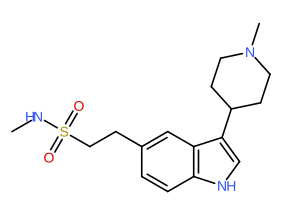
| Molecular structure drawn from PubChem coordinates |
| Physical properties [] | |
|---|---|
| Molecular mass | 335.50 g/mol [1] |
| Melting point | 246 °C (HCl salt) [1] |
| Solubility | 35 mg/mL [1] |
| Predicted LogP | 2 [1] |
| Structural Identifiers [] | |
|---|---|
| Molecular formula | C17H25N3O2S |
| IUPAC name | N-methyl-2-[3-(1-methylpiperidin-4-yl)-1H-indol-5-yl]ethanesulfonamide |
| SMILES | CNS(=O)(=O)CCC1=CC2=C(C=C1)NC=C2C3CCN(CC3)C |
| InChI | InChI=1S/C17H25N3O2S/c1-18-23(21,22)10-7-13-3-4-17-15(11-13)16(12-19-17)14-5-8-20(2)9-6-14/h3-4,11-12,14,18-19H,5-10H2,1-2H3 |
| InChIKey | AMKVXSZCKVJAGH-UHFFFAOYSA-N |
| CAS number | 121679-13-8 |
| UNII | QX3KXL1ZA2 |
| PubChem CID | 4440 |
| Pharmacokinetics[] | |
|---|---|
| Elimination half-life | 5–8 hours |
| Metabolism | Hepatic |
| Excretion | Renal |
| Routes of administration | Oral |
Naratriptan (also known as Naramig, naratriptanum, 1H-Indole-5-ethanesulfonamide, N-methyl-3-(1-methyl-4-piperidinyl)-, N-methyl-2-(3-(1-methylpiperiden-4-yl)indole-5-yl)ethanesulfonamide, N-Methyl-2-(3-(1-methylpiperidin-4-yl)-1H-indol-5-yl)ethanesulfonamide, N-methyl-2-[3-(1-methyl-4-piperidyl)-1H-indol-5-yl]-ethanesulfonamide, N-methyl-2-[3-(1-methylpiperidin-4-yl)-1H-indol-5-yl]ethane-1-sulfonamide, N-methyl-2-(3-(1-methylpiperidin-4-yl)-1H-indol-5-yl)ethane-1-sulfonamide, N-methyl-2-(3-(1-methyl-4-piperidyl)-1H-indol-5-yl)-ethanesulfonamide or N02cc02).
Chemistry
Salts []
Stereochemistry []
Naratriptan is achiral.
Druglikeness
Lipinski's rule of five
Naratriptan matches Lipinski's rule of five.Pharmacology
ATC Classification
- nervous system (N)
- analgesics (N02)
- antimigraine preparations (N02C)
- selective serotonin (5ht1) agonists (N02CC)
- (N02CC02)
- naratriptan (N02CC02)
MeSH Classification
Mechanism of action []
Three distinct pharmacological actions have been implicated in the antimigraine effect of the triptans: (1) stimulation of presynaptic 5-HT1D receptors, which serves to inhibit both dural vasodilation and inflammation; (2) direct inhibition of trigeminal nuclei cell excitability via 5-HT1B/1D receptor agonism in the brainstem and (3) vasoconstriction of meningeal, dural, cerebral or pial vessels as a result of vascular 5-HT1B receptor agonism. [1]
Interactions []
Interaction mechanisms documented in KEGG DRUG (number of interacting drugs):
| CYP3A4 | induction / metabolism / inhibition | 71 (4 contraindicated) |
|---|---|---|
| CYP2D6 | metabolism / inhibition / induction | 25 (1 contraindicated) |
| CYP2C9 | induction / metabolism / inhibition | 22 (1 contraindicated) |
| CYP1A2 | metabolism / inhibition | 10 (2 contraindicated) |
| CYP3A5 | metabolism / inhibition | 9 (1 contraindicated) |
| HTR1D | shared target | 7 (6 contraindicated) |
| HTR1B | shared target | 6 (6 contraindicated) |
| CYP2E1 | metabolism | 2 (1 contraindicated) |
Medical side effects []
188 side effects listed on drug labels in SIDER 4.1 (naratriptan).
- Infection
- Nausea
- Vomiting
- Migraine
- Feeling hot
- Paraesthesia
- Sensation of pressure
- Vertigo
- Dry mouth
- Photophobia
- Dizziness
- Syncope
- Somnolence
- Asthenia
- Fatigue
- Pain
- Stinging
- Malaise
- Discomfort
- Feeling abnormal
- Feeling strange
- Confusional state
- Ill-defined disorder
- Anxiety
- Arthralgia
- Musculoskeletal discomfort
- Myalgia
- Atrial fibrillation
- Atrial flutter
- Bronchitis
- Cognitive disorder
- Constipation
- Cough
- Cystitis
- Bladder pain
- Cystitis noninfective
- Dehydration
- Depression
- Dysthymic disorder
- Diarrhoea
- Polyuria
- Oedema
- Body temperature increased
- Gastroenteritis
- Inflammation
- Muscle spasms
- Palpitations
- Pneumonia
- Urine output increased
- Pruritus
- Rheumatic disorder
- Sinusitis
- Hyperhidrosis
- Swelling
- Thirst
- Tinnitus
- Tremor
- Urticaria
- Tachyarrhythmia
- Chills
- Polydipsia
- Ventricular extrasystoles
- Fluid retention
- Balance disorder
- Vision blurred
- Blood pressure increased
- Electrocardiogram abnormal
- Electrocardiogram PR prolongation
- Phonophobia
- Sleep disorder
- Electrocardiogram QT prolonged
- Abdominal discomfort
- Muscle rigidity
- Shock
- Loss of consciousness
- Musculoskeletal stiffness
- Dissociation
- Aggression
- Alopecia
- Anaphylactic shock
- Anaphylactoid reaction
- Anaemia
- Aphasia
- Asthma
- Libido decreased
- Disturbance in sexual arousal
- Dermatitis
- Rash
- Oesophagitis
- Eye haemorrhage
- Muscle contractions involuntary
- Folliculitis
- Gastritis
- Glycosuria
- Hallucination
- Cardiac murmur
- Haemorrhage
- Haemoglobin
- Haemorrhoids
- Hostility
- Hypercholesterolaemia
- Hyperaesthesia
- Hyperglycaemia
- Hyperlipidaemia
- Hypersensitivity
- Hypoaesthesia
- Numbness
- Hypotension
- Hypothyroidism
- Labyrinthitis
- Mastitis
- Neuralgia
- Neuritis
- Neuropathy peripheral
- Panic reaction
- Parathyroid tumour
- Pleurisy
- Purpura
- Vascular purpura
- Pyelonephritis
- Scotoma
- Convulsion
- Sialoadenitis
- Skin disorder
- Gastric ulcer
- Thrombocytopenia
- Tracheitis
- Ulcer
- Erythema
- Urinary incontinence
- Vaginal inflammation
- Vaginal infection
- Pollakiuria
- Micturition urgency
- Agitation
- Hyperkinesia
- Breast discharge
- Liver function test abnormal
- Bone pain
- Eye pain
- Dry skin
- Ketonuria
- Muscle twitching
- Haemorrhage urinary tract
- Salivary gland enlargement
- Dry eye
- Photosensitivity reaction
- Psychomotor retardation
- Bradycardia
- Coordination abnormal
- Paralysis
- Altered state of consciousness
- Depressed level of consciousness
- Mass
- Dermatitis atopic
- Oral pruritus
- Blood bilirubin abnormal
- Regurgitation
- Rhinitis allergic
- Angina pectoris
- Arteriospasm coronary
- Ischaemia
- Myocardial infarction
- Acute coronary syndrome
- Colitis ischaemic
- Prinzmetal angina
- Arrhythmia
- Cerebral infarction
- Transient ischaemic attack
- Dyspnoea
- Gastrointestinal disorder
- Headache
- Cardiac disorder
- Blood disorder
- Immune system disorder
- Nervous system disorder
- Sensory loss
- Cerebrovascular accident
- Subarachnoid haemorrhage
- Angiopathy
- Ventricular fibrillation
- Ventricular tachycardia
- Vasospasm
- Burning sensation
- Myocardial ischaemia
- Pain in jaw
- Serotonin syndrome
- Medication overuse headache
Indications
- Aura
- Cluster headache
- Migraine
Legal status []
- Other: Naratriptan is a Rx-only.
External links []
References []
National Center for Biotechnology Information. PubChem Compound Summary for CID 4440, Naratriptan. Accessed November 20, 2026. https://pubchem.ncbi.nlm.nih.gov/compound/4440
U.S. Food and Drug Administration; National Center for Advancing Translational Sciences. Naratriptan. UNII: QX3KXL1ZA2. Global Substance Registration System. Accessed November 20, 2026. https://gsrs.ncats.nih.gov/ginas/app/beta/substances/QX3KXL1ZA2
Data sources []
| Source | Status | Updated (UTC) |
|---|---|---|
| dosing | missing (no dosing statistics) | 2026-11-20 11:53:58 |
| drugspro | missing (no DrugsPRO reagent data) | 2026-11-20 11:53:54 |
| erowid | missing (no Erowid substance of that name) | 2026-11-20 11:53:54 |
| gsrs | ok | 2026-11-20 11:53:56 |
| hmdb | missing (hmdb.ca refused automated access to HMDB0015087) | 2026-11-20 11:53:54 |
| kegg | ok | 2026-11-20 11:53:56 |
| pubchem | ok | 2026-11-20 11:53:54 |
| missing (no r/tripreports posts mention it) | 2026-11-20 11:53:54 | |
| sider | ok | 2026-11-20 11:53:55 |
| structure | ok | 2026-11-20 11:53:54 |
| wikipedia | ok | 2026-11-20 11:53:54 |